
Key takeaways:
Pricing commercial cleaning jobs requires a strategic approach to stay competitive and profitable while meeting a wide range of client needs.
- Understand industry rates and service types. Typical pricing methods include charging per square foot ($0.05–$0.40), per hour ($20–$150+), flat rates, or per room—tailored to the job type, building, and region.
- Choose the right pricing method for each project. Use hourly, square footage, flat rate, or per-room pricing (or a combination) to match the specific details and scope of each job, with recurring contracts usually favoring flat or per-square-foot pricing.
- Calculate costs thoroughly for accuracy. Always factor in labor, cleaning materials, overhead (like travel, insurance, and equipment), and a profit margin so you cover your expenses and safeguard profitability.
- Adjust prices for specialty services and add-ons. Offer and price extras like carpet cleaning, window washing, and green cleaning as upsells to boost revenue and customize service for client needs.
- Avoid common mistakes and present transparent quotes. Ensure your prices account for all expenses (including travel and admin), clearly outline the scope of work, and use professional quotes to build trust and win more jobs.
Stay competitive and keep your pricing skills sharp—get more expert tips like these by signing up for the Jobber Newsletter. Sign up here.
Pricing commercial cleaning jobs can be tricky. If your price is too high, you might lose the job. On the other hand, pricing too low could cut into your profits.
Most businesses charge $0.05–$0.20 per square foot or $25–$50 per hour in the United States, depending on location, building size, and scope of services. The key is finding a rate that keeps you competitive while still earning a healthy profit.
In this guide, we’ll show you how to price a commercial cleaning job based on different specialities and methods. Plus, you’ll learn more about the factors that go into setting your prices and how to send quotes to new clients.
Your complete commercial cleaning pricing guide:
-
How much does commercial cleaning cost?
-
Pricing strategies for commercial cleaning jobs
-
How to price a commercial cleaning job step-by-step
-
Factors that affect commercial cleaning prices
-
How to bid commercial cleaning jobs
-
How to quote commercial cleaning jobs
-
Commercial cleaning pricing mistakes to avoid
How much does commercial cleaning cost?
Wondering how much to charge for different types of cleaning services? We’ve broken it down using real, 2026 U.S. pricing data from Thumbtack and HomeAdvisor.
| Service type | Per hour (per cleaner) | Standard room rate |
| Office cleaning | $20–$80 | $50–$150 |
| Janitorial services | $20–$80 | $50–$150 |
| Medical office cleaning | $50–$150 | $75–$150 |
| Commercial kitchen cleaning | $50–$80 | Varies (based on equipment) |
How much to charge for office cleaning
For professional cleaning at an office building, you could charge these office cleaning rates:
- Hourly Rate: $20–$80 per hour, per cleaner
- Flat Rate: Anywhere from $150 to $1,500 as a flat rate, depending on the size of the job
- Room Rate: $50–$150 per room
- Sq Ft Rate: $0.10–$0.40 per sq ft (higher rates for high-effort areas like bathrooms)
This type of cleaning service involves cleaning a business office’s common spaces, cubicles, restrooms, break rooms, and reception areas. Regular cleaning tasks include mopping, dusting, polishing, and removing trash or waste.
On the Reddit thread r/housekeeping, professional cleaners report earning around $500 per month for a typical office cleaning job. Use this as a benchmark when quoting small to mid-sized office contracts.
READ MORE: How to find commercial cleaning contracts
How much to charge for janitorial service
For janitorial cleaning, you can charge:
- Hourly Rate: $20–$80 per hour per cleaner
- Flat Rate: $150–$1,500+, depending on the size of the space you’re cleaning
- Room Rate: $50–$150, depending on your per-room rate breakdown (e.g., $50 for individual offices, $150 for kitchens)
- Sq Ft Rate: $0.10–$0.40 per sq ft (similar to typical office cleaning jobs)
Janitorial services cover cleaning and maintenance for large public buildings, like schools, hospitals, or corporate complexes. Tasks include mopping floors, sweeping hallways, emptying trash bins, restocking supplies, and handling basic facility upkeep.
Because janitorial work usually involves regular service rather than one-time cleanings, pricing is often based on square footage, building type, and frequency. Establishing a predictable schedule helps create steady, recurring revenue while keeping costs consistent for clients.
READ MORE: Best janitorial software to boost efficiency
How much to charge for medical office cleaning
For a commercial cleaning job at a medical office, you can charge:
- Hourly Rate: $50–$150 per hour, depending on scope and experience level
- Flat Rate: $200–$1,500+, based on the size of the medical building
- Room Rate: $75–$150, depending on room sizes (e.g., exam rooms versus waiting rooms)
- Sq Ft Rate: $0.25–$0.35 per sq ft (with higher rates for sanitization)
If you have the experience and skill set to offer medical office cleaning, it can be a highly profitable niche.
These jobs require strict attention to sanitization and disinfection, along with the usual cleaning tasks. The added responsibility often allows you to charge premium rates compared to standard commercial cleaning work.
How much to charge for commercial kitchen cleaning
Here’s the average commercial cleaning rate for kitchens:
- Hourly Rate: $50–$80 per hour per cleaner
- Flat Rate: $200–$500+, depending on the kitchen size and cleanliness
- Room Rate: A room rate may not apply to commercial kitchens, since you’ll most likely clean one room or space.
- Sq Ft Rate: $0.15–$0.30 per sq ft
Hotels, restaurants, convention centers, and other facilities often pay a premium for a clean commercial kitchen. In this type of contract, you’ll sanitize cooking and food prep surfaces, wash floors, and remove buildup from cooking equipment.
How much to charge for specialty commercial cleaning services
Specialty services are add-ons that help solve specific problems for your clients—like a trapped odor in the carpet or mildew in ceiling tiles. For instance, you might bundle specialty carpet or rug cleaning into a regular office cleaning service.
Here’s how much to charge for commercial cleaning services (in addition to your agreed-upon contract rate):
| Service | Price |
| Sanitization and odor removal | $75–$100/hour |
| Furniture, upholstery, and curtain cleaning | $100/hour |
| Ceiling/wall cleaning | $0.50–$0.60/sq ft |
| Floor stripping and waxing | $0.30–$0.50/sq ft |
| Floor buffing and burnishing | $0.04–$0.12/sq ft |
| Tile cleaning | $0.12–$0.21/sq ft |
| Carpet cleaning | $0.08–$0.40/sq ft |
| Green cleaning supplies | $5–$10 per cleaning job |
| Blinds and window cleaning | $2–$5 per window |
| Appliance cleaning | $10–$40 per appliance |
| Disaster restoration cleaning | $1,000–$4,000 |
Some of these add-ons may already be included in your service packages—like wiping blinds, cleaning appliances, or offering green cleaning options. If not, consider adding them as upsells to boost your revenue and give clients a more customized service.
Pricing strategies for commercial cleaning jobs
Price your services for profit by using one of these methods: hourly, fixed, per room, or per square foot. You can even combine methods, depending on what works best for your business.
Commercial cleaning rates per hour
Setting commercial cleaning rates per hour is a good idea when you’re unsure about the scope of work. It’s especially useful when you’re just starting a commercial cleaning business and may need extra time to complete each visit.
Consider these sample rates for hourly cleaning services:
| Experience level | Example hourly rate | What to expect in commercial cleaning |
|---|---|---|
| Entry-level commercial cleaner | $15–$25 | Slower pace as you build experience and reliable processes |
| Experienced cleaner | $25–$50 | Faster, more consistent results with established work routines |
| Specialized services | $50–$100+ | Higher rates for deep cleaning, post-construction, or regulated environments (like medical buildings) |
There are a couple of important considerations to keep in mind with this pricing model:
- Speed doesn’t always mean higher earnings. You won’t necessarily make more money just because you complete a job faster.
- Clients may need reassurance about value. Make sure they understand your hourly rate reflects the quality and results of your work, not only the time spent on the job.
Relationships are everything when it comes to commercial work.
You actually always have to court your higher, bigger customers. I think it’s so important to keep those lines of communication open.

Commercial cleaning flat fees
A flat fee gives clients peace of mind about their budget and saves you from having to negotiate every job detail. Plus, when you work efficiently, you get to keep more of what you earn.
A fixed fee or flat rate works well when you understand the scope of work, so it’s ideal for established cleaners. That said, the biggest downside of this pricing method is that underestimating a job could mean lost time or revenue.
For example:
- You could charge $150 per visit for a small office with standard weekly cleaning like dusting, vacuuming, trash removal, and restrooms.
- A larger 8,000 sq ft office could be closer to $300 with added tasks like breakroom and glass cleaning.
- A 5,000 sq ft medical office may be $400 or more because of disinfection requirements.
If you quote $300 for a job and complete it in three hours instead of five, your effective hourly rate increases without charging the client more.
Commercial cleaning room rates
With a room-based commercial cleaning rate, you count the number of rooms you’ll be cleaning, calculate a per-room rate, and calculate an average.
Say you’re cleaning an office building with:
- One bathroom ($100)
- Kitchen ($150)
- Two separate offices ($75 each)
- Reception area ($50)
In this example, your average commercial room rate would be $90 ($450 divided by five spaces to clean).
This method makes it easy to estimate cleaning jobs quickly. Clients don’t need to know their exact square footage, and you can avoid the challenges that sometimes come with hourly pricing.
Commercial cleaning rates per square foot
Charging by the square foot is one of the most common ways to price commercial cleaning—especially for recurring contracts.
Your square foot rate depends on two key factors: the size of the commercial space and the type of surfaces you’re cleaning.
Rates by building size
Larger buildings typically cost less per square foot because your team can clean more efficiently as the size of the space increases.
Smaller spaces often require more setup time relative to their size, which increases the rate.
| Building size | Rate per sq ft | What to expect |
|---|---|---|
| Small office (<5,000 sq ft) | $0.10–$0.40 | Higher rates due to setup time and tighter space |
| Medium (5,000–10,000 sq ft) | $0.08–$0.20 | Balanced pricing with more efficiency |
| Large (10,000+ sq ft) | $0.05–$0.15 | Lower rates with more consistent, uninterrupted cleaning |
Keep in mind that not every client knows their building’s exact square footage. You may need to confirm measurements or make a quick site visit before quoting.
Rates by building type
The type of facility has a major impact on pricing. Higher-touch, high-traffic, or regulated environments require more time, labor, and attention to detail.
| Building type | Rate per sq ft | Why does pricing vary? |
|---|---|---|
| Office | $0.05–$0.15 | Standard cleaning tasks with predictable usage |
| Retail | $0.07–$0.20 | High foot traffic and frequent touchpoints |
| Restaurant | $0.15–$0.40 | Grease, food waste, and strict sanitation needs |
| Healthcare | $0.20–$0.40 | Disinfection protocols and compliance requirements |
| Industrial | $0.10–$0.30 | Heavy-duty cleaning, equipment, and safety considerations |
What drives each price range?
Not every job will fit neatly into a predictable pricing category. You may need to adjust your rates based on the details of each job, such as:
- Frequency: More frequent cleaning lowers the per-visit cost but increases total contract value.
- Condition: Dirtier spaces take longer and on average cost more upfront.
- Scope: Add-ons like floor waxing, carpet cleaning, or disinfection raise the rate.
- Access and layout: Multi-floor buildings, tight spaces, or limited access can slow down your team.
Square footage pricing gives you a fast way to estimate jobs. At the same time, the most accurate quotes come from combining your starting pricing with a site walkthrough and clear scope of work.
READ MORE: How to get clients for a cleaning business
We price our jobs based on the amount of work.
We price it by square footage, whether it’s a standard or a basic clean versus a deep cleaning or a move-out cleaning.

Which pricing model should you use?
The right pricing model depends on the type of job, how predictable the work is, and how much detail you have upfront. Most cleaning businesses use a mix of these models depending on the client and contract.
Use this table to choose the best fit:
| Pricing model | Pros | Cons | When to use it |
|---|---|---|---|
| Hourly pricing | Simple to calculate and explain | • Less predictable for clients • Harder to scale | One-time jobs, new clients, or unclear scopes |
| Per square foot | • Easy to estimate quickly • Consistent for recurring work | • Can miss details if scope varies • Less accurate for complex spaces | Offices and large buildings with standard cleaning needs |
| Flat rate (per visit) | • Predictable for you and the client • Easier to package services | • Requires accurate estimating upfront • Risk of underpricing | Recurring contracts with a clear, consistent scope |
| Per room or area | • More precise for varied spaces • Easy to customize | • Takes more time to quote • Can get complicated | Facilities with different zones (offices, restrooms, kitchens) |
| Contract pricing (monthly) | • Stable, recurring revenue • Builds long-term relationships | Requires strong systems and consistent delivery | Ongoing commercial clients with set schedules |
In most cases, the best approach is to estimate using hourly or square footage pricing, then present it to the client as a flat monthly or per-visit rate.
This keeps your pricing accurate behind the scenes while giving clients a simple, predictable number to approve.
How to price commercial cleaning jobs step-by-step
To calculate a commercial cleaning estimate, start by checking what competitors charge in their area. Just remember that approach doesn’t always capture your full value or costs.
A better pricing strategy is to base quotes on your own expenses, skill level, and the quality of your service. Here’s how to price a cleaning job step-by-step so you stay profitable and competitive:
1. Define your scope of work
Consider factors that affect commercial cleaning service prices, like the job location, building size, types of cleaning services needed, and types of rooms you’ll be cleaning.
The best way to get all this information is to visit the job site, speak to the client on the phone, or use your cleaning CRM to track every job detail.
We do a walkthrough to determine the amount of cleaning needed and to figure out how many hours we’re going to need, level of build-up, and so forth.

2. Calculate your labor costs
Follow these three steps to calculate your labor cost:
- Calculate labor hours. Determine the number of hours a job will take in your commercial cleaning estimate. Then, multiply that by the number of employees needed. This gives you your labor hours. For example, say you’re cleaning a small office space and you know the job will take four hours and three employees. This means your labor hours are 12 (4 x 3 = 12).
- Calculate hourly labor cost. This includes hourly wages and extras like workers’ compensation, taxes, and other employee-related expenses. Twenty percent is usually a reliable amount to add for these extras. For example, if you pay employees a $15 hourly wage, your hourly labor cost is actually $18 ($15 x 1.2).
- Multiply labor hours by labor cost. Using our example, you’ll multiply 12 labor hours by your $18 hourly labor cost. Your total labor cost for the job is now $216 (12 x $18).
Pro Tip: It can be tricky to know how long a job will take when you’re first starting a commercial cleaning company. Use Jobber’s time tracking software to track how long your crew spends on a job, and use that information to estimate time spent in the future.
3. Factor in materials and overhead costs
In addition to labor, you’ll want to add in other business expenses like marketing, cleaning insurance, vehicle mileage, and the cost of your commercial cleaning software. These are your overhead costs.
Your overhead costs will differ from other commercial cleaning businesses. In the cleaning industry, adding 20–25% to your labor total is a safe estimate to cover overhead costs like insurance, supplies, equipment, and administrative expenses.
Continuing with our previous example, multiply your total labor cost by your overhead cost percentage. The job’s total cost is now $259.20 ($216 x 1.20).
4. Add your markup for profit
Finally, add your markup percentage. This is the amount you add to your cost to make a profit, instead of just breaking even on a job.
Let’s say your markup is 30%. That means your final commercial cleaning cost is $336.96 ($259.20 x 1.30). That’s a profit margin of 23%, which is pretty healthy for a commercial cleaning company.
At the end of the day, your profit margin is the portion of revenue that fuels reinvestment, stability, and long-term success.
READ MORE: How much markup should I charge?
Factors that affect commercial cleaning service prices
There are several factors to consider before you set your commercial cleaning prices and start getting cleaning contracts:
Overhead costs
Your commercial cleaning prices should be high enough to cover your overhead expenses during the time you’re working. For example, if your hourly overhead rate is $18, you need to earn enough to cover that cost—plus labor, supplies, and profit margin.
That said, try to keep your overhead rate as low as you can. Look for ways to run your cleaning business more efficiently.
For example, you could buy cleaning supplies in bulk, optimize routes to cut fuel costs, or review your expenses regularly to cut unnecessary costs and improve your margins.
Christine Hodge of Clearview Washing recommends adjusting your rates regularly to stay ahead of rising overhead costs. Her team increased prices by 15% in one year to offset transaction fees and encourage clients to keep their credit cards on file for automatic payments.
Building type
Certain buildings allow you to charge more per square footage due to more specialized cleaning needs. For example, you can charge more for a medical building than for a general office block because you’ll use different supplies and more detailed cleaning methods.
Room type
High-traffic rooms take longer to clean (e.g., bathrooms, breakrooms, and kitchens), increasing the overall cost.
Building conditions
A dirtier office building requires more cleaning, so charge more to cover the time and effort spent cleaning it. You may even want to do a deep cleaning before you provide ongoing service.
On the other hand, a building that’s been cleaned often will likely take less time to clean and you can likely charge a lower rate for regular cleaning.
Cleaning frequency
It’s common for commercial cleaning professionals to charge less as cleaning frequency increases because each subsequent visit requires less cleaning.
Job location
The further you have to travel to the job, the higher the rate you need to charge to cover costs. To keep costs down, optimize your routes to reduce mileage and schedule all clients who are close to each other on the same day.
Cleaning experience
The more time you spend in the commercial cleaning industry, the more experience you’ll have. This also translates to more clients and a better reputation, so you can charge a higher rate for your time.
Undercharging or offering steep discount pricing won’t always help you build a profitable cleaning business. Instead, build up your experience and reputation so you can charge premium prices to higher-value clients.
Service area
Where your clients are located plays a major role in how much you should charge. In smaller towns or rural areas, cleaning rates usually run lower because both costs and client budgets tend to be lower.
Cleaning services in large metropolitan areas or high-cost-of-living regions—like New York City or San Francisco—naturally command higher rates to offset increased labor, transportation, and supply costs.
Here’s a quick look at how average rates compare across different parts of the country:
| City/region | Estimated hourly rate |
|---|---|
| New York, NY | $30–$100/hour |
| Chicago, IL | $44–$52/hour |
| Boise, ID | $21–$45/hour |
| Los Angeles, CA | $50–$75/hour |
| Dallas, TX | $35–$50/hour |
| Atlanta, GA | $30–$75/hour |
| Phoenix, AZ | $30–$90/hour |
| Cincinnati, OH | $35–$75/hour |
| Smaller U.S. markets (mid-size cities, non-coastal) | $25–$60/hour |
| Other premium markets (San Francisco, Boston, Seattle) | $50–$120+/hour (premium market pricing may exceed national average) |
When setting commercial cleaning services rates, benchmark against local competitors. This ensures your rates stay competitive while still reflecting the true cost of doing business where you operate.
How to bid commercial cleaning jobs
Winning commercial cleaning contracts comes down to preparation, clarity, and follow-through. Use this process to create accurate, professional bids that help clients confidently say yes.
- Start with a site walkthrough. Visit the property before pricing. Take in the layout, floor types, high-traffic areas, and overall condition. Ask about cleaning frequency, priorities, and any concerns.
- Define a clear scope of work. Break down exactly what’s included by area, cleaning task, and frequency. For example, outline what gets cleaned in restrooms versus offices. Be specific to prevent misunderstandings and protect your pricing from scope creep.
- Build and present a professional bid. Create a clean, easy-to-read proposal that includes a company overview, pricing, and optional add-ons.
- Follow up and close the job. Don’t stop after sending the bid. Follow up within a few days to confirm, answer questions, and reinforce your value. If needed, adjust the scope or pricing without cutting into your margins.
A strong bidding process helps you win more jobs, set clear expectations, and build long-term commercial cleaning contracts.
Use Jobber’s commercial cleaning bid template to create professional estimates faster and send quotes your clients feel confident accepting. Start customizing your quotes today.
How to quote commercial cleaning jobs
Once you’ve set your rates, the next step is to create quotes that clearly communicate your services and value. A professional quote can help you win bigger, more profitable jobs. It also sets clear expectations from the start between you and your clients.
You can present your quote in a few different ways depending on the job, especially for commercial cleaning contracts. For example, send it by email after a walkthrough, review it in person with the client, or deliver it as a polished digital proposal they can approve online.
Jobber helps you speed up the quoting process with customizable templates you can pre-load with your most popular services and pricing. This saves time and ensures every quote looks consistent and professional.
Using Jobber’s advanced quote customizations, you can also enhance your quotes by attaching files or visuals of your work, or including Google reviews to build trust and show the quality of your services upfront.
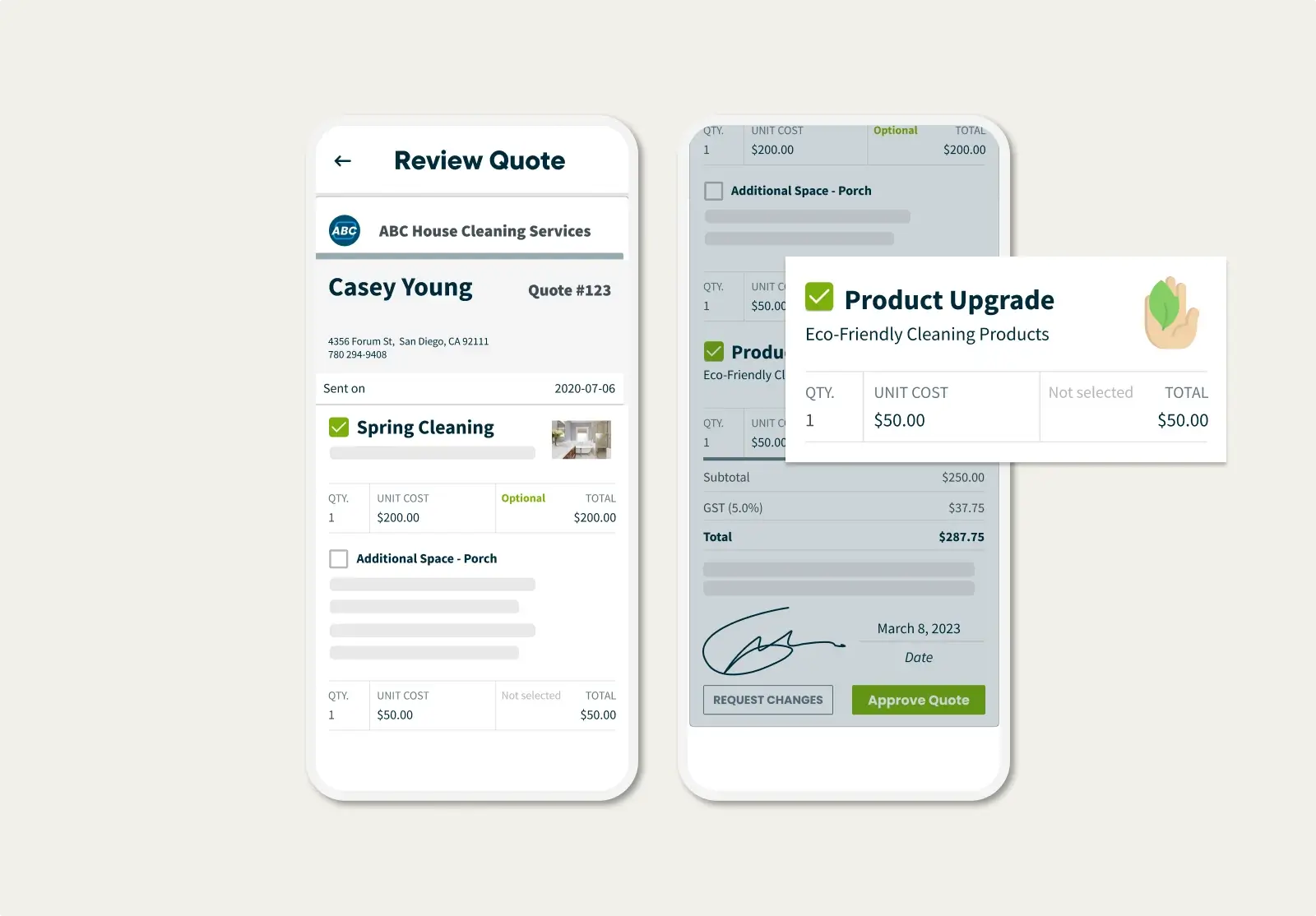
Additionally, you can include optional line items that showcase premium packages or add-on services—like green cleaning products, appliance detailing, or sanitization. These quote markups give clients flexibility while helping you upsell higher-value work.
Plus, Jobber automatically follows up with customers who haven’t responded, so you spend less time chasing leads and more time booking jobs.
What to include in a commercial cleaning quote
A strong quote should clearly show what the client is getting and how it’s priced. That’s why you should always reference:
- Scope of work: Tasks broken down by area (offices, restrooms, common areas)
- Cleaning frequency: Daily, weekly, or monthly cleaning service
- Pricing: Per visit, monthly, or per square foot
- Line items: Core services vs. optional add-ons
- Supplies: Who provides cleaning products and equipment
- Terms: Payment terms, contract length, and cancellation policy
A clear, professional presentation builds trust and makes it easy for clients to say yes. Keep your quotes simple, walk clients through key details when needed, and follow up so nothing slips through the cracks.
Commercial cleaning pricing mistakes to avoid
Even experienced cleaning businesses lose money on jobs because of small pricing gaps. These are the most common ones to watch for:
- Not accounting for drive time: Travel time, fuel, and vehicle use all cost money. If you don’t include them, you’re losing paid hours on every job.
- Underestimating supplies and equipment: Cleaning products and equipment maintenance are ongoing costs. If you underprice them, your margins shrink over time.
- Forgetting insurance and business expenses: Insurance, licensing, and admin tools are usually required for commercial work. Every job or contract should help cover these fixed costs.
- Not building in a profit margin: Breaking even isn’t enough to build something sustainable. You need a clear profit margin to grow, reinvest, and handle unexpected costs as your commercial venture grows.
Avoiding these mistakes helps you protect your margins and confidently take on new contracts.
Run a more profitable commercial cleaning business
Once you’ve mastered your pricing structure, you’ll be on your way to tracking crucial job details, collecting invoice payments, and generating recurring business. In other words, running a successful cleaning business.
Use commercial cleaning software to stay organized, impress your customers, and grow your cleaning business.
First published November 2020. Last updated on April 22, 2026.
Frequently Asked Questions
-
Start with your hourly labor rate, then estimate how long the job will take. You can use this simple formula:
Labor cost = hourly wage × hours needed (per cleaner) × number of cleaners
From there, add payroll expenses like taxes, workers’ compensation, and benefits. These extra costs can add 25% to 40% on top of wages. As a result, many cleaning businesses multiply hourly pay by 1.2 to 1.4 to estimate their true labor cost.
To stay profitable, track how long similar jobs actually take and use that data to refine your estimates over time. Adjust your pricing based on the building’s size, condition, and scope of work. -
Yes. Every quote should include both overhead and profit, not just labor and supplies. Overhead costs may include:
• Insurance and licensing
• Equipment and maintenance
• Cleaning supplies
• Fuel and transportation
• Admin tools and software
Once overhead is covered, add a profit margin (typically 10–30%) to ensure your business grows instead of simply breaking even.
A strong quote should include your labor and supplies, plus a portion of your overhead and a clear profit margin. If you leave out overhead or profit, you risk underpricing the job and losing money as your contracts get larger. -
Commercial cleaning rates typically range from $0.05 to $0.20 per square foot, depending on the type of space and level of service.
Pricing varies based on:
• Facility type (office, medical, industrial)
• Cleaning frequency
• Level of detail required
• Floor types and fixtures
For example, basic office cleaning typically falls on the lower end of the price range, while medical or high-sanitization spaces land on the higher end due to stricter requirements.
Square footage pricing works best for larger facilities, recurring contracts, and standardized scopes, but for smaller or more complex jobs, hourly or custom pricing is usually more accurate. -
Yes—and it’s one of the biggest factors in your pricing strategy.
• More frequent cleaning (daily cleaning or multiple times per week) should have a lower price per visit, as well as higher overall contract value. There’s less time needed per clean because buildup is minimal.
• Less frequent cleaning (weekly or monthly) should have a higher commercial cleaning price per visit. That’s because you’ll need more time and intensive labor due to dirt buildup.
You can also use cleaning frequency to incentivize clients by offering discounted rates for recurring contracts or bundling services into weekly or monthly plans. This helps you build predictable revenue while making your pricing more appealing. -
Adding specialty services is one of the easiest ways to boost your average job value. Common high-margin add-ons include:
• Carpet cleaning and extraction
• Floor stripping, waxing, and buffing
• Window washing (interior and exterior)
• Disinfection and sanitization services
• Post-construction cleanup
• Pressure washing (for exterior areas)
• Restroom deep cleaning or restocking services
These extras not only increase revenue but also position your business as a full-service provider.