How to Get Jobs as a Contractor: 7 Proven Strategies to Win More Work

Key takeaways:
Winning more jobs as a contractor requires a shift in mindset and adopting proven business strategies to stand out and grow your profits.
- Embrace a business-first mindset. Focus on running your company as a business, not just a craft, by understanding your numbers, costs, and lead requirements to ensure long-term success.
- Set your own pricing and aim for high profit margins. Ignore the local “going rate.” Instead, calculate your own costs and strive for at least a 50% gross profit margin to build a more sustainable and profitable business.
- Deliver professional and prompt quotes. Detailed, well-presented quotes, quick response times, and a clear explanation of your differentiators help win more bids and establish trust with potential clients.
- Position your brand and market consistently. Create educational content, engage regularly on social media, update your online profiles, and actively nurture your reputation to increase visibility and attract quality leads.
- Leverage existing customers and sell confidently. Stay connected with past clients through personal outreach and referral programs, and approach sales conversations with confidence to close more deals at better margins.
For more contractor growth tips and business insights, sign up for the Jobber Newsletter. Subscribe here.
Contracting is cutthroat. If you want more jobs and bigger profits, you need to stand out.
The biggest thing in your way? You.
As someone who’s been in the trenches, built a successful contracting company from the ground up, and with years of experience coaching others to do the same, I’m sharing my top tips for landing more jobs at higher margins.
1. Embrace the mindset shift
The first and most crucial step in getting more jobs as a contractor is embracing a new mindset.
Your primary role as a business owner is no longer just doing the craft— it’s about running and scaling a profitable business.
Craftsmanship is essential, but without a solid business foundation, your skill alone won’t take you far. Understanding your numbers, knowing how to break even, and determining how many leads you need are critical to your success. The moment you decide to run a business, you must fully commit to mastering these aspects.
LISTEN AND LEARN: 12 Daily Habits of a Multi-Million Dollar Business Owner
2. Ignore the “going rate”
Pulling in my #1 piece of advice here is to decide what to sell your services at. Often, this is where most new contractors make the biggest mistake.
Instead of following the “going rate,” do your own math. Determine your costs, calculate your break-even point, and set your prices based on what you need to be profitable. My rule of thumb is if it costs you a buck, charge at least two. This is the fastest way you will go from doing, say, $300K a year to $2.7 million.
3. Aim for a 50% gross profit margin
I’m a strong advocate of targeting a 50% gross profit margin. If a construction job costs you $1,500 in labor and materials, you should charge at least $3,000.
Many contractors underprice their services, leading to slim margins that barely keep their businesses afloat. By aiming for a higher profit margin, you’ll make more and have the resources to grow your construction business.
Ignore the noise about not being able to charge a certain rate in your service area. Reverse engineer the numbers until you can make it work for your business.
People often ask me: Why do I never talk about net profit? Because net profit is the result of things that happened before that. The fastest way I’ve found to help somebody make money is to keep more from the current jobs they’re doing. So if I sell a $10,000 contractor job and keep three grand after labor, materials, cost of goods, and so on, I’ve got three grand left. That’s a 30% gross profit. A 50% gross profit would mean I’ve got five grand left.
So again, how you do a project scope or construction bids, the work hours, the management time—all these things go into the pie. You figure out what it will cost at the starting point, multiply that by at least two, and you’ll be ahead of where you were yesterday. I promise you that.
FREE TOOL: Jobber’s profit margin calculator
Win more bids with professional quotes
Even if you do incredible work, you’re likely losing jobs if your quote looks like it was scratched on a napkin. The truth is, your quote is often the first real impression a homeowner gets of how you run your business. A sloppy estimate tells them you’ll run the job the same way.
- Detailed, professional quotes close more work. When your quote clearly breaks down scope, materials, timeline, payment terms, and what sets you apart, the homeowner feels confident saying yes. They can see exactly what they’re paying for. Compare that to a one-line text message that says “$4,500 for the deck” — there’s nothing there to build trust or justify your price.
- Speed matters more than you think. The contractor who responds first wins more often than the contractor who responds best. If a homeowner requests a quote on Monday and you don’t get back to them until Thursday, someone else already has the job. Aim to follow up within a few hours, not a few days. Using a tool like Jobber’s quoting features or a contractor proposal template helps you send polished quotes fast without starting from scratch every time.
- Include your differentiators. Don’t just list line items. Add a short note about your warranty, your experience with similar projects, or your communication process during the job. These details separate you from the three other bids sitting on the homeowner’s kitchen counter.
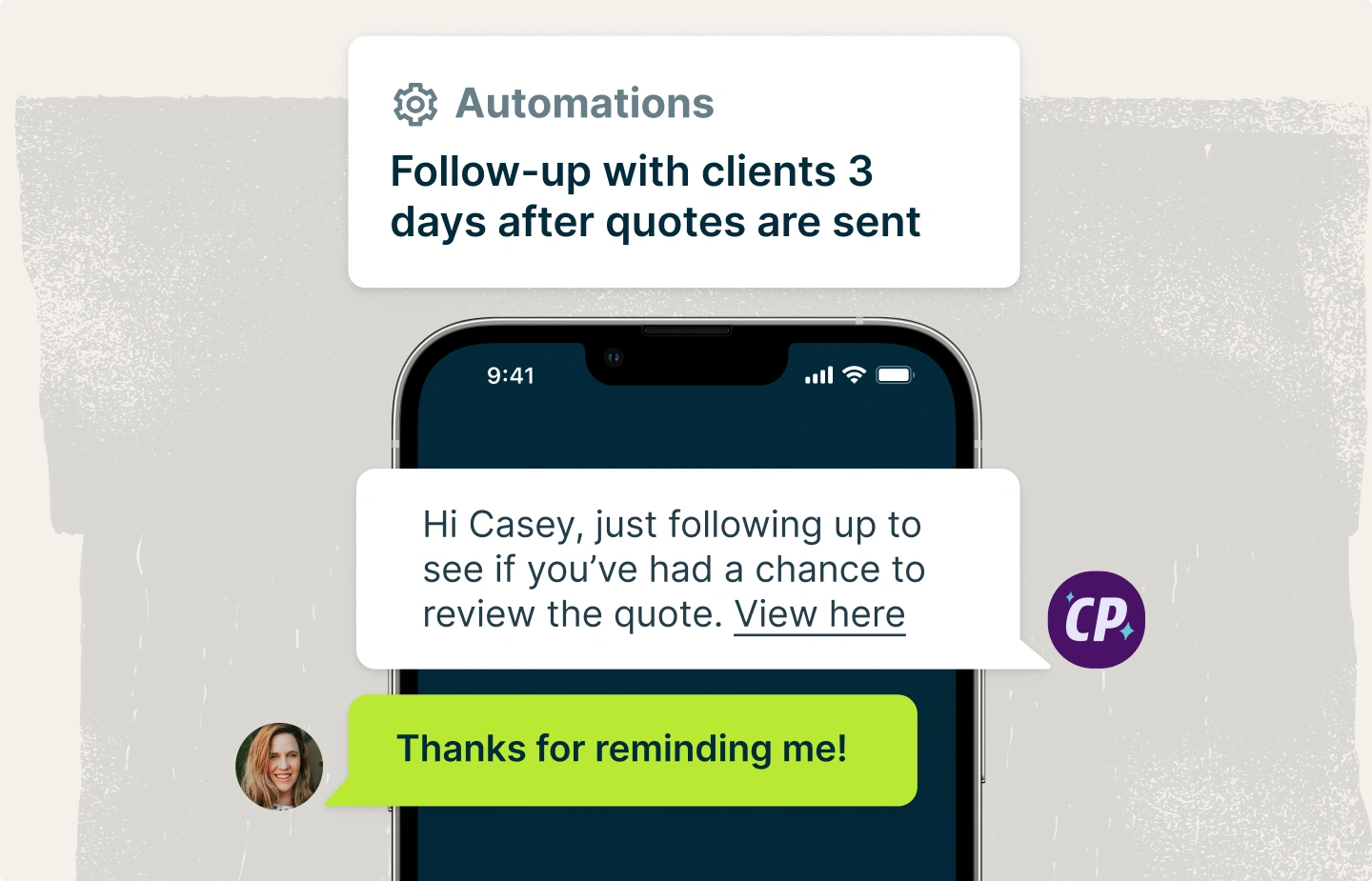
- Follow up on every quote you send. This is where most contractors leave money on the table. A quick call or text two to three days after sending the quote — “Hey, just checking in, any questions about the proposal?” — keeps you top of mind and shows professionalism.
4. Position your brand while educating your audience
Brand positioning is key for contractors who want to command higher prices and get more jobs.
Most contractors are not creating content to educate potential clients about their services. Instead, they’re letting third-party lead-generation sites dictate the narrative.
Nothing in your business works independently of other components, so if you want to sell at higher rates, your brand positioning has to be on point. Take control of your brand by writing articles, making videos, and sharing your expertise.
I started writing articles about the real costs of doing business back in the late 2000s because that’s the main thing people want to know for every industry: How much does thing X or service Z cost?
I wrote an article for every room in the home. How much does it cost to paint a bathroom? How much does it cost to paint a bedroom? How much does it cost to paint a living room? How much does painting this, that, or the other thing cost? And within three months, I held eight out of the 10 top organic spots on Google—without paying for ads.
By educating your audience, you position yourself as an authority in your trade, which can help you charge what you’re worth and attract clients who value quality (and are willing to pay for it).
READ MORE: How to make money as a general contractor
5. Consistently market your services
I always get comments on our content or questions like, “How do I get leads?” I’ve got no leads coming in, and the answer is always the same: It’s because you weren’t doing what you should’ve been doing six to nine months ago. Market like your next meal depends on it.
Commit to building your brand every single day.
Marketing is the lifeblood of a contracting business. A successful contractor needs to be fanatical about their marketing strategy. Too many contractors fall into the trap of only marketing when business is slow, but it’s often too late by then.
You need to consistently build your brand and generate leads, even when you’re busy. Utilize social media, update your website, and engage with your community on a regular basis to find new bidding opportunities.
And these are just the tip of the iceberg. Pick up the phone, log into your socials and chat with people, add your company to your personal profile, offer company swag, wrap your vehicles with your logo, invest time into SEO, and become an educator for your audience.
Remember, marketing is a long game—plant the seeds now to reap the rewards later. And take it from my experience: Spend your marketing budget when demand is the highest.
READ MORE: How to get remodeling leads
Where to find contracting jobs
Most contractors don’t have a lead problem—they have a visibility problem. The jobs are out there, but homeowners can’t find you. Fixing that starts with knowing where to show up and how to stand out once you’re there.
- Your Google Business Profile is free money. If you haven’t claimed and fully filled out your Google Business Profile, you’re invisible to the people searching “contractor near me” right now. Add photos of your actual work, keep your hours updated, and respond to every review. I’ve seen contractors double their inbound calls in 30 days just by completing their profile and posting weekly updates.
- Reviews are your best contractor lead generation tool. Homeowners trust online reviews as much as personal referrals. After every completed job, ask for a review. Make it easy — send a direct link via text or email. Tools like Jobber’s review management features let you automate this so you’re not chasing it manually. Five-star reviews don’t just make you look good. They push you higher in local search results, which means more calls.
- Lead platforms can work, but be strategic. Angi, Thumbtack, Nextdoor, and local Facebook groups all generate leads. The trap is competing on price alone. If you’re the cheapest bid on Thumbtack, you attract price shoppers who ghost you or grind you on every dollar. Instead, use these platforms to start conversations, then move prospects to a phone call where your professionalism and expertise close the deal. Pick one or two platforms, track your cost per lead, and cut the ones that don’t convert.
- Build referral partnerships with people who already have your customers. Real estate agents, property managers, insurance adjusters, and complementary trades (an electrician if you’re a plumber, a landscaper if you’re a painter) — these people talk to homeowners every day. Buy them coffee, do great work on a referral, and follow up. One solid referral partner can feed you more qualified work than any ad campaign.
- Don’t overlook subcontracting and joint ventures. If you’re still growing, partnering with a larger contractor who needs extra crews is a reliable way to keep your schedule full. You build your skills, your reputation, and your crew’s experience while someone else handles the sales. And when you know how to find contracting jobs through multiple channels, you’re never stuck waiting for the phone to ring.
6. Leverage your existing customer base
Your existing customers are a gold mine of future work, and it’s so important to stay in touch with past clients.
Whether it’s a follow-up call to see how a project is holding up or a personalized thank-you message, these gestures can lead to repeat business and referrals.
Past clients are one of your most valuable sources of future work. Construction businesses retain an average of 80% of their customers, making repeat clients far more likely to hire you again than a new prospect is to hire you for the first time. So don’t ignore your database—nurture those relationships and watch your business grow.
And there are a ton of genuinely easy and effective ways to engage and re-engage.
Here are a few of my top engagement strategies for contractor marketing:
- Send a personalized video to past clients
- Thank your clients for choosing you, and run email marketing and re-engagement campaigns
- Create a customer referral program to accelerate word-of-mouth marketing
- Call clients a year later to see how they’re doing and make sure they’re still happy with the job you did
If you consistently do the work with these “touches,” about 5% of your database will convert to another project annually. Let’s say it’s 800 touches in a year—that turns into 40 more $10,000+ new projects.
I can guarantee there are people in your database right now, and all they need is a little nudge.
That little nudge means you’re booking more jobs. I have a general contractor in Milwaukee, and he built a ton of business from those little nudges—just a text or a phone call like, “Hey, we built the garage for you. How’s it holding up?” Last year, he was pulling in about $1.5 million. He sold more than a million dollars in jobs on top of that, just by doing that kind of outreach a couple of times a day.
7. Sell like you don’t need the money
My final tip is to sell as if you’re independently wealthy. When you approach sales with confidence, knowing your numbers, and without desperation, you’ll close more deals at higher margins.
It’s essential to remember that people buy for their own reasons, not yours. What’s a lot of money to you might not be much to someone else. By shifting your mindset and approaching sales with a clear understanding of your value, you’ll be more successful in landing the jobs you want.
Here are just some tips to remember when you’re trying to land new jobs without losing your nerve:
- Come confident in your numbers—job costing is the number one way that you’re going to impress leads
- Don’t bring your baggage to the sales call (remember, what’s expensive to you might not be to them)
- Sales training, sales coaching, or even role-play exercises can all help improve your confidence
FREE TOOL: Contractor proposal template
In my experience, contractors are waiters. They’re waiting for the phone to ring or the leads to roll in, and it’s time to get proactive if you want to get more jobs. So, I’ll close with a challenge for you. Pull out your phone, text an old client just to check in, and say thank you—see where it takes you.
Originally published November 2024. Last updated June 19th, 2026.
About Tom Reber
Tom Reber is the visionary Founder of The Contractor Fight, a powerful movement and training platform that has empowered hundreds of thousands of home improvement contractors to elevate every aspect of their lives and businesses. Through transformative coaching, Tom helps contractors crush mediocrity and build thriving, high-impact businesses. The Contractor Fight community provides contractors with essential education, camaraderie, and encouragement as they tackle their next level of success.
With a journey as unique as his approach, Tom has worn many hats: he’s been an HGTV Host, Campus Minister, successful contractor, and a proud United States Marine.
Tom’s podcast, The Contractor Fight, and Contractor Fight TV on YouTube deliver hard-hitting advice, actionable strategies, and inspiration to help contractors take their businesses to the top. The Contractor Fight has become the premier coaching program for serious contractors committed to achieving their highest potential. Originally from Wheaton, Illinois, Tom now calls Colorado Springs, Colorado, home you can follow Tom on Facebook and Instagram.