Window Cleaning Prices: How to Set Rates, Price Jobs, and Maximize Profit

Key takeaways:
Setting the right window cleaning prices is key to staying competitive and maximizing your business profits.
- Understand industry averages and pricing models. Residential window cleaning typically costs $4–$8 per pane or $8–$16 per window, with different pricing formulas for commercial and construction jobs. Use per-pane rates for consistency and efficiency.
- Factor in job complexity, operational costs, and add-on services. Consider window type, accessibility, level of dirt, labor, materials, and overhead. Price higher for hard-to-reach or dirtier windows, and offer related services like screen or gutter cleaning to boost revenue.
- Use a clear pricing formula to ensure profitability. Calculate your cost (labor + materials + overhead), then add your target profit margin to set a sustainable price.
- Adjust pricing for different markets and job types. Research local competitors, recognize seasonal demand, and tailor your rates to the property and client demographic. Use recurring contracts and bundled offers to increase client retention.
- Keep estimates simple and professional. Start with straightforward, transparent rates, provide clean estimates, and embrace ongoing learning to refine your bids and strategies over time.
Get more tips and strategies to grow your service business—sign up for the Jobber Newsletter today. Sign up here.
Knowing how to price window cleaning services correctly helps you stay competitive, protect your profit margins, and grow your business. While pricing can vary based on the job size, window type, and level of difficulty, having a clear pricing formula makes quoting faster and more consistent.
If you’re just starting out, keep it simple. Use this window cleaning pricing guide as a starting point. Then, follow our formula to learn how to price more profitable jobs.
Learn how to charge for window cleaning:
-
Average price of window cleaning
-
How much does window cleaning cost?
-
Factors to consider when setting window washing prices
-
Window cleaning pricing formula
-
How to price residential window cleaning
-
How to price construction window cleaning
-
How to price commercial window cleaning
-
Window cleaning add-ons and upsell pricing
-
How to present window cleaning pricing to customers
-
Tips for bidding on window cleaning jobs
Average price of window cleaning
The average cost for window cleaning on a house with 22 standard double-hung windows is $310, ranging from $190 to $460.
This rate breaks down to these averages:
- Hourly rate: $40 to $75
- Cost per pane: $4 to $8
- Cost per window: $8 to $16
These averages give you a starting point for setting competitive prices in your area. Most window cleaning businesses charge by the pane or window for residential jobs because it creates more consistent pricing. Plus, as your team gets faster, they can complete more jobs and earn more revenue each day.
READ MORE: Window cleaning industry statistics
How much does window cleaning cost?
Window cleaning prices depend on several factors, including property size, window count, accessibility, and whether the job is residential or commercial.
To account for these differences, you may want to use a specific pricing model based on the type of service being provided.
Here’s a quick look at current market rates for professional window cleaning services:
| Pricing model | Typical rate | Best for |
|---|---|---|
| Per-window rate | $8–$40 per window | Residential homes |
| Per-pane rate | $2–$8 per pane | Multi-pane or French windows |
| Residential hourly rate | $40–$75 per hour | Smaller or irregular jobs |
| Commercial hourly rate | $50–$100+ per hour | Storefronts, offices, and larger buildings |
| Commercial per square foot | $0.07–$0.75 per sq. ft. | Large commercial contracts |
Pricing can vary depending on the size and condition of the job, as well as how often the windows are cleaned. First-time cleanings, for example, are usually priced higher because they require more labor and the removal of more buildup.
You can also use a combination of pricing models to stay profitable. For example, you may charge per window for residential jobs while using hourly or square-foot pricing for commercial work. Or set minimum service charges, especially for smaller jobs, to ensure travel time and labor costs are covered.
Once you understand the going market rates, the next step is choosing the right pricing method for your business.
Factors to consider when setting window washing prices
The right window cleaning pricing guide should be a system that reflects your costs, aligns with the market, and leaves room for profit. To figure out how to price window cleaning jobs with confidence, look at these four factors:
The complexity of the job
Think of each window like a mini job site. Factor in what kind of windows they are, where they are, and what shape they’re in. Here’s what to watch for:
- Number of panes: It’s easy to underestimate how many panes a home actually has. You can charge per pane or per window, but make sure to count smaller windows that homeowners often overlook, like basement hopper windows and transoms.
- Window type makes a big difference: Picture windows are usually wide-open spaces with fewer nooks your squeegee needs to deal with. But get into French panes or sunburst patterns, and you’re doing a lot more detailed work.
- Height and accessibility: Anything above the second floor is a hazard and a hassle. You’ll need ladders and maybe a helper. Charge more for every floor past the first, or if you’re spending extra time to set up safely.
- Condition of the glass: At some point, you’ll show up to a job thinking it’s a basic clean, but then realize no one’s given the windows any TLC in a decade. Water stains, bird droppings, and paint overspray all take time. It’s common to add $2 to $4 more per pane for the extra elbow grease.
Operational costs
When you’re thinking about how much to charge for window cleaning, it’s easy to forget just how much money you’re spending. These are the day-to-day costs that’ll eat into your profits, so factor them in:
- Labor costs: Whether you’re flying solo or managing a crew, labor’s usually your biggest expense. Some pros charge $40-75 per hour for residential work. If you’re doing high-rise or rope access, that might shoot up to $170/hour. Others stick to a per-pane model, especially for repeat jobs or maintenance cleans.
- Materials and gear: Your day-to-day materials might include squeegees, scrubbers, towels, and applicators. You’ll also need gloves, safety glasses, and harnesses.
- Overhead: These costs are sneaky. Account for gas and travel, insurance premiums, and the cost of replacing/upkeeping your equipment.
Service add-ons and frequency
Let’s say you’re wrapping up a quote and the client hits you with, “Can you do the screens too?” Consider your service add-ons, bundles, or recurring contracts when pricing window cleaning so you always have an answer (and pricing) ready.
- Screens, sills, and tracks: You can charge anywhere from 50 cents to $8 per screen, depending on size and how dirty it is. Tracks and sills can run $2-4 per window.
- Frequency of service: Not all customers are one-and-done. Some want regular shine, like storefronts and real estate agents. A 10-20% discount on recurring cleanings will keep clients coming back and make pricing more predictable. Plus, recurring jobs can often be quicker (less buildup), so your hourly rate actually increases.
- Bundling other services: If you also offer gutter cleaning or pressure washing, bundle them to save your client time and make the job more efficient. Bundling can boost your average ticket size and increase your margins without extra travel.
The name of the game is providing as much value as possible for your clients.
When you’re performing in-person estimates, it’s really important that you quote that client for more than just the services that they called you out for. For instance, if you notice that their walkways have dirt on them, give them a quote for pressure washing their walkways or patio.”
Market and competition
If you’re charging $20 per window in a market where the average is $10, you’ll price yourself out. On the flip side, undercharging just to land a job can easily sink your margins.
Price window cleaning based on what your market expects. Here’s how to stay competitive:
- Local rates: Research what other window cleaners in your area are charging to establish a competitive baseline. Residential window cleaning typically ranges from $8–$16 per window, while commercial jobs are often priced by square footage at around $0.50–$2.50 per square foot. You can also review competitors’ quoting processes by requesting window cleaning estimates from local companies.
- Seasonality: Demand for professional window cleaning spikes in spring and fall, so use this to your advantage. You can charge premium rates when you’re booked solid. During slow seasons, offer packages or discounts to help fill your schedule.
- Client demographics: If you’re quoting jobs in a high-income area, your price point should reflect the expectations and budget of that market. A good rule of thumb is that window cleaning should cost about 1-2% of a client’s discretionary income. In wealthy areas, customers may value reliability and bundles over low prices.
Window cleaning pricing formula
To understand how to price window cleaning jobs, start with the formula you’ll use to determine your final customer price:
Total price = Total cost + (profit margin x total cost)
Step 1: Determine the total cost of the job
Figure out how much the job will cost your business to complete. This includes labor costs, material costs, overhead costs, and your desired profit margin.
Start by calculating your total window cleaning costs using this formula:
Total cost = Labor cost + material cost + overhead cost
For example, if a two-hour job costs $80 in labor, $15 in supplies or materials, and $25 in overhead expenses (like insurance, fuel, or software), your total job cost would be $120. From there, you can add your profit margin to determine the final customer price.
Step 2: Apply your profit margin
Next, determine how much you should charge your customer by applying your profit margin to your total window cleaning cost. Here’s the formula you should use:
Total price = Total cost + (profit margin x total cost)
If your total job cost on a residential home is $120 and you want a 30% profit margin, you would multiply $120 by 0.30 to get $36. Add that to your original cost, and your final price would be $156.
Understanding the formula:
- Labor cost is the number of hours it takes to complete the job multiplied by your hourly rate.
- Material cost is the cost of cleaning supplies and other equipment needed to perform the job.
- Overhead cost refers to the ongoing business expenses that aren’t directly tied to a specific job, like insurance, vehicle expenses, marketing, software, and other administrative costs.
- Total cost is the total labor cost, material cost, and overhead cost put together.
- Total price with profit margin is the total cost plus your desired profit margin percentage of the total cost.
Labor costs
Before committing to any window cleaning price, evaluate the job to determine how long it’ll take and how much you’ll have to pay yourself and your team.
Here are key things to watch out for to properly estimate the labor costs:
- Types of windows: Different windows require different tools and cleaning methods, which could increase the job’s duration.
- Number of windows: The more windows there are, the longer it’ll take to complete the work.
- Difficulty of access: Properties with multiple floors or hard-to-reach areas will need more time and effort to clean.
- Amount of dirt on windows: Depending on how often the customer has their windows cleaned, you might be in for a big effort if there’s a large amount of dirt to deal with.
Material costs
Material costs are necessary to ensure you have the right tools and products to complete a job. You may already have many of the items you need. But depending on the size and scope of the job, you may need to get more or buy something not yet in your inventory.
Here are some key materials and the costs to consider for your window cleaning pricing:
- Soap and other cleaning liquids: A must-have for your window cleaning business. Figure out what cleaning supplies and in what quantities you need for each job.
- Tools and equipment: Squeegees, extension poles, ladders, buckets, sprayers, and gloves are just a few key pieces. If you don’t yet have these supplies, you need to factor in the cost of renting or buying them into your final price.
READ MORE: 13 best window cleaning tools for window washing professionals
Overhead costs
Every business comes with operating expenses. These costs factor into your annual costs but can also be broken down per job. These costs include your:
- Business insurance
- Vehicles to get to and from jobs
- Marketing efforts to win new business
- Administrative costs like bookkeeping and invoice management
The nature of the job may change—residential, construction, or commercial bids—but the formula is always applicable for how to price window cleaning.
I believe most home service businesses do not charge enough, and the problems in the business result from poorly pricing the job to begin with.
We have set packages made up in Jobber for sizes of houses for house washing, window and gutter cleaning. Our systems are accurate about 80% of the time. For more challenging jobs, having an experienced person estimate the job in person is a must!
How to price residential window cleaning
When deciding how much to charge for window cleaning, most residential window cleaners price jobs by the pane instead of by the hour.
Pane-based pricing is more consistent for both you and the customer. It rewards efficiency as your team gets faster and gives homeowners a clearer understanding of what they’re paying for.
A pane is each individual piece of glass in a window. Standard windows have 2-3 panes. Storm windows will have up to 4.
Residential window cleaning prices per pane and window type
Common window cleaning pricing models and average rates include the following:
| Type of Window | Cost Per Pane | Cost Per Window |
|---|---|---|
| Single-hung (most common) | $4-8 | $8-16 |
| Double-hung | $4-8 | $8-16 |
| Sliding | $4-5 | $8-10 |
| Casement | $4-15 | $15-30 |
| Skylight | $25-35 | $25-35 |
| Sunburst | $30-40 | $30-40 |
| Storm | $20-40 | $30-40 |
French windows are large windows (often doors) divided into multiple smaller panes. The average charge is $6 for a half door and $12 for a full door.
If the panes are larger than 3-5 feet, count them as two panes and adjust the price accordingly.
Charging for sills and tracks is optional. Depending on the client’s request, you can offer a deep clean for an additional $2-4 per window (not per pane) or a simple wipe-down for free.
Residential window cleaning prices by home size
Many window cleaning companies also use the total number of windows in a home to estimate pricing quickly during the quoting process.
| Home size | Typical number of windows | Average exterior-only price | Average interior + exterior price |
|---|---|---|---|
| Small home | 10–20 windows | $80–$200 | $160–$350 |
| Medium home | 20–30 windows | $175–$350 | $300–$550 |
| Large home | 30–50 windows | $300–$600 | $500–$900 |
| Luxury or multi-story home | 50+ windows | $600–$1,500+ | $1,000–$2,500+ |
Prices increase for homes with difficult ladder access, oversized windows, storm windows, or heavy buildup.
Interior vs. exterior window cleaning pricing
Exterior-only cleaning is typically faster because technicians don’t need to move through the home or work around furniture and valuables. Interior cleaning often increases the total price by 50–100%.
| Service type | Typical price difference |
|---|---|
| Exterior-only cleaning | Base rate |
| Interior-only cleaning | Similar to exterior pricing |
| Interior + exterior cleaning | 1.5x–2x the exterior-only price |
Many homeowners choose exterior-only cleanings more frequently and reserve full interior/exterior service for seasonal deep cleans.
First-time vs. recurring customer pricing
First-time cleanings usually take longer because of built-up dirt, mineral deposits, bug debris, pollen, and neglected tracks or screens.
As a result, many window cleaning businesses charge higher initial rates and then offer discounted maintenance pricing for repeat customers.
| Service frequency | Typical pricing adjustment |
|---|---|
| First-time cleaning | Standard or premium rate |
| Quarterly service | 10–15% discount |
| Biannual service | Standard maintenance pricing |
| Monthly storefront or residential service | 15–25% discount |
Recurring customers are often more profitable because the windows stay cleaner and jobs take less time to complete.
Seasonal pricing considerations
Window cleaning demand tends to spike in spring and fall, especially in residential markets. Some companies raise prices slightly during peak season due to increased demand and scheduling limitations.
| Season | Pricing trend | Notes |
|---|---|---|
| Spring | Highest demand | Post-winter buildup and pollen season |
| Summer | Moderate demand | Good for recurring maintenance |
| Fall | High demand | Homeowners prepare for holidays |
| Winter | Lower demand in colder climates | Opportunity for promotions or bundled services |
Most homeowners have their windows cleaned about twice per year. If a client requests a higher frequency, you can offer a volume discount and still be very profitable.
You can also increase average ticket value by bundling services like gutter cleaning, pressure washing, or holiday light installation alongside window cleaning.
Through integrations that we do with Jobber, we were given the opportunity to bundle services.
So we could say ‘well we know that you want window washing, so here’s our a la carte pricing, but if you get window washing, roof cleaning, and siding, we can bundle that and give you 10% off.’ You always want to be upselling.
How to price construction window cleaning
Construction cleans are priced higher because of the time needed to remove paint and grime. You may also need to wear special safety equipment (like hard hats and steeled toe boots), invest in new window cleaning tools, and do more ladder work.
The average price for a construction clean is estimated at $4 for exterior windows and $5 for interior windows.
For example, if a newly constructed cafe or store has 25 exterior windows and 25 interior windows, you could charge a total of around $225: $100 for exterior cleaning and $125 for interior cleaning.
For deeper cleaning services, like removing hard water or mineral stains, you may need to charge more per pane. Always inspect the windows in person before providing an estimate so you can accurately assess the condition and labor required.
How to price commercial window cleaning
Commercial storefront window cleaning is usually priced based on the number of windows, doors, screens, and the frequency of service. Many window cleaners also offer discounts for recurring contracts because the windows stay cleaner and require less labor over time.
A simple way to price commercial storefront window cleaning jobs is:
Total Price = (Windows × Price per Window) + (Doors × Price per door) + (Screens × Price per screen) − Recurring Discount (if applicable)
Commercial window cleaning pricing example
For example, say a café has 10 large exterior storefront windows, 1 glass entry door, and 10 screens. You charge $12 per window, $8 for the door, and $3 per screen.
- 10 windows × $12 = $120
- 1 glass door × $8 = $8
- 10 screens × $3 = $30
One-time service total: $158
For a recurring monthly contract, you might offer a 10% discount because the windows stay cleaner and take less time to maintain:
- $158 × 10% = $15.80 discount
- $158 − $15.80 = $142.20 per visit
If the café books weekly service, that becomes:
- $142.20 × 4 visits = $568.80/month
This gives the customer a better per-visit rate while giving your business predictable recurring revenue.
Many commercial window cleaning businesses also set minimum service charges to ensure smaller jobs remain profitable. Here are a few guidelines you can use to get started:
| Commercial Service Type | Typical Minimum Charge |
|---|---|
| Small storefront | $25–$75 |
| Small office building | $100–$250 |
| Multi-story commercial property | $500+ |
Before bidding on a commercial job, walk the property carefully. Look for obstacles like signage, landscaping, furniture, sprinkler systems, or difficult access points that could increase labor time.
It’s also important to plan for delayed payment cycles. Unlike residential jobs, many commercial clients pay on net-30, net-45, or even net-90 terms. Extended pay cycles mean that you may wait weeks or months to receive payment after completing the work.
To do commercial window cleaning service, you need funds to do it.
Commercial clients have a net pay of 45 [days] and sometimes 90.
What that means is you need to have enough funds to pay your employees because you will not see that big check for 90 days. Versus residential, you get rewards on a daily basis.
Commercial window cleaning pricing models
Commercial window cleaning companies typically use one of four pricing methods, depending on the property type and scope of work.
| Pricing model | Typical rate | Best for |
|---|---|---|
| Per square foot | $0.50–$2.50 per sq. ft. | Offices, large buildings |
| Hourly pricing | $50–$100+ per hour | Complex or irregular jobs |
| Storefront flat rate | $25–$75 per visit | Small retail stores and restaurants |
| Per-window/per-pane pricing | Variable | Smaller commercial properties |
Storefronts are often priced using flat monthly service rates because the work is quick and recurring. For example, a small retail storefront may pay $30–$50 per weekly visit, while larger restaurants or dealerships may cost several hundred dollars per month.
Multi-story commercial window cleaning pricing factors
Pricing increases substantially for taller buildings and more complex jobs due to additional labor, safety requirements, and equipment.
Factors that affect multi-story pricing include:
- Lift, rope, or scaffolding requirements
- Safety equipment and insurance costs
- Crew size and labor hours
- Accessibility around the building
- Frequency of cleaning
- Hard water stains or heavy buildup
Buildings with difficult access or specialized equipment needs are often priced hourly or bid as custom projects instead of using standard square-foot pricing.
Recurring contract pricing
Most profitable commercial window cleaning jobs are recurring contracts rather than one-time cleanings.
| Service frequency | Typical pricing adjustment |
|---|---|
| Weekly | Lowest per-visit price |
| Biweekly | Moderate discount |
| Monthly | Standard commercial rate |
| Quarterly or one-time | Higher rate |
Recurring service reduces buildup and speeds cleanings, which is why many companies offer lower per-visit pricing for ongoing contracts.
Window cleaning add-ons and upsell pricing
Add-on services are one of the easiest ways to increase your average job value without significantly increasing travel time or customer acquisition costs.
Many homeowners are already looking for related exterior cleaning services, so presenting upsells during the quoting process can help you maximize revenue on every job.
Here are common window cleaning add-ons and typical industry pricing ranges:
| Window cleaning price list add-on services | |
|---|---|
| Screen cleaning | $2–$5 per screen |
| Track detailing | $3–$6 per window |
| Sill cleaning | $2–$5 per window |
| Hard water stain removal | $10-$30 per window |
| Skylight cleaning | $25–$35 each |
| Storm window cleaning | $5–$12 per pane |
| French pane detailing | $1–$3 extra per pane |
| Paint or debris removal | $5–$15 per window |
| Gutter cleaning bundle | $100–$300+ |
| Pressure washing add-on | $150–$500+ |
Hard water stain removal and construction debris cleanup are typically priced higher because they require specialized chemicals, tools, and additional labor time.
How to present window cleaning pricing to customers
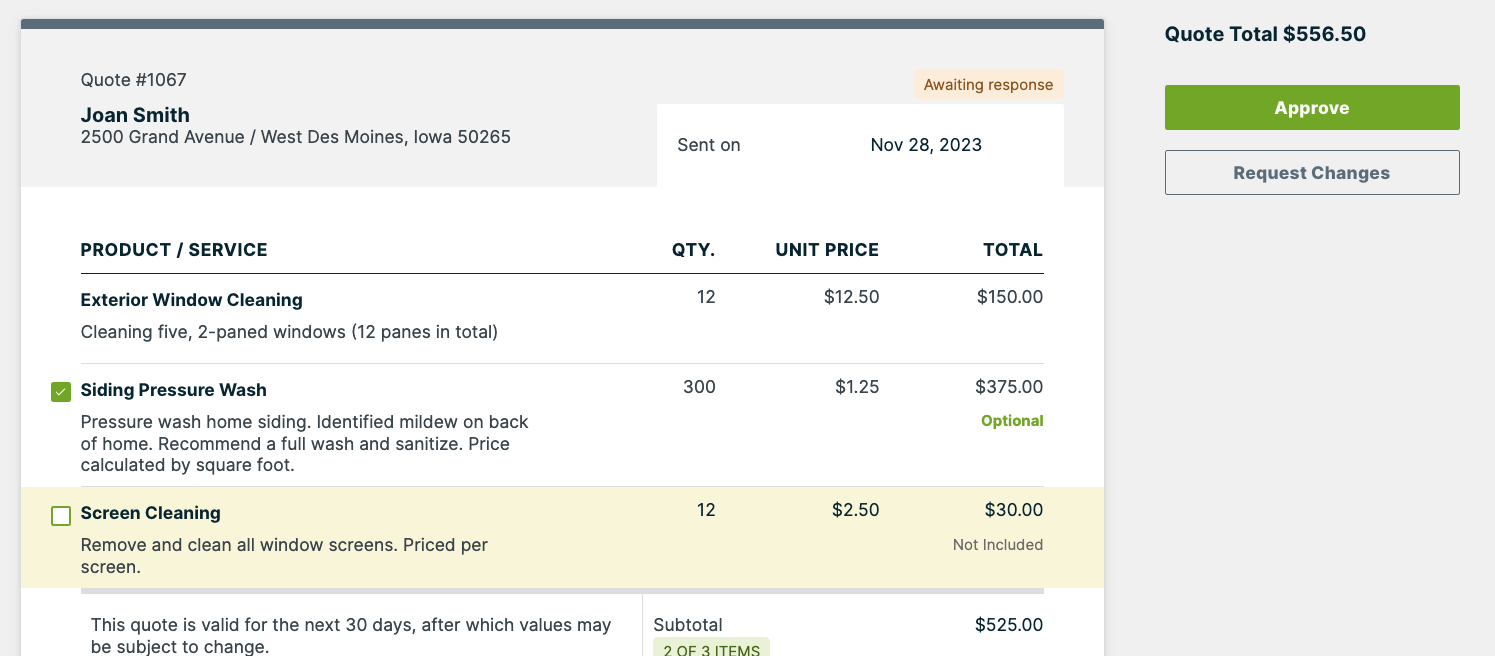
A professional quote helps homeowners understand exactly what’s included in the service and makes it easier for them to book with confidence.
Your window cleaning estimate should include:
- Number of windows or panes
- Interior, exterior, or full-service cleaning
- Screen, sill, and track cleaning
- Any add-on services or access fees
- Total project cost and service timeline
It’s also helpful to clarify what’s not included, like hard water stain removal or construction cleanup, and whether those services cost extra.
With Jobber’s quoting software, you can create professional quotes that include photos, detailed service descriptions, and optional line items for upsells like track cleaning or gutter cleaning. Customers can review and approve estimates online, helping you book jobs faster.
- Save time with reusable quote templates that include preset pricing and common services like pane cleaning, screens, and tracks, so you can send consistent estimates faster.
- Use optional line items to upsell services like hard water removal or gutter cleaning directly in the quote, letting customers customize their service while increasing average job value.
- Turn on automated quote follow-ups to remind customers about pending estimates and win more jobs without manually chasing leads.
Fast and professional communication plays a major role in whether homeowners choose a service provider.
Additionally, in-demand features like automated quote follow-ups can help you respond quickly and win more jobs without adding extra admin work.
Tips for bidding on window cleaning jobs
The prices above are general guidelines. As you get out into the field and start bidding, you’ll quickly learn how to price effectively and for profit.
Here are some final tips to help you win more window cleaning contracts:
- Keep it simple. Charge a standard rate for all windows, and give your clients 1-2 options, max. You can always change your pricing as you grow, become more skilled, and build your reputation.
- Monitor your profit margins. Winning jobs doesn’t always mean you’re making more money. Track your labor, material, and overhead costs regularly to make sure each job stays profitable. Tools like Jobber’s job costing software help you compare estimated versus actual costs so you can adjust your pricing over time.
- Provide professional estimates: Writing your bid in chicken scratch on a piece of paper or the back of a card can make you look unprofessional. Download a free quote template or use window cleaning software to give every prospect a professional, memorable estimate that will set you apart from your competitors.
- Don’t be afraid to raise prices: If you’re winning 100% of your bids, you might be pricing too low. As you gain experience and improve your efficiency, regularly review your pricing to make sure it reflects your costs, skill level, and profit goals. If you lose a bid, politely ask the winning competitor what they offered so you can better understand your local market.
READ MORE: Is a window cleaning business profitable?
Learn how to price your window cleaning services for profit and more tips to help you grow your business:
Originally published in July 2019. Last updated on May 20th, 2026.