How to Ask for a Deposit Politely: Samples for Requesting Upfront Payments From Clients

Key takeaways:
Here’s how to ask for a deposit politely so you protect your business, maintain client relationships, and keep your cash flow steady.
- Clearly explain the purpose and timing of deposits. Deposits cover upfront costs, secure bookings, and show client commitment; request them before work starts, especially for large jobs, new clients, or projects with high material costs.
- Use straightforward, professional communication. Incorporate deposit requests directly into quotes, or use the provided email and text templates for new, existing, or high-value clients to make requests polite and easy to understand.
- Know how much to ask for. Deposit amounts typically range from 10–50% of the job cost, with specific percentages varying by industry and state law; always check local regulations before setting requirements.
- Prepare for and confidently handle objections. Use clear, friendly explanations to address common pushbacks—like concerns around upfront costs or payment methods—to make clients comfortable and protect your business interests.
- Streamline the process with tools. Leveraging platforms like Jobber automates deposit collection within quotes, making it convenient for both you and your clients while improving payment reliability.
Want more practical advice to help your business thrive? Sign up for the Jobber Newsletter.
Asking for a deposit upfront helps cover material costs and gets clients invested in a job before it begins. It’s common practice for many service businesses, but it can be an uncomfortable ask if you don’t know how to word your request.
Use these samples and templates to learn how to ask for a deposit politely so you can keep client relationships and cash flow steady.
How to ask for upfront payment from clients:
What is a deposit?
A deposit is a payment a client makes to you before a job begins. Its purpose is to help cover material costs, increase cash flow, and ensure clients are invested in a project.
A deposit can either be a portion of the total job cost, a standard fee, or full payment upfront. How much you ask for depends on the service, your location, and state laws.
Once paid, the deposit amount is deducted from the total amount due and is reflected in the final invoice you provide to the client.
How to ask for a deposit
As a service provider, you can ask for a deposit before a job begins by emailing the customer, sending a text message, or adding requests to payment terms in your quotes.
Email and text messages are effective, but they add an extra step to your process. They’re also more prone to errors, and you’ll be responsible for double-checking client names and deposit details, like the amount and due date.
The easiest way to request a deposit is by building it directly into your quote. That way, the ask happens automatically. In Jobber, you can add a deposit to any quote by clicking “Add Deposit or Payment Schedule”.
Choose between a fixed dollar amount (for example, $300) or a percentage of the quote total (for example, 25%). The deposit appears on the quote your client receives, so they see the total, the deposit amount, and exactly what’s due before work starts.
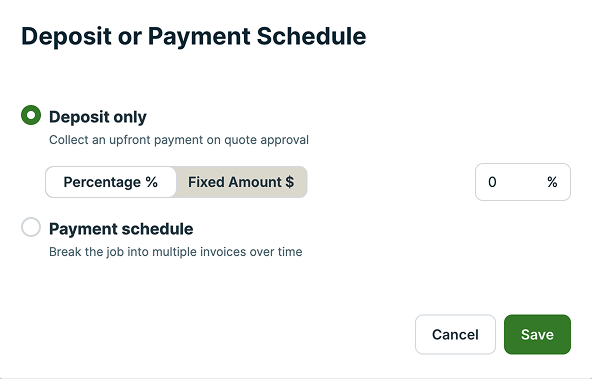
Instead of writing a separate email asking for a deposit, add it directly to your quote in Jobber. When you send the quote, your client sees the deposit amount, approves the work, and pays—all in one step. No awkward follow-up, no separate invoice, no chasing.
When to ask for a deposit
You don’t need to ask every single client for a deposit on every single project. Instead, follow these guidelines to ensure you’re requesting deposits at the right times.
1. Before a job begins
Deposits are typically requested and paid before a job begins. It’s an upfront payment to cover costs associated with a job, so you shouldn’t ask for one halfway through a project unless:
- It requires multiple visits.
- The scope changes significantly.
- Material costs are more than expected.
You should require the deposit when you get the approval on the quote, whether it’s 10%, 20%, 50%—you should get it before you ever start working.
2. When material or labor costs are high
Some projects come with high material or labor costs, like when a job requires a specialist contractor or a client requests premium or hard-to-source supplies. Deposits are common in these cases because they prevent you from covering unusually high costs out of pocket.
For example, say a remodel client wants marble countertops that have to be special-ordered. In that case, you may ask the client to cover material costs upfront instead of a percentage of the total job.
3. From new clients
If you’re working with a new client, it’s hard to know whether they’ll make good on their invoice. Asking for a deposit before their first job ensures you have the funds you need to cover job costs while building a client relationship.
4. On long-term projects
Projects that will span multiple visits often require deposits so you aren’t left waiting on payment while work is underway.
For example, you can ask for a single deposit upfront, or you can use progress invoicing to ensure each stage of the work is funded.
5. For high-value jobs
A smaller job, like replacing a faucet or cleaning a single room, doesn’t come with high upfront costs. But a large job, like a bathroom remodel or fence installation, requires you to commit both time and money.
Many service providers only ask for deposits on jobs over a certain dollar value, like $1,000. Asking for a deposit beforehand provides the money you need to purchase materials and gives you some breathing room if the client cancels.
Deposit request email templates
If you prefer to email clients, you can customize these sample letters to ask for a deposit politely.
1. New client deposit request email
You may want to request a deposit from clients you don’t have an established relationship with yet. Use this email template for standard deposit requests from new clients you haven’t worked with before.
Hi [client name],
Thanks for choosing [company name]. We’re looking forward to working with you!
Before we set a start date, we require a deposit to secure your booking. This covers initial costs and secures your spot in our schedule.
The total amount is [total cost of project], with a deposit of [deposit amount] due [deposit due date]. We’ve attached a copy of the total invoice for your reference.
You can pay the deposit via [payment method]. Once we receive it, we’ll be in touch to confirm a start date.
If you have any questions, please reach out to us by calling [phone number] or emailing [email address].
See you soon!
[Your name]
2. Large project deposit request email
Large projects come with more up-front costs and time commitments on your end. Use this sample letter requesting a deposit payment before starting a high-value or long-term project.
Hi [client name],
Thanks for choosing [business name] for your [project description]! For projects over [amount], we require a [percentage] deposit before work begins. This secures your start date and helps cover upfront costs.
Your deposit of [amount] is due by [deposit due date]. Please refer to the attached quote for a full breakdown of the project fees.
You can make a payment via [credit card/payment link]. Once it’s received, we’ll reach out to schedule a start date.
If you have any questions, please don’t hesitate to give us a call at [phone number] or email us at [email address].
Looking forward to getting started!
[Business name]
3. Email to request material costs upfront
Your business may not be able to pay for a client’s material costs and hang onto that expense for the duration of the project. If you need to ask the client to cover this material cost upfront, use this email template to get started.
Hi [client name],
Before we get started on your [project description], we need to order [material description]. To ensure we can secure the required materials for your job and prevent delays, we require full payment for materials upfront.
The total cost of materials is [amount], due by [due date]. This amount will be deducted from your final invoice.
You can see the full cost breakdown by viewing the full quote attached to this email.
Please submit your materials deposit at [payment link] by [due date] so we can place an order. Once it’s received, we’ll be in touch to coordinate a start date.
If you have any questions, you can reach us at [phone number] or [email address].
Thanks!
[Company name]
4. Deposit request for a returning customer
Not all jobs require deposits, so not all your clients may be familiar with the concept, even if they’ve used your services before.
If an existing customer reaches out to hire you for a new job that requires a deposit, you can use this email template to let them know.
Hi [customer name],
It’s great to be working with you again on [project description]! For projects of this size, we do require a [percentage] deposit before we begin.
Your deposit of [amount] is due by [due date]. You can pay via [payment link/credit card], or give us a call at [phone number] to arrange a different payment method.
Thanks again for choosing [business name]. We’ll reach out once your deposit is received to schedule a start date.
If you have any questions, please let us know!
[Your name]
[Company name]
Deposit request text message samples
If your client prefers to communicate via text, you can use these text message deposit samples to keep them informed.
1. Quick deposit reminder
Use this text message template when you’ve already sent a quote requesting a deposit but haven’t heard back. It’s a fast, friendly way to remind them about the payment deadline without placing too much pressure:
Hi [client name], just a reminder that your deposit of [amount] is due by [due date]. To pay, visit: [payment link]
2. New customer deposit request text
Use this text message template for new clients who want to receive texts rather than emails. It outlines your deposit requirements before you commit time in your schedule.
Hi [client name], thanks for choosing [business name]! A deposit of [amount] is due [due date] to book your job. Pay securely here: [payment link]. Questions? Call [phone number].
3. Text message to confirm a deposit was received
Use this text message sample to let a customer know you received their deposit. It confirms their appointment is moving forward and lets them know when to expect you.
Hi [client name], we’ve received your deposit. Your [service] is booked for [date] at [time]. Thanks for choosing [company name]!
How much to charge for a deposit
Deposit amounts vary based on several factors, such as:
- Your industry
- The total cost of the job
- How long the project will take
- Whether you’re working with a new client
- Where you live
How much you charge also depends on how you want to structure deposits, such as:
- A standard fee on every job, like $25
- A percentage of the total job value, like 30%
- The equivalent of material costs
- The full amount of the service
“How much should you charge for the deposit? This is solely up to the business owner. It’s up to the project that you’re working on. It could be a dollar amount. It could be a percentage. So I do anywhere from 25 to 50% of the project cost for my required deposit.” —Mitchell Gordy, MITHGO Outdoor Services LLC
Here are some average deposit ranges for different industries you can reference:
| Industry | Deposit range |
|---|---|
| Cleaning | 20–50% |
| Electrical | 25–60% |
| HVAC | 50% |
| Lawn care | 15–25% |
| Plumbing | 10–50% |
| Roofing | 50% |
| Contracting | 10–50% |
For smaller services, like residential lawn mowing or basic house cleaning, many businesses charge a small fee, like $25, instead of a percentage.
It’s important to note that each state has different limitations when it comes to deposits. For example, in California, you can only charge up to 10% of the total job price or $1,000, whichever is less.
Before choosing an amount or percentage, check your state’s requirements.
How to create a deposit invoice
When you request a deposit, you have two options. You can either send the customer:
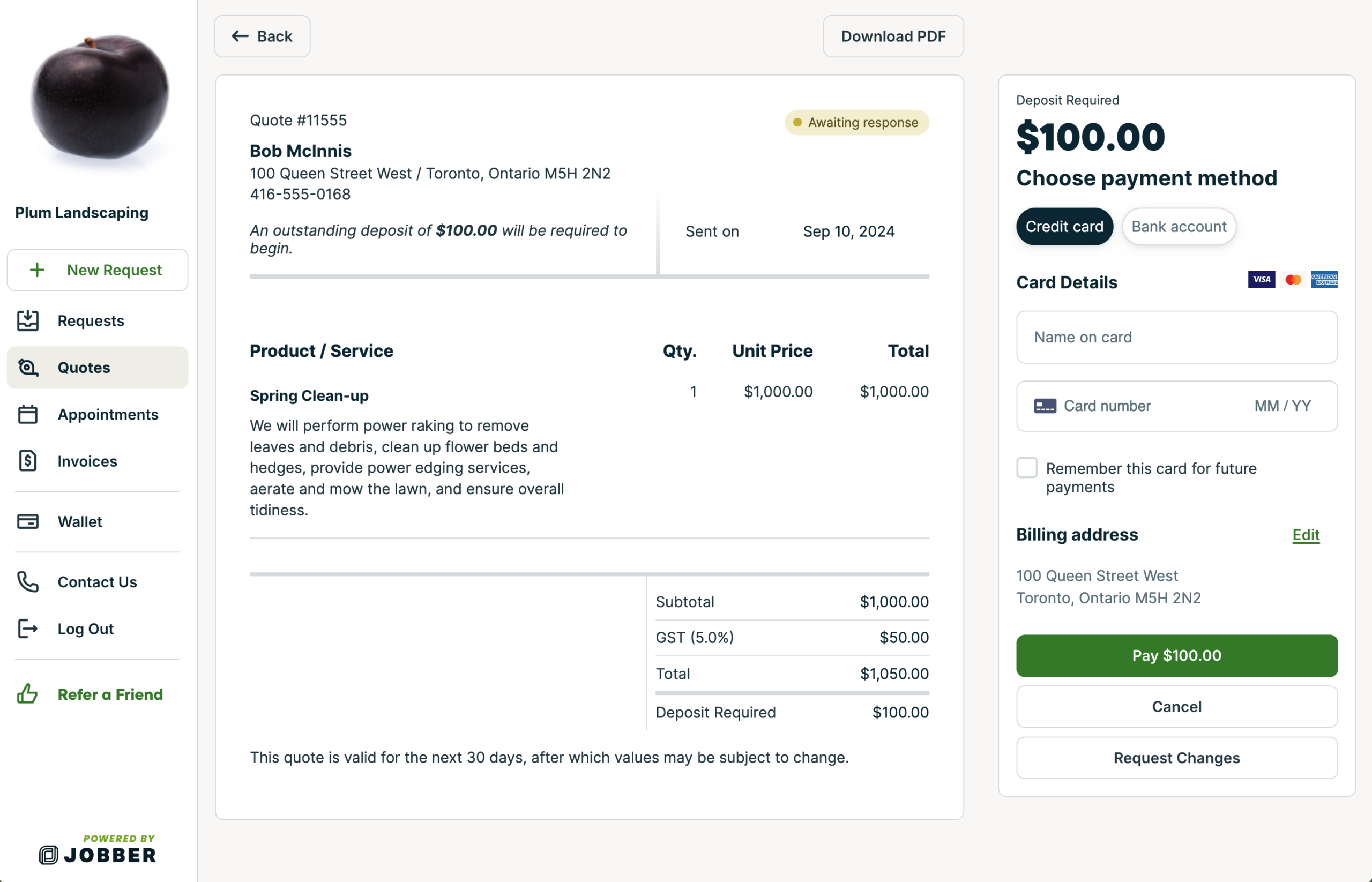
- An invoice for the total job cost, showing the deposit as the amount owing (e.g., a deposit of $50 due on a total invoice of $500).
- An invoice for the deposit, which only includes the total amount owing for the deposit (e.g., $50 due).
You can use a deposit invoice when:
- The customer already approved a quote, and you’re invoicing the deposit separately.
- The deposit is being collected weeks or months before work begins.
- The deposit amount has changed from the original quote based on scope or materials.
- You’re working with a client who needs a separate invoice for a deposit.
Your deposit invoice template should include:
- The customer’s name and job address
- Your business name and contact information
- An invoice number
- The deposit amount due
- A description of what it’s for (deposit on quote #)
- Your accepted payment methods
How to handle deposit pushback
Sometimes, clients may push back against your deposit request, no matter how polite your “we need payment upfront” wording is. They may not want to pay money before work starts, especially if they haven’t worked with you before.
Use these common objections and responses to prepare for pushback.
1. “I’ve never had to pay a deposit before”
Deposits are standard across most service industries. They give you a safety net in the event of a last-minute cancellation and provide the funds you need to purchase materials and supplies.
If a client rejects your deposit request by saying no one has ever asked them for one before, you can respond with:
Deposits are standard practice in [industry]. They help to cover initial costs like [materials] and secure your spot in our schedule. This way, we’re both invested in the job before work begins.
2. “Can I pay you after you start?”
Deposits are meant to be paid before a job starts. They help keep your cash flow steady and secure time in your schedule for the client’s project.
If a client asks to pay a deposit after work begins, you can say:
We collect deposits upfront so we can cover material costs and confirm your booking in our schedule. This makes sure we have the supplies we need to [service description] and gives you a clear record of payment before the job starts.
3. “That’s too much upfront”
If a client wants to work with you but can’t pay the full deposit amount upfront, you have two options. You can reduce the deposit, or you can offer consumer financing.
Jobber’s consumer financing lets them spread payments over time, so you get paid in full, and they get the flexibility they need. Offer this by saying:
I understand where you’re coming from. We can reduce the deposit amount to [amount], or, if it’s easier, we also offer consumer financing options. That way, you can pay the balance in installments instead of all at once. Either way, we’ll make sure it works for you!
Jobber’s consumer financing lets them spread payments over time—so you get paid in full, and they get the flexibility they need.
4. “I’d rather pay in cash when you arrive”
Cash payments don’t protect you if a client cancels and you’ve already purchased materials. And without a deposit, you may not be able to guarantee time in your calendar for the customer.
Paying by card online is safer because it provides a paper trail for both parties to reference. The customer gets a receipt and booking confirmation, and you get a record of the transaction.
If a customer wants to provide cash upon arrival instead of a deposit, you can say:
We process deposits online or by card, so both of us have a secure record of payment. If you need to arrange to make your deposit another way, we also accept [payment over the phone / in office payments / checks]. Let us know what you prefer, and we’ll get the work scheduled as soon as it comes in!
Why you should ask for a deposit
Asking for a deposit comes with several benefits to your service business. Collecting deposits is an effective way to:
1. Improve cash flow
Deposits help cover upfront costs like materials, supplies, and labor. This way, you aren’t paying for job-related expenses out of pocket, keeping cash flow steady.
The deposits help us cover all of the beginning stages of the projects, so that’s going to be the administrative work that goes into sourcing anything specific for the project.
2. Reduce cancellations
When a customer is already invested in a project, they’re less likely to change their mind. Deposits ensure clients are committed to the work before it begins, making cancellations and no-shows much less likely.
And if they do happen, a non-refundable deposit covers costs, so you don’t lose money on the job.
3. Prevent non-payments
Deposits also cut down on unpaid invoices from customers who refuse to pay, so you don’t have to spend as much time collecting payments.
Having a reliable payment method on file and getting a customer invested in the work early helps to filter out those who are unlikely to follow through on payment later.
4. Filter out bad clients
Bad clients may not be serious about a project, or may not have the funds to pay for the work. Asking for a deposit upfront prevents both of these issues by getting them to commit to a job before you waste any time or money on it.
That keeps your calendar full of high-quality clients while cash flow stays strong.
Making deposits part of your day-to-day
Asking for a deposit doesn’t have to be uncomfortable. By making your request professionally and politely, you can turn an awkward conversation into a standard business practice that helps you secure more reliable work, cover costs, and improve cash flow.
With Jobber, you can automate deposits on every quote, making it easy to collect them without adding to your to-do list—and while maintaining good relationships with your clients.
Originally published in February 2022. Last updated on April 29, 2026.
Frequently Asked Questions
-
A deposit is an upfront payment a customer makes before a job begins. It’s typically a percentage of the total job cost and is applied to the final invoice.
-
To politely ask for a deposit from a client:
Include your deposit request in a professional email, text message, or directly in your quotes.
Be upfront and approach the request as a standard business practice.
Provide deposit details, including what it is, how much it is, and when it’s due.
Aim for a friendly tone. -
You should ask for an upfront deposit before a job begins. You can ask for deposits:
• On all jobs
• On jobs over a certain value
• From first-time clients
• When material costs are higher than usual
• On jobs that require multiple visits -
Most deposits fall between 10% to 50% of a job. How much you charge depends on the service, your industry, and state laws. Each state has different limits on deposits, so it’s important to check legal requirements in your area before choosing an amount. When a 10–50% deposit is required, wording could follow the templates above.
-
Whether you charge a deposit on each job is up to you. Some service providers only charge deposits on jobs over a certain dollar value or for first-time customers. Others charge deposits for every job, even if it’s only a small fee, like $25.
-
Yes, each state has different laws for deposits. For example:
• In Maryland, you can’t charge more than a third of the total job cost as a deposit.
• In New York, contractors must put deposits in an escrow account and only use them to cover job costs until the work is “substantially complete.”
To find out what you can charge in your state, consult your local contractor licensing board.