
Key takeaways:
Starting a cleaning business is a straightforward and rewarding journey, especially when you follow a solid step-by-step plan.
- Research your local market and choose your niche. Decide between residential or commercial cleaning based on local demand and your business goals, and identify any gaps in the services offered by competitors.
- Select your services and invest in supplies wisely. Offer core cleaning options to start, considering both essential and specialty services, and purchase only the equipment and supplies you need for your first jobs to minimize costs.
- Register your business and manage legal requirements. Pick a unique business name, choose an appropriate business structure, obtain all necessary licenses, and secure the right insurance to protect yourself and your company.
- Set up your pricing, accounting, and business systems. Research competitor rates, choose a pricing structure, open a business bank account, and use accounting software to keep finances organized and tax filing simple.
- Market your business and build strong client relationships. Use branding, personal networks, online marketing, and community connections to attract new clients, and leverage software to streamline scheduling, invoicing, and customer communication.
Stay ahead in the industry and get more tips for running a successful cleaning business by signing up for the Jobber Newsletter. Subscribe here.
Originally published May 2023. Last updated on July 25th, 2025.
Cleaning services are in high demand. In fact, the cleaning industry is expected to grow by $200 billion between 2024 and 2030. This means it’s the perfect time to start your own business.
With minimal overhead and basic equipment, you can jump in and start a profitable cleaning business right away. This article walks you through all the steps on how to start a cleaning business, whether you plan to offer residential or commercial cleaning services.
What do you need to start a cleaning business?
-
Get to know your local market
-
Choose what cleaning services you’ll offer
-
Write a business plan
-
Register your company name and choose a business structure
-
Get a business license
-
Get cleaning business insurance
-
Set up accounting and bookkeeping
-
Stock cleaning supplies and equipment
-
Learn how to price your cleaning services and estimate jobs
-
Market your cleaning business and get your first customers
-
Learn how to manage your cleaning business and client relationships
-
Hire and train cleaners so you can grow
1. Get to know your local market
Start by determining whether you’d like to focus on residential (house cleaning), or if you want to be a commercial cleaning business that serves other businesses in your area.
- Residential cleaning might be a good fit if you work alone and want to clean smaller spaces (although you can do it with a team, too). You’ll most likely have at least a dozen homes that you clean every week or two, and you’ll get paid right after you finish a visit.
- Commercial cleaning requires a larger team to clean offices and retail spaces, as well as a vehicle to transport yourself and your supplies to the business’s location. However, you should only need a few regularly paying commercial cleaning contracts to stay profitable.
Your service area may also dictate whether you offer residential or commercial services. For example, if you’re targeting a downtown area, offering commercial cleaning will expand your pool of potential customers.
READ MORE: How to start a commercial cleaning business
When you’re deciding what type of cleaning business to run, you’ll need to understand the local market. Here are a few ways to do that:
- Do online research by heading to Google and searching “residential/commercial cleaning businesses near me.” Look at top competitor websites, pricing pages, and local reviews.
- Get feedback from neighbors or local business owners about their experiences with cleaners or cleaning services. Ask what made their experiences great, and dig into any areas for improvement.
- Identify your ideal customers and what they’re looking for. Do they want only basic cleaning services? Or are they looking for higher-end cleaning experiences?
- Look for any local gaps in cleaning services and think about how your company can fill them. For example, if there’s no local option for upholstery cleaning, but neighbors or community members need that service, this is an easy way to meet that market need.
Once you know which type of cleaning business you want to operate, you’ll have a better idea of what cleaning services you should provide to your clients.
2. Choose what cleaning services you’ll offer
Your cleaning business can offer a wide variety of services for clients. Here are some types of cleaning services you can provide:
- Basic residential cleaning
- Deep cleaning
- Maid service
- Spring or seasonal cleaning
- Sanitization services
- Move-out cleaning
- New home or construction cleaning
- Office cleaning
- Dishwashing
- Laundry services
- Eco-friendly cleaning services
What is green cleaning services?
Eco-friendly (“green”) cleaning offers an alternative to standard cleaning methods. Certain harsh cleaning products and methods can contribute to personal health risks, environmental hazards, and even toxic air pollution.
Every type of business has some kind of environmental effect. Harsh chemicals, extra water usage, and paper or plastic waste are some of the environmental byproducts of traditional cleaning services.
Should I offer green cleaning services?
In addition to reducing your corporate carbon footprint, eco-friendly cleaning has several benefits:
- It’s eco-friendly and appeals to clients who care about the environment.
- It’s healthier since eco-cleaning products often use natural, non-toxic ingredients.
- You can charge more for a premium service and offset higher cleaning supply costs.
- It’s good for your brand and shows your company’s commitment to sustainability.
You could also offer one-off specialized cleaning services that give clients more flexibility.
Specialty add-ons can include cleaning business ideas like:
- Upholstery cleaning
- Carpet cleaning
- Window cleaning
- Pool cleaning
- Pressure washing
- Gutter cleaning
How to decide which cleaning services to offer
Here’s how to make smart decisions on which cleaning services to offer your clients:
- Research competitors: Look at competitors’ websites to see what they offer. This shows you which services are missing in your service area—and what you can offer to stand out.
- Understand demand: Select services that fit your target market. For example, a higher-income residential area might be interested in maid service, while a lower-income area may only need occasional deep cleaning.
- Start small: Focus on a few core options for your final services list. Think short and long term—what can you do now, and what can you do later when you have more money to invest?
- Prioritize quality: Whatever services you offer, make sure you can do them well. Practice at home or in the homes of friends and family, and see how quickly you can work while maintaining a high level of quality.
Do I need formal training to offer cleaning services?
Unless your city or state has rules about certification, you don’t need formal training to start a cleaning business—casual training will do just fine!
But it’s important to educate yourself on how to clean professionally before you start cleaning homes. You’ll also want to know how to avoid cross-contamination from one location to the next.
The American House Cleaners’ Association offers cleaning certification courses to help you learn about cleaning guidelines, cleaning chemicals, disease prevention, and even the history of the cleaning industry.
You may have other costs to manage, so investing in professional certification might not be a priority right away. Even so, you can start learning professional tactics by using our house cleaning checklist and cleaning business resources.
You don’t really need any special skills to start a cleaning business.
What you will need are great listening skills and the ability to summarize and paraphrase your customer’s needs.

3. Write a business plan
A cleaning service business plan helps you define how you’ll run your company, manage your finances, and get more customers. It also helps you get funding from investors.
Your residential cleaning business plan should include information like:
- An executive summary that explains your goals, values, and competitive advantage
- A brief company overview that includes your location and business structure
- A leadership introduction to your management team, including name, title, and salary
- A list of your cleaning services and your pricing strategy for each
- Your market positioning (i.e., who your business serves and how it stands out)
- Your sales and marketing strategy for winning new customers
- A financial plan for making money, including your annual budget and sales forecast
4. Register your company name and choose a business structure
Next, you’ll need to register your cleaning business name with your local government. Here’s how to register your business depending on which country you’re in:
- United States: Make sure nobody else in the state is using your name, then trademark it and register your domain name.
- Canada: Does your business have the same name as you? If so, you don’t need to register it. But if not, register the trade name and trademark it to protect your brand.
- United Kingdom: Set up as a sole trader or business partnership, check your name availability, search for a trademark, and register your company name and business.
- Australia: If your business isn’t the same as your personal name, you’ll need to register your business name through the Business Registration Service, ASIC, or a private service provider.
Part of the registration process is deciding what your business structure will be:
- If you’re in the U.S. and you want complete control over your business, you might want to register as a sole proprietorship. However, being a sole proprietor means you’re also fully responsible for the business from a legal perspective—for example, if a client or employee ever sues your business—so be aware of that.
- If you’re opening your cleaning business with two or more people, you’ll have to register as a partnership.
- A limited liability company (LLC) is best for medium or higher-risk cleaning businesses. It protects your personal assets and separates them from the company.
- A corporation sets up your business separately from yourself and provides the strongest liability protection. That said, the cost of incorporating is higher than other types of business structures, and corporations require detailed records and reporting.
When you’re registering, you’ll need an employment identification number (EIN) for federal tax purposes if you have employees, operate as a corporation or partnership, or have a Keogh retirement plan as a self-employed person.
Depending on the location, your city or state may require similar business identification to file taxes in your area.
Pro Tip: Not sure what the local ordinances and regulations are for your cleaning business? Just Google “YOUR CITY NAME + business laws”.
READ MORE: Should I incorporate my small business?
Should I join a cleaning franchise?
That depends on how much support you need to start your business and how much freedom you want as the business owner.
Buying into a cleaning franchise is a straightforward way to start a business. You get the support of a larger company, can use their branding and marketing tools, and can take advantage of their existing reputation.
On the other hand, you’ll have to run your franchise in a very specific way and follow the franchisor’s established processes. There won’t be any room for flexibility, and you won’t be able to make any large-scale business decisions.
There’s no right or wrong decision—when it comes to cleaning franchises, it’s entirely up to you and what you’re comfortable with.
5. Get a business license
You must have a business license before you start cleaning. This is what legally allows you to run your business. Without a license, you can face serious consequences (including fines and legal action).
Apply for a business license through your city’s business development department and provide information about your company, like its structure and the services you provide.
You’ll likely pay an up-front licensing cost, which varies depending on where you live. You’ll also need to renew this license in your city or county every year and pay the same fee at that time.
Need a business license but not sure where to start? Check out our guide to getting your cleaning business license in each state:
What licenses are needed to start a cleaning business?
You need a business license before you can clean a home or business. There are no other licenses required to start your own cleaning business.
Want to boost your reputation as a cleaning company? Think about getting certified through the AHCA or another industry group—and make sure to advertise that certification to clients.
READ MORE: Is it worth it to start a cleaning business?
6. Get cleaning business insurance
When it comes to protecting your business and your future employees, cleaning business insurance is non-negotiable.
The last thing you want as a new entrepreneur is to accidentally cause damage to a client’s home and not have insurance. In this scenario, you risk getting into debt when you cover the property damage out of pocket.
Your policy gives you peace of mind without costing too much. There are different types of insurance available, with variations based on your assets and the level of protection your business needs.
Consider getting a cleaning insurance policy that includes:
- General liability insurance
- Health insurance
- Vehicle insurance
- Business owners’ policy
- Workers’ compensation
- Employment practices liability
Shop around for the right insurance plan for your business and check out various providers in your area. Some cleaning business owners recommend using Thimble or Next Insurance.
You’re going to need insurance for your business.
And you’re going to need personal insurance, like for Worksafe or WCB in the event that you hurt yourself on the job, because you’re now self-employed.
7. Set up accounting and bookkeeping
You can’t run your business out of your personal bank account. Get a business bank account where you can accept payments and monitor cash flow separately from your personal assets.
From there, create an expense budget for purchases, equipment, gas, marketing, and any additional overhead. This is the budget you’ll stick to every month. Don’t worry, you can adjust over time if you need to!
One of the most important expenses is your own personal paycheck. Decide what you’ll be paid, then set up an automatic bi-weekly withdrawal so you can pay yourself from your profits. Do the same for employees or subcontractors if you have them.
Use accounting software to track your income and expenses so you can report accurately when it’s time to file your taxes. Depending on where you live and work, you’ll follow these avenues:
- United States: You’ll file business taxes with the Internal Revenue Service (IRS).
- Canada: Go through the Canada Revenue Agency (CRA) to file your business taxes.
- United Kingdom: The UK offers the Companies House online portal for you to send your company tax return.
- Australia: Lodge your business taxes with the Australian Taxation Office (ATO).
READ MORE: 30 small business tax deductions to save money when filing
How much money do I need to start a cleaning business?
New cleaning company owners often ask, “How much does it cost to start a cleaning business?” Expect to spend about $685 (USD) to start with a few must-have purchases:
- License and registration: $75–400/year
- Cleaning business insurance: $360/year
- Equipment: $100 for a basic vacuum and all-purpose supplies
- Marketing: $150 for a simple DIY website and business cards
Startup costs vary depending on where you’re located. Before you buy anything, make a budget so you know what you need and how much everything will cost. You can then prioritize which expenses should come first and which ones can wait.
What if you don’t have that much money right now?
Not everyone has the money available to start up a cleaning business. That’s okay! Don’t let that keep you from following your dream of becoming a business owner. You can start a cleaning business with no money using free and low-cost tools and marketing strategies.
Start with only what you need for your first cleaning job: your business license and registration, cleaning insurance, basic equipment, and transportation. Then invest in better equipment and marketing over time.
If you don’t already have cleaning experience, it’s a good idea to work for another cleaning company first before starting your own. This will also give you the startup money you need.
Some business owners also gather their startup funds by applying for a small business loan, putting expenses on a credit card, or borrowing money from friends and family. This can be helpful as long as you’re able to pay it back.
Learn how these house-cleaning business owners got started with zero budget:
8. Stock cleaning supplies and equipment
While starting a residential cleaning business is a low-cost venture, you’ll need to buy certain items before your first job. Use our cleaning business supplies list to stock up:
- Face mask
- Rubber or latex gloves
- Trash bags
- Paper towels
- Sponges
- Cleaning towels or rags
- Microfiber cloths
- Scrubbing brushes
- Duster
- Extendable pole
- Vacuum cleaner
- Broom and dustpan
- Mop and bucket
- Bleach or disinfectant
- All-purpose cleaning solution
- Soap scum removal cleaner
- Toilet cleaner
- Glass cleaner
- Spray bottle
Consider visiting a janitorial service supply store and asking their staff what cleaning product options they recommend. They know the ins and outs of the cleaning industry and can give you a list of the best products to use.
That said, you don’t have to get brand-name cleaning supplies, either. Head over to your local dollar store and get the generic versions of your favorite supplies for a much lower price.
Green cleaning supplies
As consumers demand more environmentally friendly choices, manufacturers are making more products with green ingredients in mind. If you’re offering sustainable cleaning services, look for products that are:
- Made from plants or recycled materials
- Reusable or have less packaging waste
- Recyclable or biodegradable
- Energy efficient or cold water compatible
- Fairtrade and produced sustainably
- Non-toxic, fragrance-free, and without certain ingredients
- Home recipes (e.g., vinegar, lemon juice, baking soda)
- Suited for multiple purposes (e.g., castile soap, dish soap)
- Green Certified
These products will do less harm when they’re thrown out, recycled, or flushed down the drain. You can also use products that are considered eco-friendly, even if they aren’t actually green.
For example, microfiber costs twice as much energy to manufacture up front, so it doesn’t meet the criteria for being green. But it also needs less water and is reusable, unlike single-use paper towels, so it’s still good for the environment.
Pro Tip: If you only want to use green-certified products, look for an Eco-Scale, EcoLogo, Green Seal, or Safer Choice (formerly DFE) label on your cleaning products. They’re all recognized green certifications.
You don’t have to buy all of your cleaning supplies at once.
As long as you have a few things—spray bottles with your cleaning products, a Swiffer, some mops, a vacuum cleaner—that’s a good way to start.
How much do you need to spend on cleaning supplies?
You shouldn’t need to spend more than $100 on cleaning supplies when you’re first getting started, especially if you’re on a tight budget and only buying a few things at a time.
Here’s how to set that budget to decide your non-negotiable supplies.
- Figure out a cleaning equipment budget that you can afford right now. (Remember, the profit from your first few jobs might help with reinvesting into your business.)
- List the tools, equipment, and chemicals you need to complete each of the services you plan to offer (e.g., gloves, microfiber towels, extendable poles, bleach, glass cleaner).
- Determine how many of each item you’ll need for each job and assign costs to each item, including the price total.
- Prioritize items you need right now. Make decisions based on importance, price, budget, and how soon or how often you’ll use them.
If you won’t offer a service till later, don’t buy the equipment for it yet. For example, you won’t need a carpet cleaner yet if you won’t be cleaning carpets for another year or two.
Pro Tip: Make sure you understand how to safely use cleaning chemicals. Using them the wrong way (like mixing bleach with other products) could harm you or damage the client’s home.
9. Learn how to price your cleaning services and estimate jobs
It’s time to decide how much to charge for house cleaning or commercial cleaning services. Follow these steps to set your prices:
- Research how much your top competitors charge for the same services, just to get a range for what’s expected in your area.
- Within that range, determine the highest and lowest amount your ideal clients would pay for a specific cleaning service.
- Choose a pricing structure, whether that’s hourly rate, flat rate, room rate, square foot rate, or specialty service rate.
- Calculate how much the job will cost based on your pricing structure, including your cleaner salary, overhead, and taxes.
- Factor in your profit margin and markup to ensure you’re making money from each visit.
- Create an estimate using a free cleaning estimate template and send it to your client. (If it’s for a commercial cleaning client, you can use a cleaning proposal template instead.)
You can also use our free house cleaning cost calculator to accurately price out your cleaning visits and keep your work profitable.
Should I upcharge for eco-friendly cleaning services?
As a cleaning business owner, deciding whether to upcharge for eco-friendly services depends on various factors, like whether your new products are more expensive or if your staff needs specialized training to use them.
At the same time, offering green services at no extra cost can set you apart and attract more clients. By using eco-friendly products, you might even be able to stretch your supplies for a longer time, meaning you have less to buy or restock.
Take a balanced approach to your pricing strategy. The decision to upcharge should be based on your business strategy, customer preferences, and the general market.
A thousand dollars a day is my new standard goal.
I make up to $5,000 a week. You can earn up to $17,500 a month or more. Last year, the Red Rose made $150,000, and this year we’re hoping to make $250,000.

10. Market your cleaning business and get your first customers
Marketing is essential for attracting potential clients and getting your first jobs. It might sound challenging if you aren’t a marketing expert, but don’t worry—you’ll get the hang of it quickly.
Try a few of these ideas to start drawing attention to your new venture:
- Create a strong business brand. Part of being a professional business is looking the part, from your business logo, uniforms, and online presence. Building a strong brand will help you generate more trust with new clients.
- Use your personal network. Tell family and friends about your cleaning business and get them in as your first clients (don’t forget to ask them to spread the word, too!)
- Print off business cards and always carry some with you. You can hand them out at events, while networking with other business owners, or even in line at the grocery store.
- Deliver door hangers or cleaning flyers to residents in your desired service area. You can also leave these behind at nearby homes or businesses when you’ve finished a job.
- Referral programs are also helpful for encouraging cleaning clients to recommend your business to others. You can thank them with a service discount or other incentive.
- Add a vehicle wrap to your car so it becomes a moving billboard. Park it in public spaces so people passing by will learn about your business.
- Connect with local realtors and see if you can partner with them to provide move-in and move-out cleaning services.
- Attend a Business Networking International meeting. Your first meeting is free, and you’ll get to give out business cards to other entrepreneurs who want to help you succeed.
If you start a commercial cleaning business, cold call businesses you’d like to work with. Be prepared for many potential clients to say no, but the handful that say yes will be worth the effort.
Join local networking groups.
They’re very, very, very low cost per month. That’s your way of getting your name out in the community… Everything about your business is going to be based on networking.

You can also try these helpful marketing tips from successful cleaning business owners:
Digital marketing: how to get established online
Most of your new long-term cleaning customers will find you online, so it’s important to understand everything you need for digital marketing.
Make sure to include these tasks in your digital marketing strategy:
- Build a professional website that lists your services and gives prospects an easy way to request work. You can do this yourself using Jobber’s website builder, which includes a booking form, Google reviews, and reporting features. Check out these cleaning company website examples for inspiration.
- Create Facebook, Twitter, and Instagram accounts for your business. Then post regular content like how-to videos, before-and-after photos, and business growth tips. It’s free and easy to set up these accounts, and you can direct people to these pages while you’re still getting your website set up.
- Set up your Google Business Profile (formerly called Google My Business). This will help you show up in local search results when people search for your business or services. Be sure to ask happy customers to leave a 5-star review as well!
- List your business in local business directories and on lead generation websites. These sites help expand your online visibility, making it easier for people in your area to find your cleaning business.
- Experiment with Google Local Service Ads. Get some ideas from these examples of real cleaning business ads.
How to market a green cleaning business
When marketing your green cleaning services, emphasize the benefits and values that sets your business apart. Check out these marketing ideas, and learn which platforms you can use to show them off:
- Share personal health benefits in your online ads and social media posts. Explain to clients how eco-friendly products can reduce allergens, toxins, and pollutants. (For legal reasons, avoid making any specific health claims or promises.)
- Highlight your eco-friendly credentials in your Google Business profile, on your website, and in print materials. Use green certifications or badges you’ve earned to build credibility and show that you meet industry standards.
- Add customer testimonials on social media and in video ads, featuring satisfied clients who love your eco-friendly approach. Real-life stories and positive experiences build trust with new clients.
- Share educational tips in blog posts and social media posts to educate your audience about green cleaning procedures and establish yourself as an expert.
- Donate a portion of your profits to environmental nonprofit groups, like those that pick up litter or clean watersheds. Clients might be more likely to work with you (and pay higher prices) if they know that investment helps the environment.
The best way to start a new cleaning business with little to no money is to start establishing a good network around you.
That means meeting people, getting out there, and getting your name in people’s ear.
11. Learn how to manage your cleaning business and client relationships
The key to running a successful cleaning business is to manage it well and keep your clients happy. Cleaning business apps can keep your operations simple and straightforward.
Here’s how cleaning software like Jobber can help you run your business every day:
- Get new business: Potential clients can contact you through the online booking form on your website. This gives you all the information you need to get in touch and talk about job details (e.g., size of space, type of cleaning, frequency of cleaning).
- Manage clients: Every residential and commercial client has information associated with their jobs. Store all of those details in Jobber’s CRM, including their name, address, contact information, and service needs.
- Send quotes: Create a quote with custom line items for all your cleaning services and email it to the client. You can automatically send a customized follow-up if you don’t hear from the client in a while.
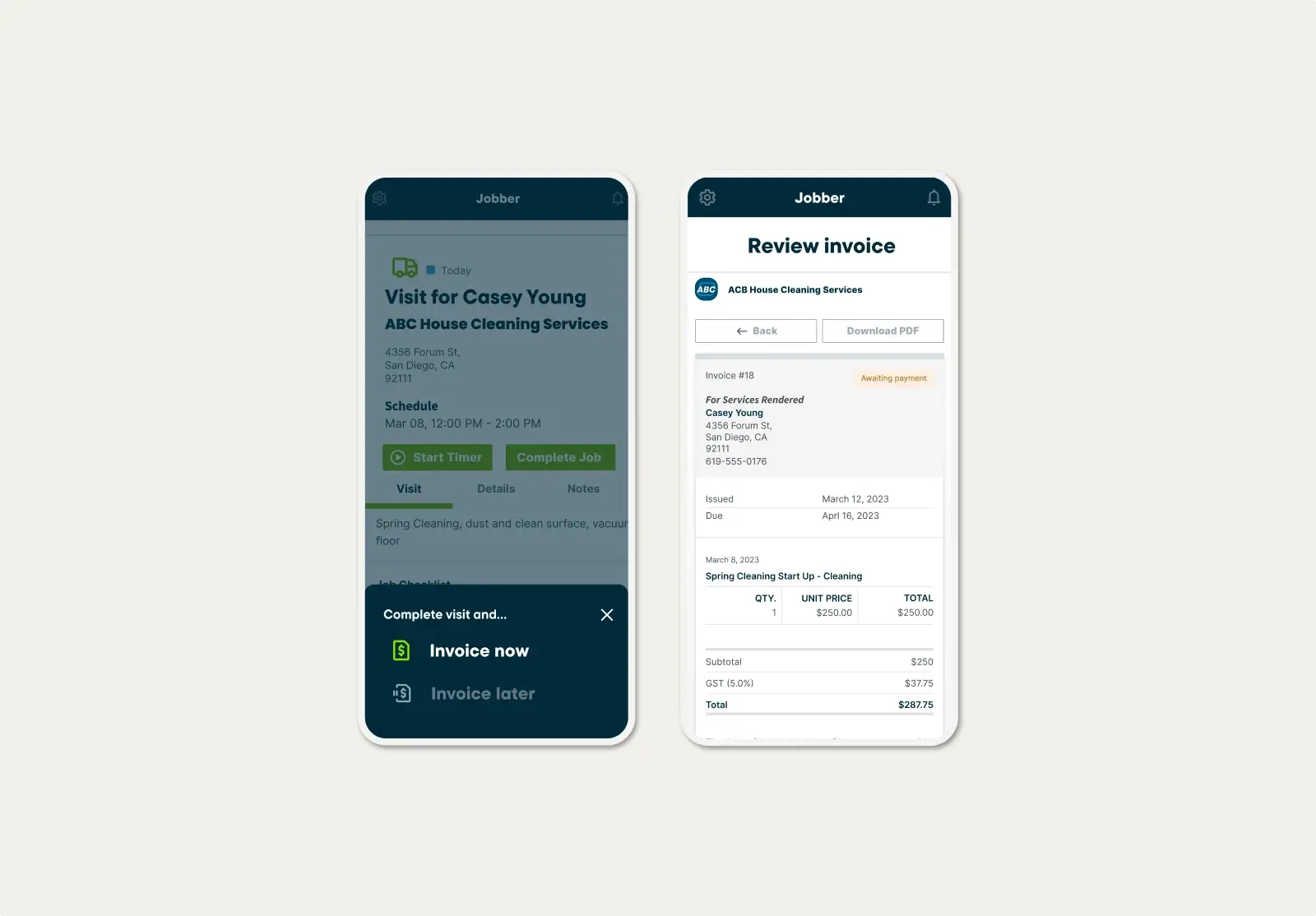
- Manage jobs: When a client approves your quote, convert it into a job and schedule the job in your calendar. Later, when you get to the job site, use a house cleaning checklist on the mobile app to remember every task and help you provide consistent service.
- Communicate with clients: Send a reminder text or confirmation email a day or two before the cleaning. You can also follow up after the job, ask the client to book their next visit, and request a review on Google or Yelp. (Bonus tip: listen to their feedback, provide great customer service, and address any concerns to maintain your good reputation.)
- Invoice clients: With user-friendly invoicing software, you can send an invoice after each cleaning job is complete. Use a cleaning invoice template to make the process even faster and easier.
- Get paid: For repeat clients who get recurring cleaning services, you can offer automated payments through a credit card on file using a tool like Jobber Payments. You’ll get paid almost four times faster than if you collected manual payments by check.
12. Hire and train cleaners so you can grow
Once the work picks up and becomes too much to manage on your own, it’s time to branch out and hire employees. This ensures your business can provide a consistent level of service, even if you get sick or aren’t available.
The process of recruiting, interviewing, and screening applicants can feel daunting, but bringing on new team members is a proven way to grow your cleaning business.
Here’s how to approach the process of hiring cleaners so it’s beneficial for you and your future team:
- Figure out who your ideal employee is, what they need from a job, and where you can find them.
- Write a house cleaner job description so you (and your future employee) understand the role and responsibilities.
- Create a job posting and share it on job-finding websites like LinkedIn, Indeed, or other places where your ideal employee spends time.
- When you start getting applications, shortlist the best ones and interview the candidates. Include a paid audition as part of your hiring process to see how candidates work.
- Hire the best candidate for the job and do your best to keep them on the team.
Invest time and effort in training cleaners so they’re prepared to work out in the field. Tools like job checklists, employee handbooks, and regular evaluations will help you keep your cleaners’ skills sharp.
The toughest thing about running a cleaning business is consistency.
If I’m cleaning a home and another staff member is cleaning a home, the home should come out the same way with the same sparkle.
Pro Tip: Don’t want the hassle and paperwork of hiring employees? You can hire cleaning contractors to complete visits for you. They charge an hourly rate, you add a percentage on top for yourself, and the client pays the full amount for service.
READ MORE: Housekeeping interview questions every cleaning business owner should ask
Ready to start a cleaning business?
A cleaning business is one of the simplest types of businesses you can run. Starting a service business is an easy way to generate revenue right away—without taking out a business loan.
You also get to be your own boss, set your own standards, and do work that makes a real difference for your clients and your community.
Need a few extra tips before you start running a successful cleaning company? You can also watch our video series to learn how to start a home cleaning business with proven advice from industry experts:
This article was reviewed by home service cleaning pro and Jobber Brand Ambassador Morgan Graffis of The Cleaning Co Coach and Verv Cleaning. She was compensated for her time and contributions to this article. You can follow her on Instagram and TikTok.