
Key takeaways:
Having a clear cancellation policy helps home service pros minimize disruptions, protect their revenue, and set clear expectations with customers.
- Establish clear rules. A solid cancellation policy should outline notice periods, penalties, refund options, and exceptions for cancellations, ensuring clients know what to expect.
- Protect your time and income. By holding customers accountable with possible fees for late cancellations or no-shows, you reduce scheduling gaps and financial losses.
- Maintain professionalism. Consistently sharing your policy across all client communications—quotes, confirmations, and your website—demonstrates that your business is organized and reliable.
- Customize for your industry. Use tailored policy templates for cleaning, landscaping, HVAC, and plumbing services to address unique scheduling and cancellation challenges.
- Stay adaptable. Regularly review and update your policy as your business evolves, and communicate any changes clearly to new and existing clients.
For more expert tips on managing your home service business, sign up for the Jobber Newsletter. Subscribe here.
A cancellation policy prevents last-minute cancellations and no-shows from disrupting your schedule. It can encourage customers to keep appointments and help you cover job costs when they don’t.
Use these tips and templates to create a solid cancellation policy. It’ll help set clear expectations with clients, support your booking process, and keep your calendar full.
Create a standard cancellation policy for your business:
What is a cancellation policy?
A standard cancellation policy outlines your business’s rules for canceled appointments. Effective cancellation policies cover:
- Notice periods, like whether you require 24 hours’ notice to cancel an appointment
- Cancellation penalties, such as whether late fees or booking fees will apply
- Instructions for how to cancel and reschedule an appointment
Depending on your services and industry, they can also include information about:
- Refund policy, like whether you offer full refunds or a partial refund amount for prepaid work or deposits
- Exceptions such as weather delays or emergencies
- Cancellation windows, like no penalties for 48 hours’ notice or more, but fees for cancellations any closer to the scheduled appointment
- Company cancellations, outlining what happens if your business cancels a job instead of the client
A good strategy for creating a cancellation policy is to start simple and add to it as needed. Your initial appointment cancellation policy may only cover a notice period and penalties.
As new situations come up—like customers asking about deposit refunds or job rescheduling—you can expand the policy to address them.
Why do you need to have a company cancellation policy?
The national average cancellation rate for appointment-based businesses in the United States is 15–30%. Having an effective cancellation policy in place is one of the best ways to reduce that number. It can also help you to:
1. Hold customers accountable for reserving your time
Your time is valuable, and you need to make money to cover operating expenses and overhead costs. When your company cancellation policy includes a penalty for last-minute cancellations, it can help compensate you for your time.
2. Discourage customers from cancellations and no shows
Customers who face late cancellation fees for canceling appointments are less likely to cancel. Especially if you already have their permission to charge a credit card on file, or you took a deposit for the work.
FREE TEMPLATE: Credit card authorization form
3. Reduce losses
Fewer cancellations means a fuller schedule, and a fuller schedule means more revenue. Charging a cancellation fee can also bring in some income, if not the full amount you would have made from the job.
When that cancellation rate comes down, you need less leads, which means you’re spending less on marketing.

4. Have a more reliable schedule
A full schedule is one of the best things you can have as a service business owner. But cancellations leave you with gaps that are hard to fill, especially when they happen with little notice.
A company cancellation policy deters customers from canceling right before an appointment. This often results in a more reliable schedule and avoids wasting time filling their empty spot.
READ MORE: How to schedule employees while saving time and money
5. Boost your professionalism
Having an effective company cancellation policy protects your revenue and prevents schedule gaps. It also adds to your reputation as a professional business. Having clear policies in place shows customers that your business is organized and legitimate.
How to write a cancellation policy
A cancellation policy sets expectations with a customer before an appointment. Follow these steps to create a fair cancellation policy that clearly communicates your rules while maintaining professionalism and supporting good customer experience.
1. Define a cancellation timeline
Choose how much notice a client must provide before canceling or rescheduling an appointment, like 24–48 hours.
The notice period should reflect how much time you need to fill a last-minute opening in your schedule.
For example, if you have a waitlist you can refer to, 24 hours may be enough. But for larger or more niche jobs, you may want to ask clients for at least 72 hours’ notice.
Policy Example: “We require a minimum of 24 hours’ notice to cancel or reschedule an appointment.”
If there’s last-minute availability from a client canceling, then we go to our waitlist and fill that spot to ensure that our cleaners have the work.

2. Set last-minute cancellation and no-show fees
If a client cancels an appointment after the required notice period, you need to decide whether you will charge a penalty and how much it will be.
For example, you could charge nonrefundable deposits, a percentage of the job, or a flat fee—like a 50% deposit on the job, 5% of the invoice total, or a $25 fee. The amount depends on the value of the job, the services you offer, and the industry you’re in.
Some states also have limitations around late cancellation fees, like how much you can charge and when they apply. To confirm laws where you live, check with your state’s consumer protection agency.
You should also address how you’ll handle fees. For example, you can charge a payment method on file, send the fee as a separate invoice, or deduct it from a deposit.
Policy example: “Appointments canceled with less than [# of hours] hours’ notice may be subject to a [$0] cancellation fee. Applicable fees will be [charged to the card on file/deducted from your deposit/billed separately].”
If you choose to apply different fees to no-shows, you can also include a line to address how you’ll handle them, like: “No-shows will be charged the full appointment fee.”
3. Provide cancellation instructions
A cancellation policy also needs to explain how to cancel a scheduled appointment. This way, customers have a chance to reschedule or cancel a job before any penalties apply.
It also provides a paper trail for both you and the client, so you have documentation to refer back to in the event of a dispute.
Make your cancellation instructions as clear and easy to follow as possible. Customers shouldn’t have to jump through hoops to get in touch. And the simpler it is, the more notice you’re likely to get.
Policy example: “To cancel your appointment, please call our office at [phone number] or follow the cancellation link in your appointment confirmation email.”
4. Plan for exceptions
Emergencies happen, like bad weather and illness. A flexible cancellation policy helps maintain strong customer relationships without compromising your guidelines.
For example, many service businesses review cancellations on a case-by-case basis. For a first-time cancellation or a missed appointment for a repeat customer, you may want to waive any penalties.
Policy example: “If you need to cancel because of an unexpected situation, please get in touch with us at [phone number] or [email address] as soon as possible.”
5. Outline how you handle company cancellations
A balanced cancellation policy covers both a customer’s responsibilities and your business’s. Let customers know how you handle rescheduling appointments if your team has to cancel or change an appointment.
For example, will you offer alternate dates in your cancellation message? Or will a team member reach out separately to reschedule?
Policy example: “If [business name] needs to reschedule an appointment, we’ll notify you as soon as possible with the next available time.”
6. Leave room for policy updates
The last element of your cancellation policy should tell clients that your policy is subject to change. It should also mention where they can find the latest version.
This is important if you make any policy changes that aren’t automatically applied to quotes, appointment reminders, or appointment confirmation emails.
Policy example: “This policy is subject to change. Please find the latest version at: [webpage address]”
General cancellation policy templates
Your cancellation policy should be consistent across booking confirmations, appointment reminders, quotes, emails, and your website. This ensures customers always have access to your cancellation terms for reference.
Use these templates to create a standard cancellation policy you can use across client communications.
1. One-sentence cancellation policy template
Use this simple, one-sentence cancellation policy template on your quotes, booking confirmations, or appointment reminders to quickly and easily outline cancellation terms:
Cancellations made less than 24 hours before your appointment will be charged [applicable fee or percentage].
2. 24-hour cancellation policy template
Customize this 24-hour cancellation policy example if you want to use a 24 hour notice period for customer cancellations:
[Business name] requires at least 24 hours’ notice for appointment cancellations or to reschedule. Cancellations made less than 24 hours before a scheduled appointment will be subject to a [applicable fee or percentage] cancellation fee.
To cancel or reschedule your appointment, please call [phone number], email us at [email address], or follow the link in your booking confirmation.
If you need to cancel your appointment due to an emergency, please reach out to us as soon as possible to discuss alternative arrangements.
When to use a 24-hour policy
A 24-hour cancellation policy is sufficient for home service businesses with flexible schedules, client waitlists, or shorter service appointments. For example, it works well for cleaning, lawn care, and handyman businesses.
It gives customers enough time to cancel or reschedule while leaving room for most service providers to fill the open slot.
However, 24 hours’ notice may not be enough for larger jobs that require significant preparation or planning, or are harder to rebook.
3. Detailed cancellation policy
Short, straightforward messaging is enough for booking confirmations and appointment reminders. However, you can include more detailed cancellation terms on your website or in contracts.
Use this template to create a detailed cancellation policy that covers all your bases:
Cancellation Policy – [company name]
Please be advised that cancellations made up to [# of hours] before a scheduled appointment via [email, text, phone call] will be processed without a penalty.
Cancellations made [# of hours] or less before an appointment will be subject to a charge of [half of the service rate]. This includes appointments where our service provider is unable to access the property, is turned away, or the client doesn’t show up.
If [company name] cancels an appointment with less than [# of hours], a new appointment will be scheduled without penalty to the client, subject to availability.
You can cancel or reschedule an appointment by emailing us at [email address], texting [mobile number], or calling our office at [office number].
Cancellation policy templates by industry
Some industries experience more cancellations than others. Use one of these industry-specific cancellation policy templates if you have a cleaning, landscaping, HVAC, or plumbing company:
1. Cleaning company cancellation policy template
[Company name] requires at least [# of hours] notice to cancel a cleaning service, including recurring appointments such as weekly or biweekly cleanings.
If you cancel an appointment less than 24 hours before the scheduled service, you may be subject to a cancellation fee of [$0].
To cancel or reschedule an appointment, please call [phone number]. If you have an emergency situation, please reach out to us as soon as possible to discuss alternative arrangements.
2. Landscaping company cancellation policy template
We require a minimum of [# of hours] notice to cancel a confirmed appointment.
If you cancel with less than [# of hours notice], turn away our staff, or our team is unable to access the property, you may be subject to a cancellation fee of [$0]. This includes all recurring lawn maintenance services.
To cancel or reschedule your appointment, please get in touch with our team at [email address], [phone number], or through the link in your booking confirmation.
3. HVAC company cancellation policy template
We require [# of hours] notice to cancel or reschedule HVAC appointments. Last-minute cancellations or no-shows may incur a cancellation fee of [$0].
To cancel an appointment, please call our office at [phone number].
4. Plumbing company cancellation policy template
[Company name] requires clients to provide at least [# of hours] notice to cancel or reschedule a booked job. Appointments canceled with less than [# of hours] notice and no shows may be subject to a [$0] cancellation fee.
To cancel or reschedule a confirmed appointment, please reach out as soon as possible to [email address] or [phone number].
Cancellation policy examples
Where you put your cancellation policy depends on how you communicate with customers and whether you have a website. This can also determine how detailed it should be.
A cancellation policy example can help you create your own policy. Check out these examples from real businesses to see where they share their cancellation terms.
1. MIL-SPEC Landscaping
MIL-SPEC Landscaping includes its appointment cancellation policy as part of its terms and conditions on its company website.

2. Boardwalk Cleaning Co.
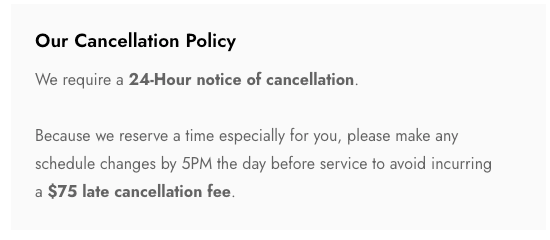
Boardwalk Cleaning Co’s cancellation policy is listed on their company’s terms of service web page.
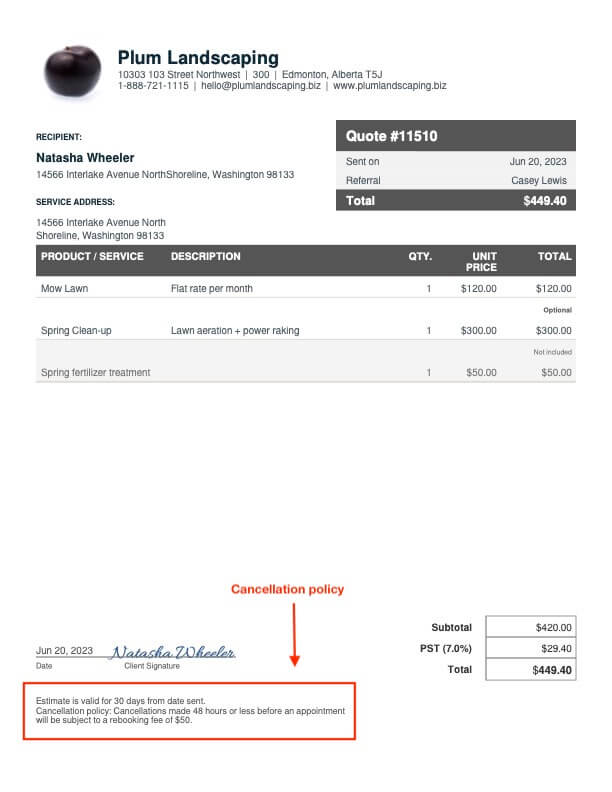
3. Cancellation policy on a quote example
You can also include your cancellation policy in the notes section at the bottom of your service quote.
How to prevent cancellations
The best way to avoid a missed appointment or cancellations is to get ahead of them. These are a few ways to prevent last-minute cancellations:
- Use an appointment reminder template to send reminder emails or texts to let clients know about an upcoming service call.
- Automate service reminders to stay top of mind with your customers.
- Set up appointment confirmation emails to send to your clients to avoid delays and prevent you from dealing with an empty calendar.
- Collect a deposit upfront to ensure your customer is invested in completing the job before it starts.
- Offer flexible booking options that make it easy for clients to book appointments when it works best for them.
- Create a company cancellation policy to deter clients from canceling in the first place.
- Offer customers a chance to reschedule at the time of cancellation instead of removing the appointment entirely.
You want to follow up with those people, not just the day before, but throughout the process of getting to the actual job.

You can use field service management software like Jobber to automate client communications like appointment reminders and confirmations. This can help you prevent cancellations and keep a fuller schedule.
Originally published in June 2023. Last updated on February 26, 2026.