How Much to Charge For Lawn Mowing in 2026: Pricing Charts and Formula

Key takeaways:
Here’s what you need to know about how much to charge for lawn mowing in 2026, with key pricing charts, formulas, and proven strategies for profitable, competitive lawn care service estimates.
- Know the typical price range. Lawn mowing services generally cost between $50–$250 per visit, depending on lawn size, location, and included services. Full-service maintenance jobs with edging and cleanup can reach $125–$450.
- Use pricing charts for accuracy. Average prices scale with property size—from $25–$60 for a quarter-acre up to $1,300 for 10 acres. Other common services like aeration, fertilization, and cleanup also have established price ranges you can reference.
- Apply a proven pricing formula. Calculate your price as: labor costs + material costs + (overhead + equipment costs) + profit margin. Be sure to account for all expenses, desired markup, and prevailing market rates.
- Choose the best pricing model. Flat-rate, hourly, per-square-foot, and hybrid models each fit different job types. Recurring service packages create steady revenue and improve route efficiency.
- Consider all price-impacting factors. Adjust for grass height, obstacles, terrain, frequency, and travel distance. Build a pricing sheet to ensure consistency and help manage negotiations or discounts.
Stay ahead in the lawn care industry—get expert tips and resources delivered right to your inbox with the Jobber Newsletter. Sign up here.
On average, you can charge between $50 and $250 to mow a lawn in the U.S. If the service includes lawn maintenance, like edging and clipping removal, you can charge between $125 to $450.
But figuring out how to price lawn mowing jobs can be tricky. You need to make sure you cover your costs, stay competitive with other lawn care providers, and profit from every job.
We’ll break down the costs of the most common lawn care services in the pricing chart below and explain the key factors to consider when pricing jobs accurately.
Learn how to price lawn care services:
-
How much to charge for mowing lawns
- How much to charge for other lawn care services
-
How to price lawn care services using a formula
-
Lawn care pricing models
-
When to adjust your lawn care service pricing
-
Factors that affect lawn mowing prices
-
How to make a lawn care pricing sheet
-
Lawn care pricing mistakes to avoid
In this episode of Ask a Business Mentor, lawn care business owners share proven tips to help you price your services like a pro.
How much should you charge for mowing lawns?
On average, you can charge between $30 and $65 per hour for lawn care, or $50 to $250 per lawn mowing service. If you’re pricing by lawn size, your average lawn mowing cost can be anywhere from $0.01 to $0.06 per square foot.
If you’re mowing large lawns, your rates can be between $150 to $200 per acre. However, that per-acre rate will decrease with larger jobs, especially if you can save time by using a riding lawn mower.
Use this chart to estimate your mowing pricing by lawn size:
| Lawn Size | Average Price |
|---|---|
| ¼ acre | $25–$60 |
| ½ acre | $50–$75 |
| ¾ acre | $100–$150 |
| 1 acre | $150–$200 |
| 2 acres | $250–$350 |
| 3 acres | $350–$500 |
| 4 acres | $400–$600 |
| 5 acres | $450–$650 |
| 10 acres | $500–$1,300 |
My business transformed when I started paying myself a set amount every single month because I realized I have to start charging my customers a lot more.

How much to charge for other lawn care services
Here are the average prices for common lawn care services you may offer:
| Lawn Care Service | Average Price Per Job |
|---|---|
| Aeration | $140 |
| Fertilization | $275 |
| Weed removal | $95 |
| Mulch service | $180 |
| Grass seeding | $1,082 |
| Leaf removal | $376 |
| Yard cleanup | $360 |
Remember, your pricing should take into account your costs (labor, materials, and overhead) and how much other lawn care businesses are charging in your area.
How much to charge for yard cleanup
You can charge customers anywhere between $200 and $600 for yard cleanup service, $40–$80 per hour, or $0.02–$0.10 per square foot. Pricing will vary depending on the yard size, amount of work, and customer’s location.
For yard cleanups, consider charging hourly and pricing each job individually. A small yard can require more labor than a larger property if it’s overgrown or filled with debris.
If there’s no additional work required, here’s how much you should charge for a lawn care or spring cleanup based on the yard size:
| Yard Size | Price Range |
|---|---|
| ⅙ acre | $150–225 |
| ⅕ acre | $175–$275 |
| ¼ acre | $225–$400 |
| ½ acre | $430–$700 |
| ¾ acre | $650–$800 |
| 1 acre | $850–$1,100 |
Here’s how much you should charge for individual spring cleanup services, including leaf removal and debris or grass clippings:
| Service Name | Price Range |
|---|---|
| Shrub trimming | $5–$20/bush |
| Garden clean-up | $45–$75/hour |
| Weed control | $50–$150 |
| Yard debris removal | $5–$10/bag |
| Tree debris removal | $100–$300+ |
| Mulch clean-up | $100–$350 |
| Flower bed clean-up | $100–$500+ |
| Leaf removal | $190–$600 |
| Tree trimming/pruning | $270–$1,400 |
How much to charge for lawn aeration
The average cost of lawn aeration service is roughly $75–$205 for a 10,000-square-foot yard, or $0.03–$0.05 per square foot. For smaller yards, you can charge $0.10–$0.35 per square foot.
| Lawn Size | Average Price |
|---|---|
| 500 sq.ft. | $50–$75 |
| 1,000 sq.ft. | $100–$350 |
| 5,000 sq.ft. | $125 |
| 10,000 sq.ft. | $175 |
| 20,000 sq.ft. | $350 |
| 1 acre | $480–650 |
| More than 5 acres | $2,400+ |
Pro Tip: Some lawn care companies charge different prices per increment. For example, they might charge $0.30 per square foot for the first 1,000 square feet, then drop the price to $0.05 per square foot for every additional thousand.
Aeration costs can depend on many factors, including:
- Lawn size
- Grass conditions
- Climate and location
- Aeration type (core vs. liquid aeration)
- Full lawn maintenance cost, if you include aeration in your service package
Charge differently for your aeration service if you’re using core aeration versus liquid aeration. Here are typical costs for different types of aeration and why they vary:
- Core aeration: $75–$250 per 10,000 square feet. You can charge less for your service if you own an aerator machine, which costs $200–$300 (or $80–$120 a day to rent). These machines have cylindrical prongs that pull pieces of grass, thatch, and soil from the ground.
- Spike aeration: $40–$250 per 10,000 square feet. Best for smaller lawns that you can easily walk across, a lawn aerator isn’t as effective as core aeration but works well for overseeding and fertilizing.
- Liquid aeration: $80–$150 per 10,000 square feet. You can charge less for this service because you’ll only need a bottle of liquid solution to aerate soil, instead of a machine. Liquid soil loosener costs $25–$60.
How much to charge for grass seeding
On average, you can charge $1,082 to seed or reseed a customer’s lawn, or between $0.09 to $0.18 per square foot. Use this pricing chart as a guide:
| Lawn Size | Price Range |
|---|---|
| 500 sq.ft. | $50–100 |
| 1,000 sq.ft. | $100–$200 |
| 2,000 sq.ft. | $200–$400 |
| 3,000 sq.ft. | $300–$600 |
| 4,000 sq.ft. | $400–$800 |
| 5,000 sq.ft. | $500–$1,000 |
| 1 acre | $3,000–$5,900 |
| 2 acres | $6,000–$11,800 |
| 5 acres | $15,000–$17,700 |
Along with your location, lawn size, and labor, there are two main factors that impact how to price your seeding services: type of grass seed and seeding method.
The grass type can affect your pricing, depending on growing conditions and maintenance requirements. For example:
- Fescue grass seed is good for shady spaces and typically costs $3 per pound. Expect to pay $30 to seed a new 1,000-square-foot yard, or $15 to reseed the same yard.
- Bahia grass seed grows best in hot climates and can withstand drier conditions. It costs $10 per pound, so you’ll pay $100 for seeding or $50 for reseeding.
The seeding method you use can also affect overall service pricing because of the equipment or labor involved. Here’s how to price each different type of seeding method, depending on the lawn size:
- Pricing for aeration and overseeding can range from $0.10 to $0.35 per sq.ft.
- Pricing for hydroseeding typically ranges from $0.08 to $0.20 per sq.ft.
- Pricing for power or slice seeding can range from $0.09 to $0.18 per square foot.
How much to charge for lawn fertilization
On average, you can charge $225 for lawn fertilization service. The cost for lawn fertilization is between $72 and $377, depending on the size of the lawn and the fertilizer you use.
Here’s what you can charge to help your clients maintain a green, healthy lawn:
| Lawn Size | Price Range |
|---|---|
| 500 sq.ft. | $10–$40 |
| 1,000 sq.ft. | $20–$80 |
| 2,500 sq.ft. | $50–$200 |
| 5,000 sq.ft. | $100–$400 |
| 7,260 sq.ft. (⅙ acre) | $250–$350 |
| 8,700 sq.ft. (⅕ acre) | $275–$375 |
| 10,900 sq.ft. (¼ acre) | $300–$400 |
| 14,500 sq.ft. (⅓ acre) | $350–$450 |
| 21,800 sq.ft. (½ acre) | $400–$500 |
| 32,700 sq.ft. (¾ acre) | $450–$550 |
| 43,500 sq.ft. (1 acre) | $500–$600 |
To choose how much you should charge for a fertilizer application, calculate the cost of the lawn fertilizer you’ll use for the job based on the square footage of the lawn.
A 50-pound bag of lawn fertilizer costs $110–$350+, depending on the type of fertilizer, what it’s made of, and what benefits it provides. This should cover up to 15,000 square feet of grass.
For the average 10,000-square-foot lawn, your fertilizer costs could be $72–$231. Make sure to include the cost of your fertilizer in your estimate.
Pricing commercial fertilization jobs
For commercial or large-scale jobs, your fertilizer supply costs might be higher than your labor costs, unlike for your other lawn maintenance services like frequent mowing and grass trimming.
Once you add up your total fertilizer costs and labor costs, add markup to your cost estimate so you can cover your supply expenses and turn a profit on your lawn service job.
How to price lawn care services using a formula
If you’d prefer to price out your own services, here’s a lawn mowing pricing formula to follow:
Lawn mowing price = Labor costs + Material costs + (Overhead + Equipment costs) + Profit margin
We’ll walk through each part of this formula step by step so you can confidently calculate accurate, profitable prices for every mowing job.
Pro Tip: If you offer the same services as another lawn care business, avoid pricing more than 15% higher than their rates. That’s usually the tipping point for potential customers to choose the cheaper option.
1. Calculate the cost of labor
The cost of labor is the cost that it takes people to actually go out and do the project.
To calculate your labor costs, multiply the total labor hours you’ll need (for each lawn care professional on the job) by your hourly labor cost (all those employee’s hourly wages plus labor expenses).
Your labor costs also include your employees’ hourly wages, taxes, workers compensation, and any other employee-related expenses.
Let’s say your client has a half-acre yard, which should take one employee three hours to mow and fertilize. Adding up the employee’s $16/hour wages, taxes, and other expenses, your total cost of labor is around $22/hour—$66 in total.
READ MORE: Types of grants for starting a lawn care business
2. Define your material costs
For services that require specific materials (like fertilizer, grass seed, or mulch), you’ll want to incorporate those costs into your overall lawn care prices.
Here’s how you can accurately estimate material costs:
- Measure the client’s lawn so you know the exact square footage
- Calculate how much lawn treatment product you’ll need to purchase (e.g., fertilizer, weed killer, mulch, liquid aerator)
- Document your expenses when you buy new products using expense tracking software so you can price future jobs faster (and file your taxes more accurately)
Continuing our example above, say your client’s lawn needs fertilization, too. You’ll need to add $300 for fertilizer. Combined with your labor costs, that brings your subtotal to $366.
The cost of material is all of the material that’s gonna be installed. The cost of overhead is everything else that it takes to run your business.

3. Determine your overhead costs and expenses
Overhead costs are everything that keeps your lawn care company operating. That includes things like:
- Office space
- Computers, tablets, or phones
- Small business insurance
- Fuel costs for company vehicles
- Advertising or marketing expenses
- Equipment maintenance and repairs
After adding up all of your overhead costs for the month, divide that amount by the number of working hours each month to get your hourly overhead cost. Then multiply that by the number of hours a job will take to complete.
Take our lawn care and fertilization example. If your hourly overhead is $45 and the job requires three hours of labor, your overhead cost for this client’s lawn care will be $135. Your subtotal is now $501.
You need to make sure that you’re covering your rent, your licensing, your insurance, the trucks, the gas, the consumables, the shirts, business cards, marketing efforts, absolutely everything.
That all goes into the overhead, and that’s something that a lot of people don’t take enough time to analyze.
4. Set your profit margins
Your lawn care profit margin is the amount you take home after you’ve covered your labor, materials, and overhead costs. The higher your percentage, the more profitable your lawn care business will be.
Let’s say that your costs for a half-acre mowing and fertilization job are $501. If your goal profit margin is 20%, you’ll need to charge at least a $125 markup (25% of your costs) to meet that margin.
That will give you an overall cost (including profit) of $626 for the job.
You figure out how much expenses you have, and then you figure out how much money you wanna make, and then you charge the difference. It’s that simple.

5. Build recurring packages
Recurring services are ideal for clients who want repeat lawn care visits. For your company, they also improve route efficiency, create predictable revenue, and help you stay profitable.
To get started with recurring packages, offer weekly or biweekly mowing frequency at a set per-visit price. You can offer a slightly reduced rate for this package to encourage sign-ups.
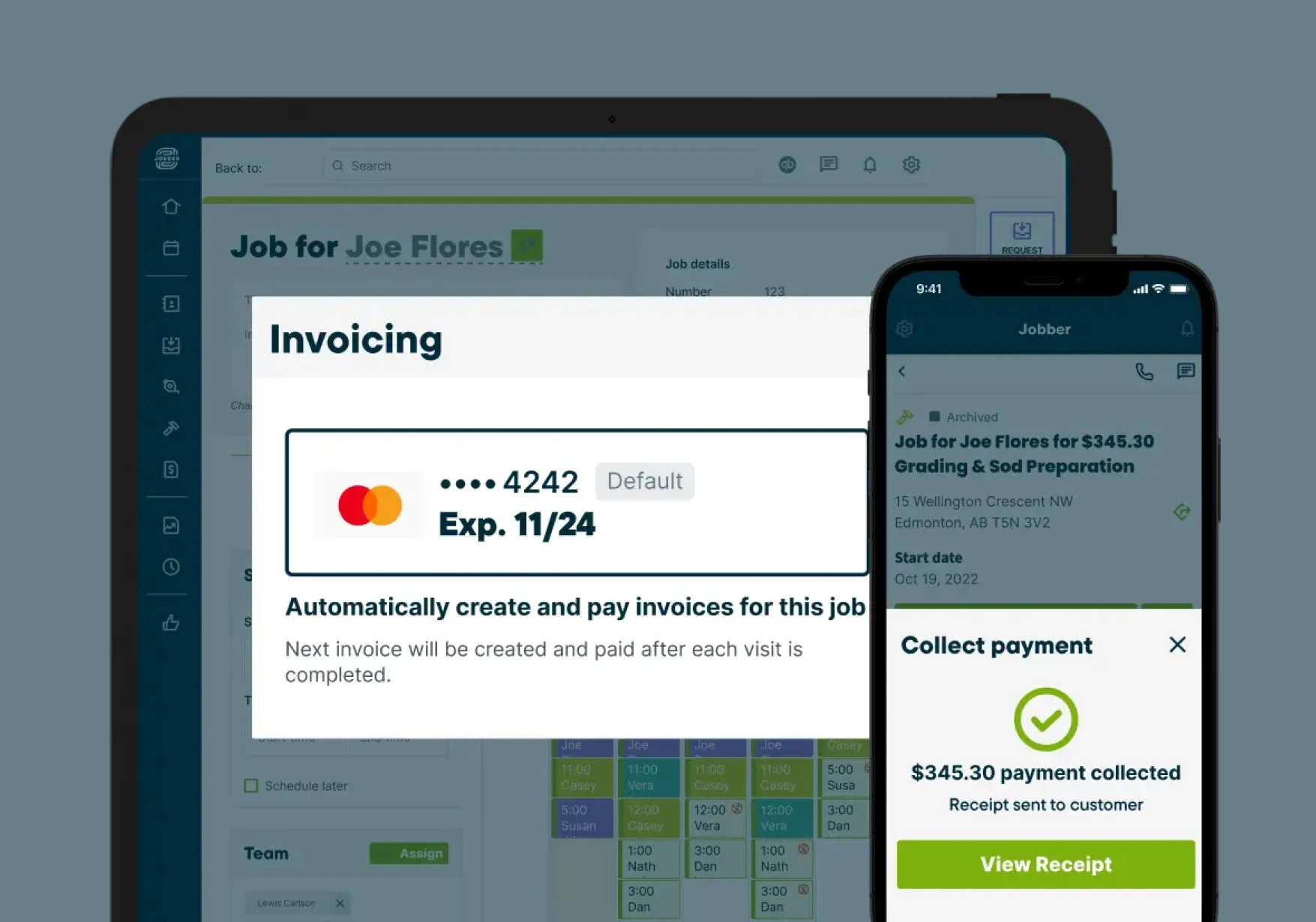
Pro Tip: To collect payments faster, use Jobber to get paid automatically after each lawn service job. With saved cards on file, you’ll get paid instantly, and your customers won’t have to hunt for invoices or tricky payment steps.
6. Review pricing yearly
Review this pricing formula at least once a year to account for changes in fuel costs, labor rates, equipment maintenance, and business expenses. According to Jobber’s 2026 Home Service Trends Report, 65% of the over 1,000 home service business owners surveyed raised their prices in the past year—most citing inflation (72%) and rising labor costs (50%) as the driving reason.
Notably, only 42% of business owners in their first few years of operation adjusted their pricing, suggesting that underpricing is one of the most common mistakes newer businesses make.
When you regularly update your pricing, you can ensure that your lawn care services stay profitable as operating costs increase. Not sure how to communicate the change to customers? See our guide on how to write a price increase letter.
Lawn care pricing models
There’s no single way to price lawn care services. Most lawn care businesses choose a pricing model based on the services offered, how predictable the work is, and whether there are any special incentives at play.
A typical lawn care company can choose from the following pricing options:
Hourly pricing
Hourly pricing works best for unpredictable or one-time jobs. This applies to overgrown lawns, seasonal yard cleanups, or first visits where you can’t accurately estimate completion time.
| Pros | Cons |
|---|---|
| • Protects your business from underpricing unknown jobs • Simple to calculate and adjust • Works well for irregular or one-off lawn care services | • Customers may prefer more predictable pricing and timing • Becoming faster and more efficient won’t increase revenue • Harder to estimate final job cost upfront |
To set hourly pricing, calculate your target hourly rate by factoring in labor, fuel, equipment costs, overhead, and desired profit margin.
Flat-rate pricing
Flat-rate pricing is ideal for recurring lawn care services like weekly or biweekly mowing where each job is predictable and clear.
| Pros | Cons |
|---|---|
| • Predictable pricing for customers • Faster quoting and scheduling • Increased profit as crew gets more efficient over time | • Incorrect estimates can reduce profit • Requires accurate job timing data • May need adjustments for difficult properties |
To set flat rate pricing, first estimate how long the service typically takes. Then, apply your hourly production rate, and convert that into a fixed per-visit price. Adjust pricing based on lawn condition, potential issues, and travel time.
Per square foot pricing
When lawn size is the main factor affecting job time, many lawn care businesses calculate how much to charge for lawn mowing per square foot. You can use a simple per-square-foot pricing model for mowing, fertilization, or treatment services.
| Pros | Cons |
|---|---|
| • Consistent and scalable pricing • Easy to standardize quotes • Prevents underpricing larger properties | • Lawn condition and complexity may vary • Requires accurate measurements • May still need manual adjustments |
To calculate, measure the lawn area or group properties into size tiers (such as small, medium, and large). Apply a consistent price per square foot or per size category, then adjust for terrain, slopes, or landscaping obstacles.
Hybrid pricing
Hybrid pricing combines multiple models. It’s a popular choice for growing lawn care businesses because it captures the best of both worlds—recurring maintenance and specialty services.
The hybrid approach works best for companies that provide routine mowing alongside occasional one-time or seasonal services like aeration, hedge trimming, or yard cleanups.
| Pros | Cons |
|---|---|
| • Flexible across lawn care service types or mowing jobs • Maximizes profitability • Supports business growth and service expansion | • Requires clear and transparent pricing systems • Slightly more complex to manage • Needs consistent quoting and follow-up |
To make hybrid pricing work for you, use flat-rate or lawn-size pricing for routine mowing, hourly pricing for unpredictable work. Then, use project pricing for seasonal or add-on services. This approach allows flexibility while maintaining consistent profit margins.
How to price lawn care with Jobber
Jobber makes it easy to create professional lawn service quotes quickly, customize them, and send them to customers by text or email for faster approval.
With lawn care quoting software, you can:
- Personalize the quote design with your logo, service details, and photos so estimates look polished and professional.
- Add markups automatically to protect your profit margins.
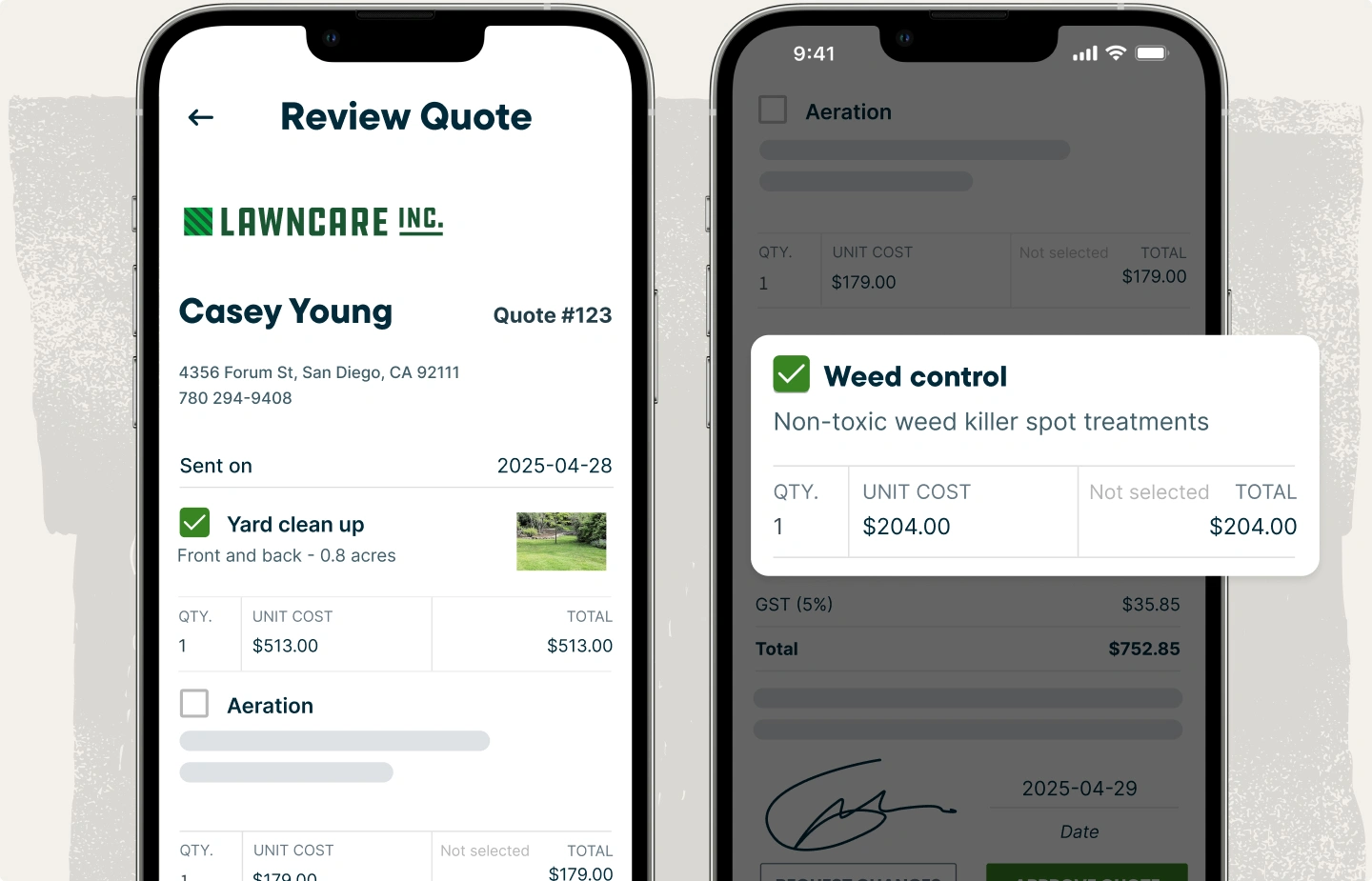
- Include optional line items for add-ons like fertilization or hedge trimming so customers can easily upgrade their service.
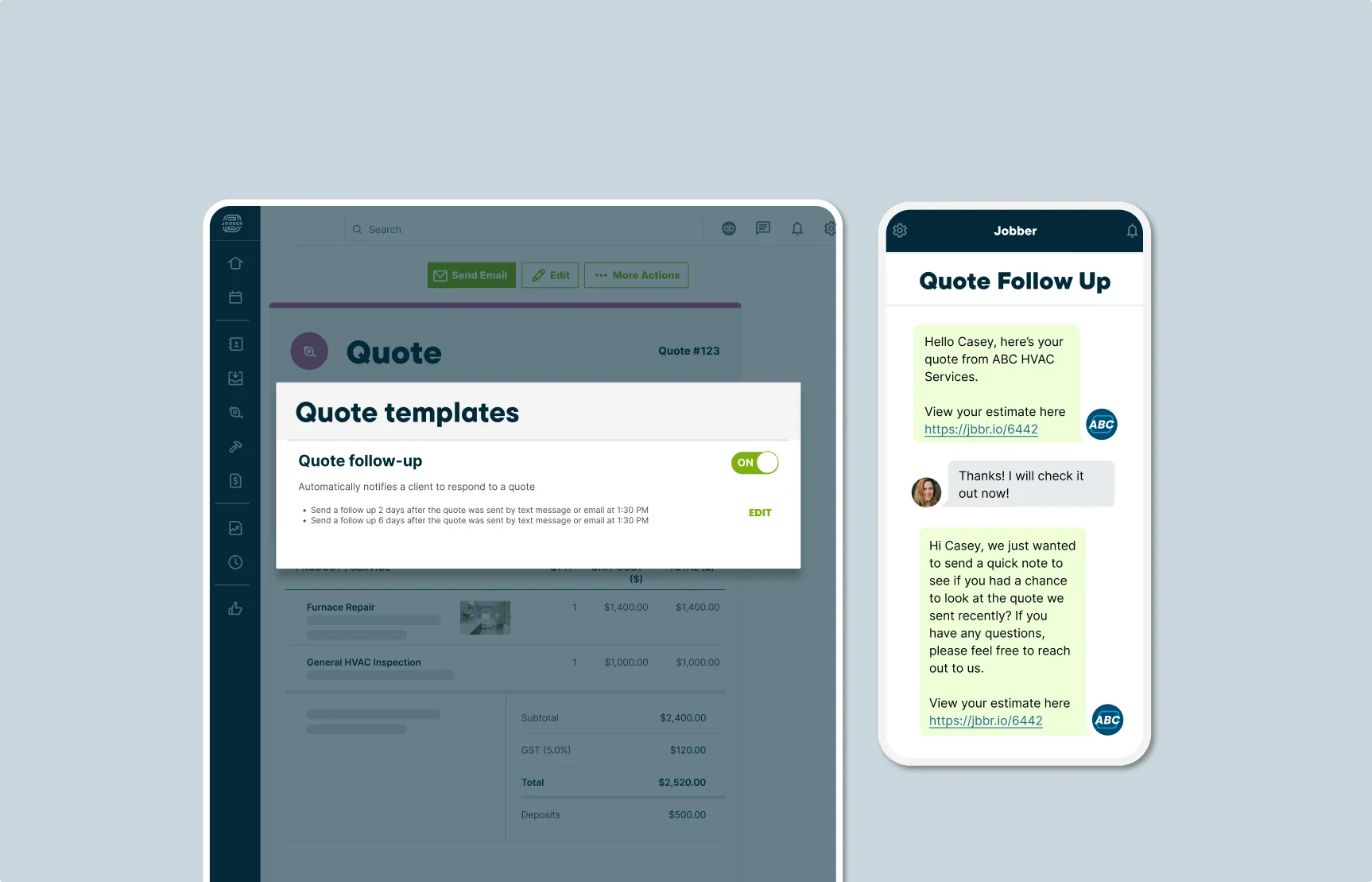
- Automate quote follow-ups to remind customers about pending estimates and help convert more quotes into scheduled jobs.
When to adjust your lawn care service pricing
As a lawn care professional, your hourly rate and service rates may change over time—and adjusting them is more common than many business owners realize. According to Jobber’s 2026 Home Service Trends Report, 65% of the over 1,000 home service business owners surveyed raised their prices in the past year. Among the most successful, fully-booked businesses in the survey, 91% had raised their prices.
Here are specific scenarios when it makes sense to adjust your pricing:
- A job is out of your normal scope and requires more work than your initial terms of service stated.
- The job site is farther away so your gas mileage is higher than usual.
- You want to target specific neighborhoods by offering a group rate.
- The job or client has specific needs outside of your usual scope (e.g., the yard is in rough shape or the client needs a job done with short notice).
- You want to offer discounts or special rates for marketing promotions.
READ MORE: How to write a price increase letter for customers [free template]
How you interact will help you dictate and understand if you can raise your price, or if you’re losing them and you’ve gotta lower your price.
You absolutely charge differently depending on who the client is, depending on the time of the year, and the speed at which the client needs you.

Factors that affect lawn mowing prices
Understanding what impacts lawn mowing costs helps you create more accurate quotes. At the same time, you’ll be able to protect your profit during the highs and lows of each year in business.
Several factors directly influence how you price lawn mowing services, including:
- Grass height and lawn condition: Overgrown or poorly maintained lawns require slower mowing, extra passes, and sometimes additional equipment. First cuts or neglected properties might require a higher price tier.
- Terrain and accessibility: Slopes, uneven ground, tight gates, fences, and landscaping obstacles can slow down crews and increase labor time. You might also need smaller equipment or manual trimming where the access is difficult.
- Obstacles and landscaping features: Trees, flower beds, playground equipment, and hardscaping increase trimming and edging time. Work these obstacles into your estimated time.
- Service frequency: Weekly mowing usually costs less per visit than biweekly or monthly service because grass stays manageable. Infrequent service often requires more time and effort.
- Travel distance: Properties located farther outside your normal service area increase fuel costs and reduce route efficiency. Some businesses add travel fees or zone-based pricing adjustments to make up for extra distance.
Accounting for these factors ensures your lawn mowing prices reflect the true time and effort required while keeping your services profitable as your schedule grows.
How to make a lawn care pricing sheet
A lawn care pricing sheet lists the costs of all your services. It helps you keep your pricing consistent across all jobs. When you’re estimating a job, you can look at this sheet and get a base estimate to build on.
Create a lawn care price sheet once you know how much you want to charge for each service. This should include your most common services and yard sizes so you have consistent pricing to refer to when selling your lawn services and making lawn care estimates.
Here’s an example of a basic lawn care pricing chart:
| Lawn care service | Price |
| Mowing | $100 |
| Thatching | $170 |
| Fertilization/weed control | $125 |
| Leaf blowing | $295 |
| Debris removal | $175 |
Here’s an example of a basic lawn care package, priced by square footage, that includes regular mowing, aeration, and fertilization:
| Square footage | Price |
| 1,500 | $180 |
| 2,500 | $300 |
| 5,000 | $600 |
| 10,000 | $1,200 |
A lawn care pricing chart can also help you respond to clients looking for discounts or negotiated rates. You’ll be able to see how much wiggle room you have, if any, before changing your rates too drastically.
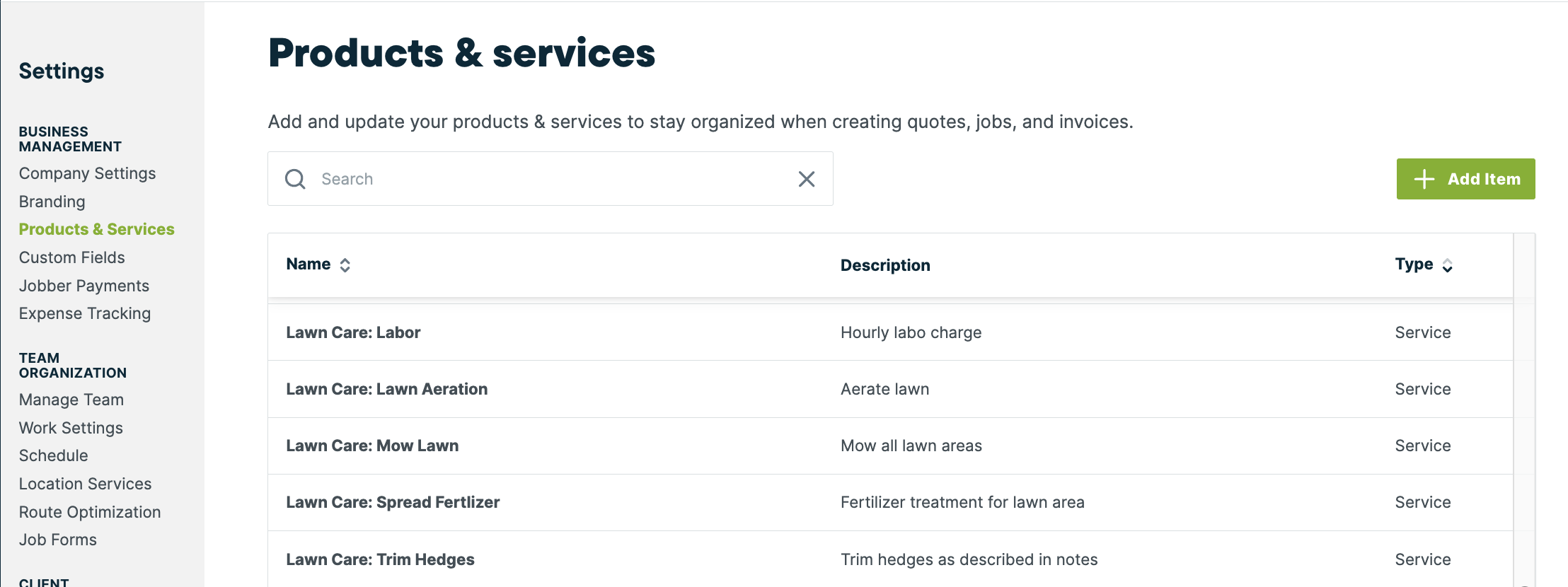
Pro Tip: Keep a digital version of your pricing sheet to speed up quoting and invoicing. When you use Jobber as your lawn care business software, you can add a products and services list and quickly add them as line items on your quotes.
How long is this job gonna take me? This job’s gonna take 10 hours. Our rate’s 100 dollars per man hour. Boom, that’s a thousand-dollar job. That’s easy math.

Your lawn care business will make more money if you estimate your costs accurately and keep a pricing chart so you can quote jobs consistently.
Setting your lawn care pricing isn’t a one-and-done job. Revisit your pricing strategy at the start of every season to take into account changes in labor rates, and raising material and fuel costs.
Lawn care pricing mistakes to avoid
Pricing mistakes can quietly reduce profit, even when the lawn care pros on your team have a full schedule.
Avoid these common lawn care pricing mistakes to ensure every job supports sustainable business growth:
- Copying competitor pricing: Matching another company’s prices doesn’t account for your labor costs, equipment expenses, or profit goals. Build pricing around what your business needs to operate sustainably.
- Forgetting to follow up on quotes: Set up automatic email or text reminders so customers don’t forget. Use Jobber’s automated quote follow-ups to turn approved jobs into scheduled work.
- Skipping a minimum service price: Small properties still require travel and setup time. A minimum stop rate helps ensure every visit remains profitable.
- Not adjusting for lawn complexity: Lawns with slopes, obstacles, fencing, or heavy landscaping often take longer to service. Pricing should reflect the actual effort required. If you think a customer will want more services, be sure to include optional markups for them to approve during the initial quote.
- Forgetting to review pricing regularly: Costs like fuel, labor, and maintenance change over time. Reviewing pricing each season helps protect your margins as your business grows.
- Not using lawn care quoting software: Manual estimates can lead to inconsistent pricing, missed details, and slower response times. Lawn care quoting software like Jobber helps you build accurate quotes quickly, keep pricing consistent, and send estimates to customers on the spot.
Avoiding these common pricing mistakes makes it easier to send accurate quotes, protect your profits, and run a successful lawn care business.
Originally published in April 2021. Last updated on March 11, 2026.
Frequently Asked Questions
-
Flat-rate pricing works best for recurring lawn care because customers know exactly what they’ll pay each visit. Some lawn care businesses calculate jobs using an internal hourly rate, then present a flat price to simplify quoting and scheduling with customers.
-
A minimum stop rate is the lowest amount you charge to service any property, regardless of lawn size. It ensures travel time, fuel, and setup costs are covered so that small jobs remain profitable.
-
Competitor pricing doesn’t always reflect your unique labor costs, equipment expenses, or profit goals. Instead, price services based on what your business needs to earn to stay profitable and grow sustainably.
-
No. Most lawn care businesses use pricing tiers based on lawn size ranges instead of unique prices for every property. Standardized tiers, such as ¼ to ½ an acre, make quoting faster and give customers a price that’s competitive and fair for their lot size.
-
That depends on how often you provide service. Just multiply your pricing model by the number of visits you provide, and that’s your monthly cost of landscape maintenance.
For example, say you charge $50 per visit to mow a client’s lawn. Assuming four visits per month, the client is paying $200/month—plus any additional services they need, like aeration. -
A good rule of thumb is to review pricing at least once per year. This ensures that rates reflect changes in fuel, labor, equipment maintenance, and local market conditions.
Even if you don’t raise prices every season, an annual review keeps your pricing competitive while protecting your profit margins as your business grows.