
Key takeaways:
If you want to quickly get more tree work, there are actionable marketing ideas you can use right away to attract customers and grow your tree service business.
- Start with a focused marketing strategy. Identify your target customers, understand your competition, set clear goals, and track the results of your efforts to avoid wasted time and money.
- Build and promote a professional brand. Stand out with a unique business name, a memorable logo, clean equipment, and excellent communication, showing customers that you’re trustworthy and easy to work with.
- Establish an online presence. Create free, easy-to-set-up profiles on Google and Facebook, and build a simple, informative website that showcases your services, credibility, and makes it easy for clients to contact or book you.
- Leverage referrals and reviews. Encourage satisfied clients to refer your services and leave online reviews, boosting your reputation and helping new customers trust your business faster.
- Stay visible with targeted outreach. Use email marketing to keep in touch with clients and promote seasonal services, and try Google Local Service Ads for fast, cost-effective lead generation.
- Join professional associations. Membership in industry groups like TCIA or ISA can add credibility and help you network with potential clients and other professionals.
For more tips to grow your business, sign up for the Jobber Newsletter. Join here.
Marketing is how you attract new business, keep your schedule full, and ultimately grow a profitable tree service—no matter how busy or competitive your market is.
In this guide, you’ll find 13 actionable marketing ideas specifically for tree services. Learn how to build a stronger presence in your community, generate consistent leads, and turn more of those leads into jobs.
Try these tree service marketing tactics:
-
Create a tree service marketing plan
-
Define your tree care brand
-
Create a professional tree service website
-
Apply the SEO basics to your website
-
Set up your Google Business Profile
-
Get new leads with Local Services Ads
-
Collect a steady stream of online reviews
-
Start a customer referral program
-
Win repeat customers with email marketing
-
Train your field technicians to sell
-
Ask permission to leave a lawn sign
-
Partner with landscaping companies
-
Register with the Tree Care Industry Association
1. Create a tree service marketing plan
You wouldn’t take down a tree without a plan, and the same goes for marketing. Having a clear strategy gives you direction, prevents you from wasting money, and ensures every effort supports your long-term goals.
To create your marketing plan, answer the following questions:
Who is your ideal customer?
Are you targeting homeowners worried about storm damage or property managers looking for regular maintenance? Knowing your customers helps you choose the right marketing method to reach them.
Maybe your best customers are in older neighborhoods with large trees. Or maybe they’re HOAs that need ongoing trimming contracts.
Who is your competition, and what sets you apart?
At its core, marketing is about convincing buyers to choose you. The competition can be local companies or larger ones with a more expansive presence, so make sure you know:
- Who they are
- What services do they provide
- What are their strengths and weaknesses
- What sets you apart
Do competitors focus on removals while you specialize in preservation or quick storm response? Maybe you’re known for spotless cleanup or safe crane work. Those details matter when explaining why clients should call you instead of someone else.
What are your marketing goals?
You might want to:
- Book more jobs during slow months
- Turn one-time removals into repeat maintenance clients
- Land more commercial contracts
- Build a reputation strong enough to earn subcontracting work
Each goal shapes how you promote yourself, whether that’s running local ads or sending seasonal reminder emails. Once you know what you’re aiming for, choose the tactics that directly support that goal. For example:
- Sending email reminders to win repeat clients
- Asking satisfied homeowners for reviews to strengthen your online reputation
- Running targeted local ads to bring in more off-season work
How will you measure what works?
Always track where new leads come from. This can be as simple as adding a “How did you hear about us” field on your work requests.
This way, you’ll know whether that lawn sign, Google ad, or $4,000 truck wrap paid off. Or if your top-paying customers all came from one very happy referral.
Tree service marketing vs. advertising
One mistake small businesses make is confusing marketing and advertising.
Marketing is the process of determining your service’s value and how to market it to the public.
It includes all the paid and unpaid methods you can use to promote and differentiate your business, from your pricing to your customer service.
Advertising is just one branch of marketing. Advertising means paying to get your message in front of your target customers.
Since marketing is the foundation of growing your tree service, we recommend starting with one or two tactics at a time.If you’re ready to try advertising, check out our roundup of tree service ad ideas.
2. Define your tree care brand
This might not sound like marketing, but your brand influences whether new customers will choose to work with you.
Your brand should communicate that you are professional, trustworthy, and easy to work with for tree care businesses.
A professional brand includes:
- A unique, recognizable tree service company name
- An official logo you can use on work trucks, uniforms, and invoices
- Clean work trucks and equipment
- Excellent communication skills
- Processes that make it easier to work with you, like online quoting and accepting multiple payment types
Setting these standards early on will help you get more tree work with the customers you want.
READ MORE:Jobber’s guide to building a brand
3. Create a professional tree service website
Your website is a place for you to tell new clients who you are, what you do, and how you can help them. Clients can also use it to book work online, approve quotes, or pay invoices.
Finally, and more importantly, your website positions you as a professional.
It makes you more trustworthy, shows clients that you take your business seriously, and shows that you’re easy to work with.
That’s why you need to create a tree service website that includes:
- Who you are and what services you provide
- Your certifications and tree service insurance numbers
- Photos of your team and your work
- An online booking form and client hub
How to get started:
Building a website might seem overwhelming, but it doesn’t have to be. If you’re looking for an easy way to get online quickly, you can simply add your business details to a Jobber Website and get your business online in minutes.
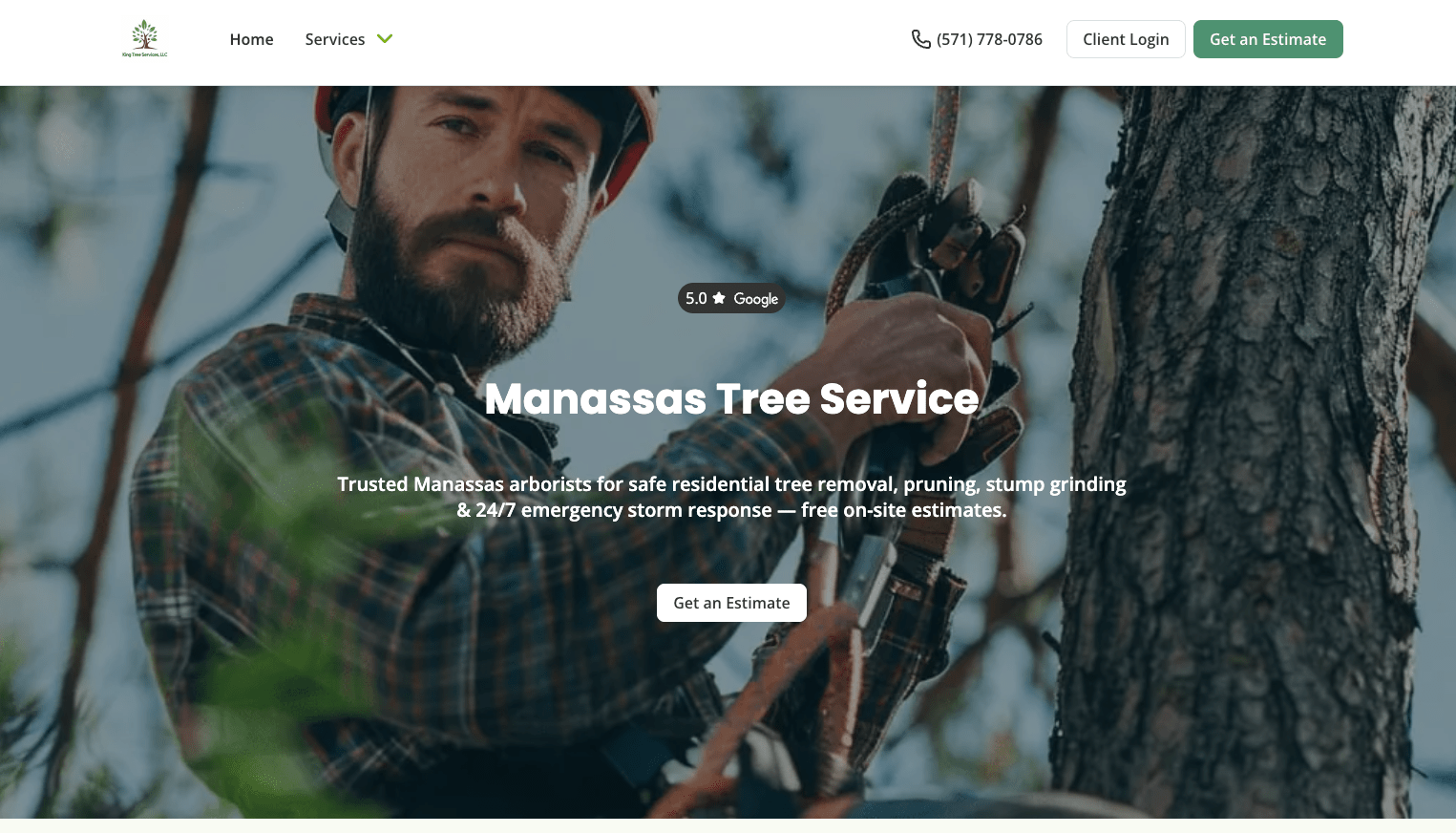
Simply provide Jobber with details about your business and tree services you offer. We’ll create a website that shows off what sets you apart from the competition.
To help you convert visitors into leads, your site automatically comes with a quote request form and an AI receptionist to chat with visitors, answer questions, and even book jobs while you’re busy.
You can even measure the success of your site directly in Jobber by tracking how much traffic your site is getting and how many requests are coming from it.
Mistakes to avoid:
- Using low-quality or outdated photos. Blurry pictures or shots of half-finished jobs can make visitors question your professionalism.
- Leaving out certifications, insurance info, or service details. People want proof that you’re qualified and safe to hire.
- Making it hard for visitors to contact you. If they can’t easily find your phone number or a booking form, they’ll move on.
4. Apply the SEO basics to your website
Search engine optimization (SEO) is a tree removal marketing strategy that helps improve the visibility of your website on Google and other search engines.
The goal is to rank as high as possible in Google Search for the keywords that are most relevant to your business. After all, you want folks who are searching “tree removal near me” or “stump grinding in [city]” to land on your pages—not your competitor’s.
How to get started:
- Use the right keywords. Work phrases like “tree trimming” and “[city] arborist” into your homepage, service pages, and meta tags. These are the search terms that homeowners actually type when they’re looking for a service company.
- Show important information. List your company name, address, and phone number on every page. This makes it easy for site visitors to contact you, and it helps with local SEO.
- Make it mobile-friendly. Many people search for help while on their phone, so your site should be easy to use on those devices. They might even be standing in their yard, looking at a fallen tree, when they land on your site.
- Keep your content fresh and helpful. Blog about seasonal care tips, like when to prune or how to spot disease. This keeps your site relevant and positions you as a local expert.
Blooma Tree Experts in Seattle is one example of a website that does the basics of SEO well, showing contact information, using keywords, and much more:
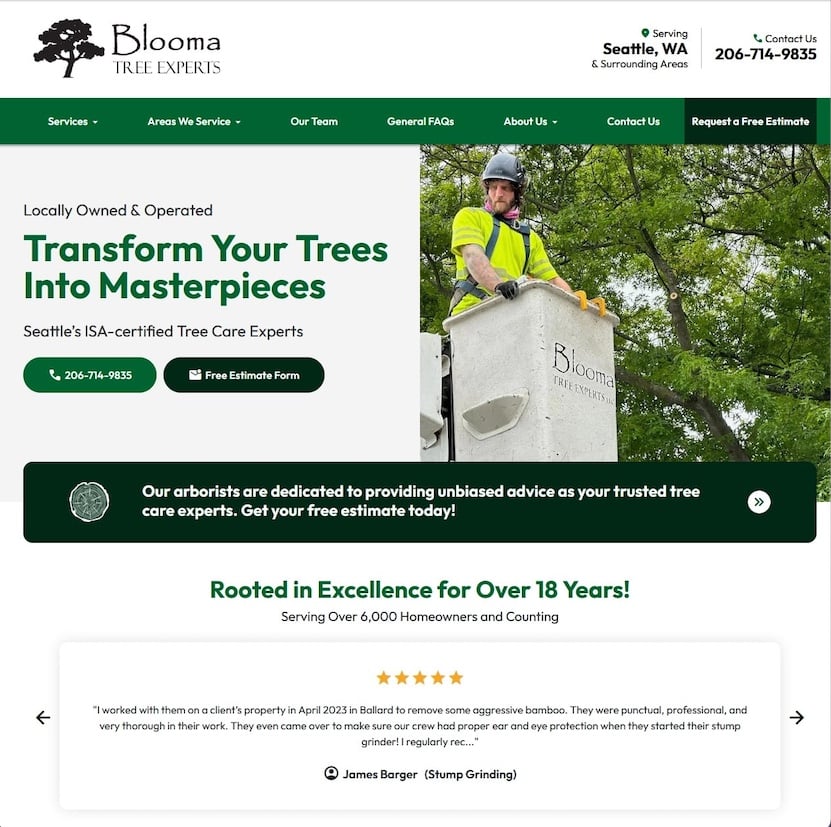
They also appear on the first page of Google’s search results when you search “tree experts in Seattle, Washington”.

Pro Tip: Jobber Websites come with built-in SEO that boosts your spot in search results.
Mistakes to avoid:
- Cramming your site with keywords. Keep it natural and conversational.
- Using vague phrases like “best tree service” unless you back them up with real proof, such as reviews, awards, or certifications.
- Forgetting to update old content. If it still mentions last year’s hurricane cleanup special, visitors might think you’ve gone dark.
- Not fixing broken links or slow-loading photos. While minor, these things can still hurt your rankings.
5. Set up your Google Business Profile
Your Google Business Profile (GBP) is the business listing that appears in Google Search and Maps when customers look for tree services in their area.
This profile is often the first impression of your business, with details like your business name, hours, reviews, and even photos of your crew in action.
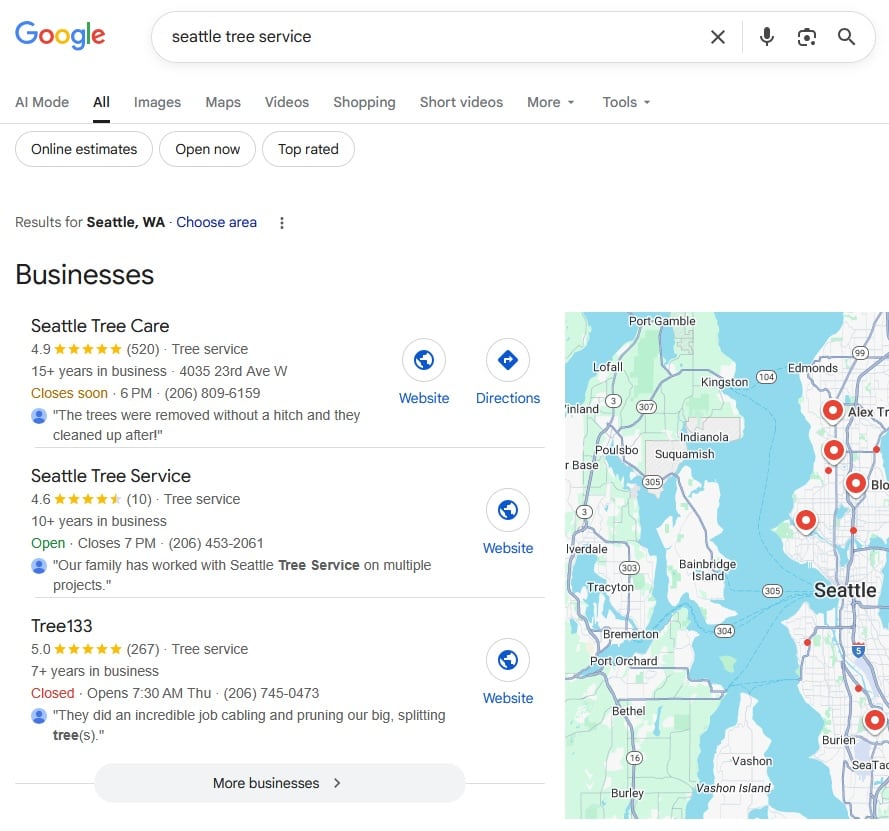
It’s a free, easy way to increase your online visibility. And it’s one of the most popular (and effective) tree service digital marketing strategies for local businesses, as 72% of consumers go to Google Search first to look up local business information.
How to get started:
- Claim or create your profile
- Enter your business details, including your business name, phone number, address, website, and hours. If you have emergency hours for handling storm calls, note those too.
- Choose relevant categories like “Tree service,” “Arborist,” or “Stump removal service.”
- Add photos of your team, trucks, and before-and-after shots
- Use posts to highlight seasonal deals (like a discount on winter pruning) or show off a removal you recently completed
- Encourage happy customers to leave a review
Metrics to track:
Check out the performance data section in GBP to see how well this channel is working for you. Look at:
- Number of profile views and searches
- Clicks for website visits, calls, and directions (if you have an office)
- Quantity and rating of customer reviews
6. Get new leads with Local Services Ads
Technically, this is an advertising method, but if you need to get more tree work fast, this can be a cost-efficient way to dip your toes into ads.
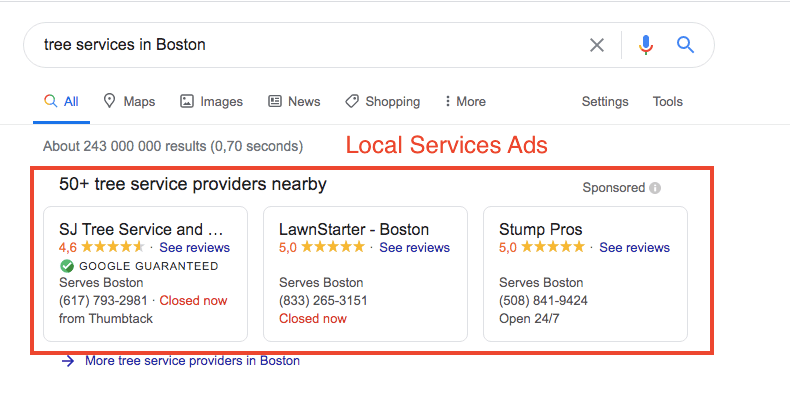
Google Local Services Ads, or LSAs, are paid ads that appear at the very top of Google search pages when someone is searching for a local business. For example, if someone searches for tree services in Boston, they may see the following:
How to get started:
- Set up an LSA account and verify your business
- Complete a background check and license verification
- Set your service areas and budget for leads
- Create your ad profile showcasing your services, reviews, and credentials
- Monitor leads directly on the LSA platform. For best results, you’ll want to respond quickly.
You can also connect Jobber with Google LSA. Leads from LSA will show up in Jobber automatically, so you can respond quickly, send a quote, and book the job from one place, faster than competitors who are bouncing between apps.
Metrics to track:
- Number of leads generated: Tells you how many people reached out directly from your ads
- Cost per lead: Shows how much you’re paying for each call or message
- Lead response time: LSAs reward you for responding quickly. Fast replies help you rank higher.
- Conversion rate: Measures how many LSA leads turn into paying jobs
- Profile views: Indicates how many people clicked into your LSA profile to look at information like reviews, services, and credentials
- Ad impressions: Shows how often your ad was shown to prospective customers
Mistakes to avoid:
- Skipping the verification steps. Google’s checks can take time, but without completing them, your ad won’t run.
- Letting leads sit. These customers are ready to book right away, and not replying quickly enough could result in the customer hiring someone else who was more timely.
- Forgetting to update your info. If your service area changes or your hours shift for storm season, keep your profile up to date so Google connects you with the right jobs.
- Ignoring reviews. The placement of your LSA factors in how often and how well you respond to customer feedback.
7. Collect a steady stream of online reviews
Online reviews have a huge influence on your business growth. When homeowners choose a tree company, they look for proof that you’re reliable and worth the money. Positive reviews can help new customers feel confident that you’ll show up on time and do the job right.
But many tree service businesses don’t bother to ask for one after a job is complete. If you don’t ask for reviews, you won’t get them.
Plus, on Google, the number and quality of reviews are both factors in how well you rank in map listings.
For a keyword like “Seattle tree service,” the business Seattle Tree Care ranks #1 in the map, partly because they have more reviews than many competitors. The customer ratings are high (4.9 average), and some of the reviews even contain images:
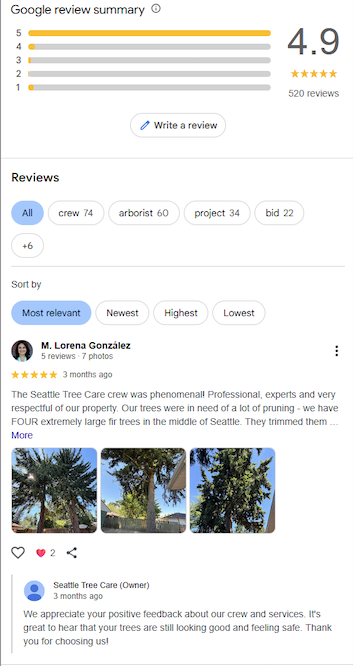
Reviews are always very important to have. That is usually one of the first things clients are looking for is a good reputation online.
How to get started
To ensure you ask every satisfied customer for a review, set up automatic review collection in Jobber. Jobber automatically sends a text to the customers you want reviews from.
When you make an invoice in Jobber, you can choose if you want to send the customer a review request.
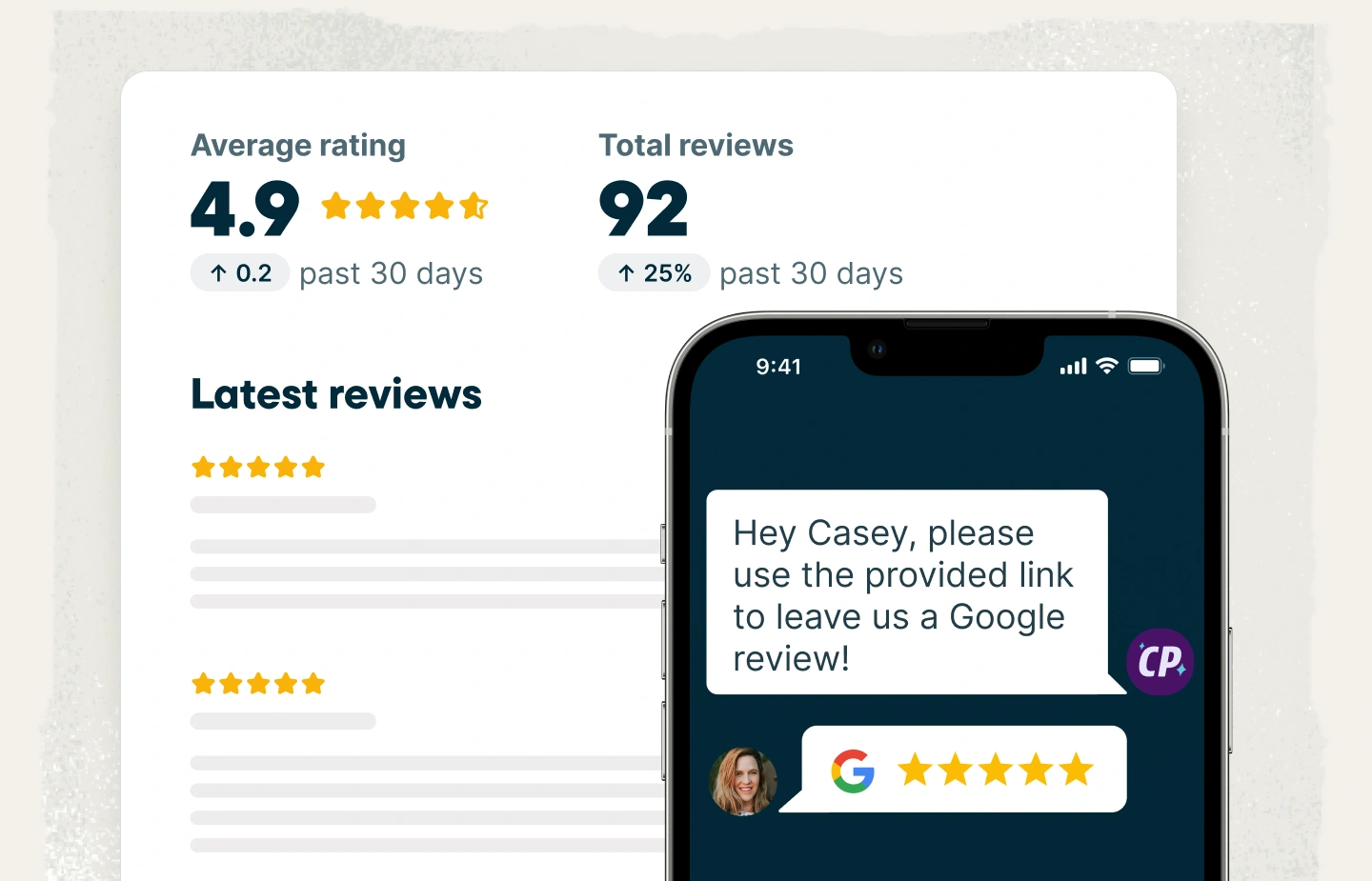
After paying their invoice, those customers will automatically get a direct link to leave a review on your Google Business Profile.
From your reviews dashboard in Jobber, you can keep an eye on your average Google rating. You’ll also see your latest reviews and resources on managing your business’s reputation.
8. Start a customer referral program
The tree service industry is based on trust. 82% of consumers say they trust referrals from people they know, and referred customers are four times more likely to make a purchase..
A customer referral program encourages your existing customers to recommend your services to other people they know. Of course, you can’t just hope customers will refer to you on their own. You need to offer the right incentives and make it easy for clients to refer family and friends.
We focus a lot on developing our relationships with our clients so that they’re giving personal referrals.
Our client base is a little older, and sometimes it’s hard for them to engage online, so we rely mostly on personal referrals.
To encourage your clients to share a referral, here are some incentives you could offer:
- A $50 discount on the client’s next tree trimming or pruning service
- $50 in cash for every closed sale the client refers to you
- Entry into a draw for a grand prize, like a $100 gift card to a restaurant in town
How to get started:
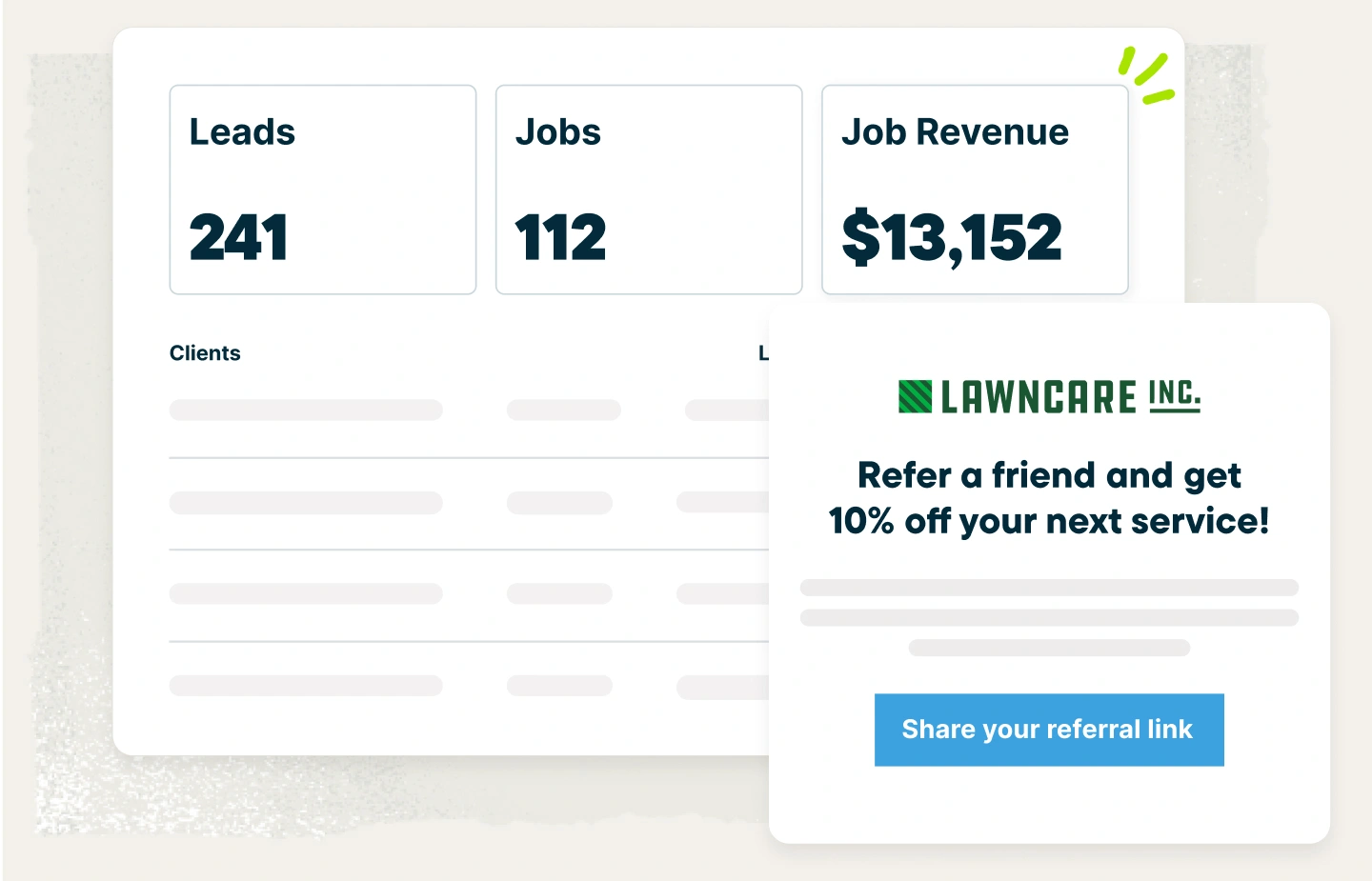
Jobber makes it easy to launch a referral program that runs itself. Promote your referral program with automated referral requests after a job is completed. Then, reward customers for bringing in new business with a referral credit that’s automatically applied to their next invoice.
You’ll be able to see how many new leads and jobs came from referrals, how much revenue they’ve generated, and which customers are your top referrers.
Metrics to track:
- Number of referrals received
- How many referrals turn into booked jobs
- Cost per acquired customer through referrals
- Repeat referral activity by individual customers
Mistakes to avoid:
- Offering rewards that don’t move the needle. If the incentive isn’t worth the effort, people won’t bother mentioning you.
- Not looping in your crew. Your field team talks to homeowners every day. They’re in the perfect position to remind customers about your referral offer.
- Losing track of who referred whom. Keep notes or use simple CRM software to record referrals and rewards that get paid out. Avoid frustrating customers by following through.
- Missing the moment. The best time to ask for a referral is right after a successful job, whether on the spot or as a follow-up.
9. Win repeat customers with email marketing
Because tree care is often a seasonal service, email marketing is a great way to stay in touch with customers year-round and encourage them to book work early.
You can use email marketing to stay top of mind with existing customers, promote new services or discounts, and increase sales.
How to get started:
- Map out your messages. Not every email you send to your email list needs to be a sales message. Mix in short updates about recent jobs or safety tips for homeowners, as educational content keeps people engaged between busy seasons.
- Add real value. Every email should give the reader something useful, like a limited-time coupon, a pruning checklist, or advice on preventing storm damage.
- Segment your audience. Splitting your email list into groups lets you tailor messages to the right people. Maybe one group is residential clients, and another is commercial property managers.
- Write subject lines that grab attention. A boring headline will get skipped over. Instead of “Spring discounts,” go with something like “Ready for greener growth? Get 15% off trimming this month!”
- Play the long game. Not everyone will book right away. Keep showing up with relevant, timely content (without being annoying) so that when they eventually do need help, your name is already familiar.
To send effective marketing emails faster, use a tool that prepares email templates and audiences for you.
When you use Jobber to create email campaigns, you can choose from premade templates that are built for specific goals and customers—and that includes your company branding.
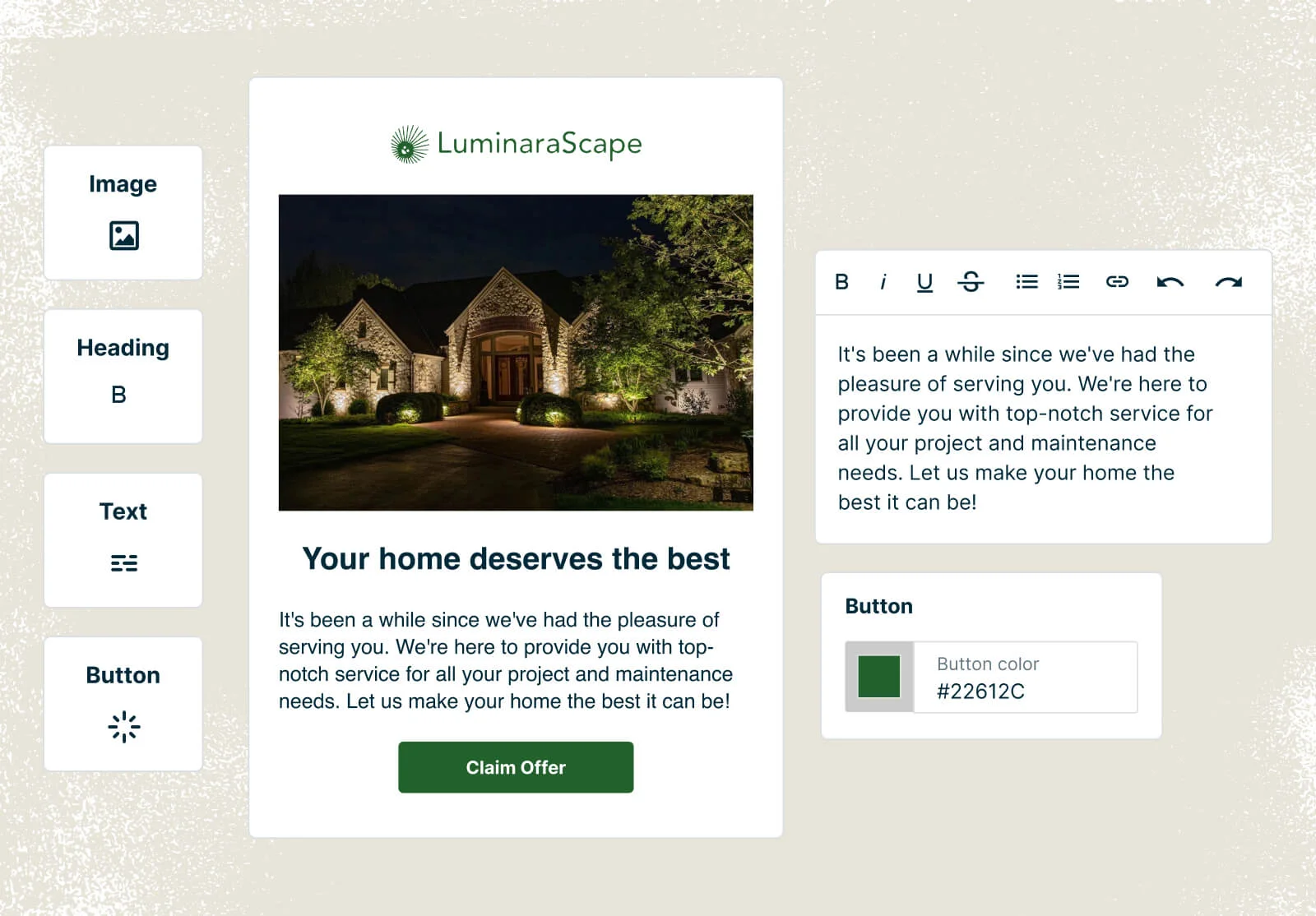
After editing the email with details on your tree care services, you can edit your client segments. This means you can choose what group of clients you want to email—like all clients or past clients.
You can even select clients using tags, job history, or by a particular service you provided.
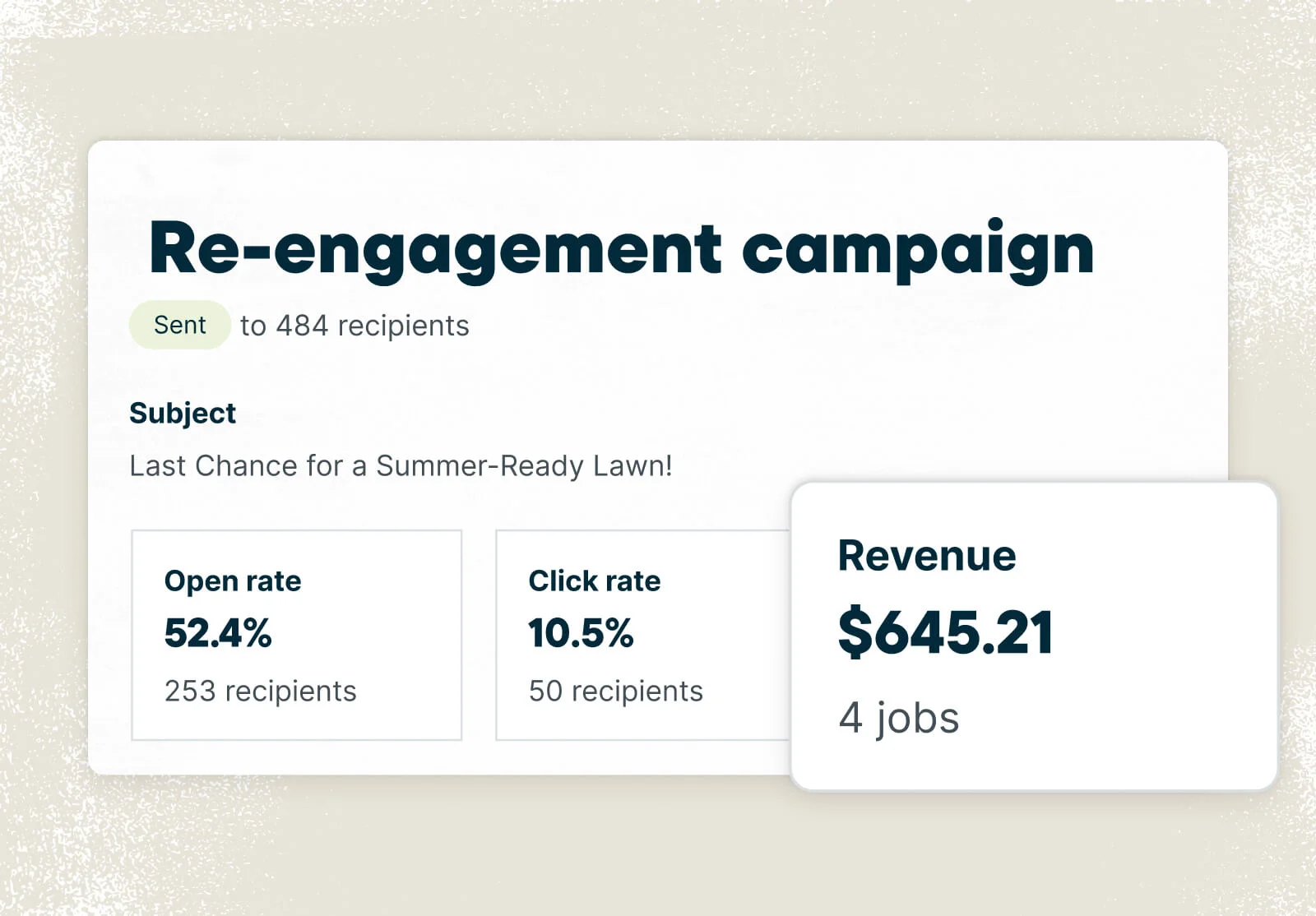
Then, track your success over time from a simple dashboard. For every campaign you send in Jobber, you’ll see the number of customers who opened the email, clicked on a link, or converted into a job.
Metrics to track:
- Open rates to gauge interest in your subject lines
- Click-through rates to measure engagement
- Conversion rates to determine how many recipients request a quote or book a service
- Unsubscribe rate. If lots of people are unsubscribing, this might indicate your messages are off-target or too frequent
Mistakes to avoid:
- Sending the same cookie-cutter message to everyone
- Ignoring customer history or seasonal needs
- Flooding inboxes with too many emails
- Forgetting to include a clear “Call now” or “Request a quote” link
10. Train your field technicians to sell
Your crew is already out there face-to-face with customers every day, which is the perfect setting for turning quick chats into booked work.
Start by focusing on listening and empathy. A homeowner might say, “I just want that limb taken off,” but they might also be worried about it falling on their roof. When your field tech responds with understanding and says something like “I get that, and here’s how we can make sure your home is safe,” they instantly build credibility.
That human connection makes all the difference in getting more tree service leads from satisfied, trusting customers.
Next, give your crew a balanced mix of technical expertise and sales confidence. They should understand basic arboriculture so they can explain why a tree needs trimming instead of removal (or vice versa). Pair that with knowing the pricing so they can present options clearly.
We prune trees and that’s our biggest income. And the secret there is making sure that we teach our employees what every tree is, how it grows, what its natural architecture is, and what it needs to be.
One easy structure to teach is the LAER communication model:
- L: Listen to what the customer says (and what they don’t say)
- A: Acknowledge their concern
- E: Explore the situation by asking questions and suggesting fixes
- R: Respond with a confident recommendation and next steps
Finally, don’t forget to train everyone to follow up and handle objections. If a homeowner says they need to “think about it,” that’s not a dead lead. It’s an opening to check in later and turn that hesitation into a yes.
11. Ask permission to leave a lawn sign
After a job wraps up and everything’s cleaned up, take a moment to ask the customer if you can leave a small sign near the curb to help local homeowners know who did the work. Some people won’t mind giving you some free exposure when the yard looks great.
A homeowner down the street who’s been meaning to remove a dead tree might finally make the call after seeing your name. That’s how grassroots tree service marketing works—authentic visibility right where your potential customers live.
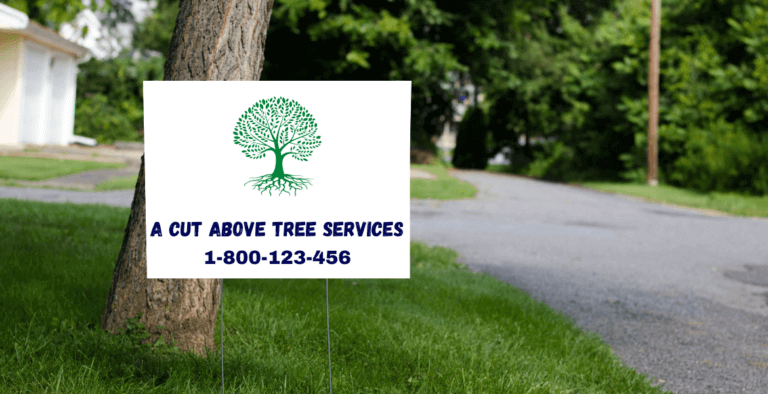
The design of your lawn sign should be clean and easy to read from the road. Include:
- Your company name and logo
- A phone number or website
- A short call to action, like “Call for a free tree inspection”
The success of many service businesses is driven by trust and local presence, and these small signs can reinforce your reputation.
12. Partner with landscaping companies
Ever had a landscaper call you when something’s not in their wheelhouse, like a diseased tree that needs to be removed before they can regrade a yard? Forming partnerships with landscaping companies in your area can turn into a steady pipeline of leads. It’s one of the most cost-effective ways to market a tree service business.
You can take it a step further by bundling services or co-marketing together. For example, you could team up for a “Spring yard refresh” campaign, where your business handles pruning and removals, while the landscaper takes care of planting and maintenance.
Keep the relationship active by:
- Checking in every so often to stay top-of-mind and make sure their crew knows you’re available
- Swapping leads to show goodwill, strengthen trust, and encourage them to return the favor when their customers need tree work they don’t handle
- Offering small referral incentives, like $50 cash for every booked referral, or a thank-you lunch now and then
13. Register with the Tree Care Industry Association
Becoming a member of the Tree Care Industry Association (TCIA) or the International Society of Arboriculture (ISA) boosts your credibility.
Industry accreditation tells potential clients you’re a legitimate business run by highly trained arborists who follow tree care best practices. It also gives clients peace of mind knowing you’re insured should anything happen on the job.
Once registered, let your clients know by adding the TCIA or ISA logos to your website, participating in local trade shows and events, and sharing your tree care expertise through your newsletter, website, or in person.
In short, be the tree care expert your customers are looking for.
Attract more tree care customers with Jobber
Attract more customers with tools that make you look like the pro you are.
Jobber’s Marketing Suite helps you bring many of these tree service marketing tactics together to build a strong reputation that attracts more customers and secures more work with less effort.
Here’s what’s included in Jobber’s Marketing Suite:
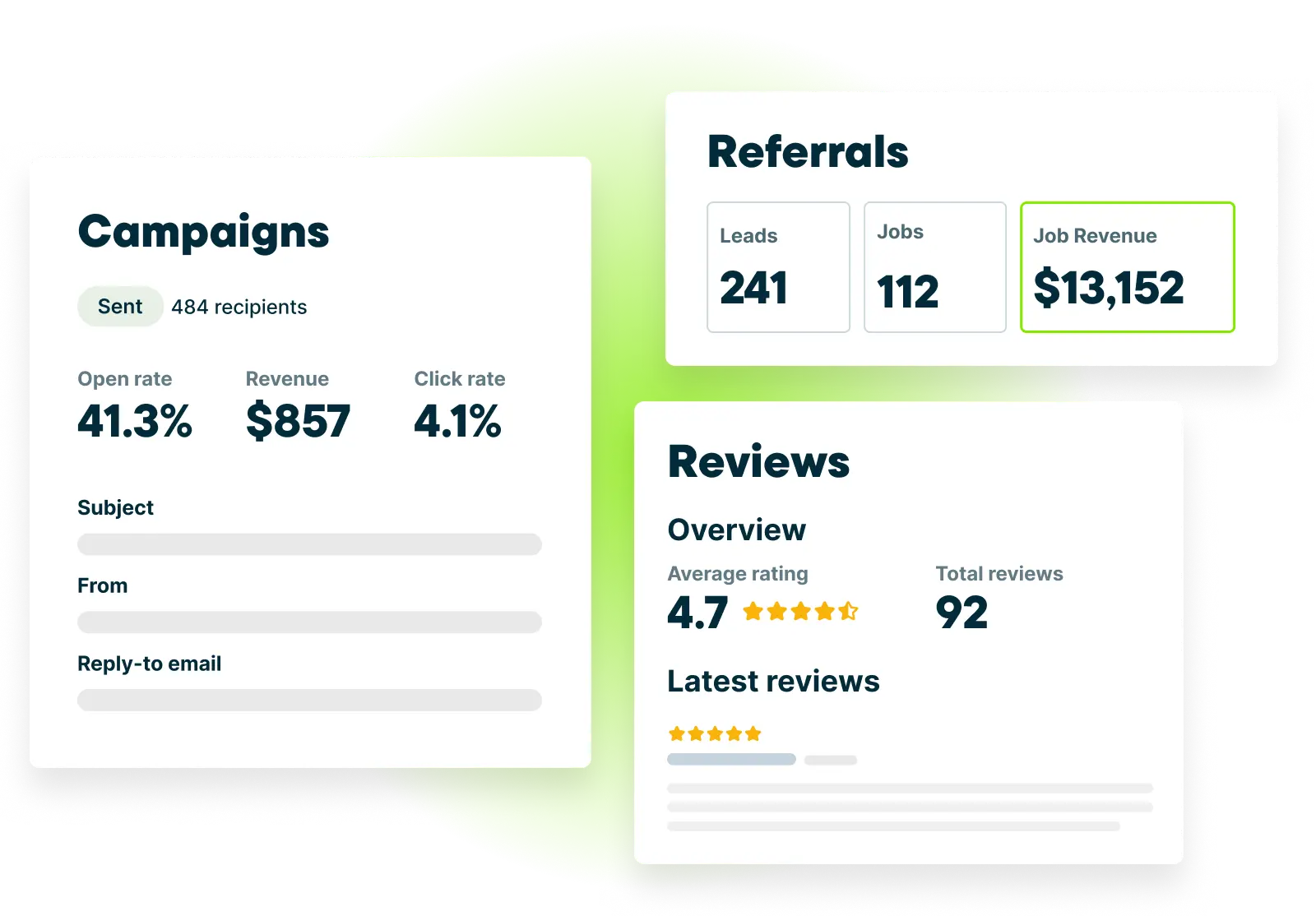
- Reviews: Give your online reputation a boost by collecting more Google reviews through automated review requests.
- Referrals: Simplify the referral process with a fully automated referral program, making it easier for customers to send new business your way.
- Campaigns: Increase sales with a user-friendly email marketing tool that turns old customers into new revenue.
Choose a couple of the marketing ideas in this article that support your goals. For example, if your marketing plan calls for boosting new leads, you might start with Local Service Ads and optimize your Google Business Profile.
If your focus is getting more repeat work, your best bet might be doing email marketing or training technicians to identify add-on opportunities.
Whatever tactics you pick, check in on how each performs. Look at where your leads come from, what’s converting, and what isn’t. Then adjust your approach to keep your tree service business growing.
Originally published in May 2020. Last updated on November 20th, 2025.