
Key takeaways:
Boosting your HVAC sales in a competitive market comes down to smart strategy, effective training, and customer-focused processes.
- Develop a documented sales strategy. Identify your target market, clarify your product positioning, and set achievable sales targets to keep your team focused and accountable.
- Hire dedicated comfort advisors. Bringing in experienced salespeople allows your technicians to focus on technical work while ensuring customers receive expert sales consultations customized to their needs.
- Train your team for consultative selling. Offer ongoing training on your products, handling objections, consultative selling techniques, and effective closing skills to create a confident, customer-centric sales force.
- Use templates for quotes. Streamline your sales paperwork with pre-made templates, allowing your team to create professional estimates quickly, improving efficiency and consistency.
- Leverage customer service phone scripts. Well-crafted phone scripts help technicians and advisors engage customers at key touchpoints, build trust, and increase sales opportunities and referrals.
Stay ahead in the HVAC industry with more tips and insights—sign up for the Jobber Newsletter. Subscribe here.
Originally published in May 2018. Last updated on August 22, 2025.
You’ve probably heard stories of HVAC business owners bringing in millions in revenue every year. The difference between those companies and the ones still struggling often comes down to one thing—sales.
The biggest players in the HVAC industry didn’t get there by chance. They got there by using expertly trained sales reps and well-researched sales strategies.
Do what those companies did years ago—create and document a sales strategy. Then train your technicians and sales staff on how to sell HVAC systems.
In this guide, you’ll get practical HVAC sales tips and ready-to-use customer service call scripts to sell more systems and drive serious growth.
Tips and scripts to grow your HVAC sales:
1. Develop your HVAC sales strategy
Many business owners dive head-first into sales without preparation. Some push their technicians and installers to start selling in the field with little to no training.
Avoid this unprofessional approach to sales. It stretches your techs too thin, and inexperienced selling is often aggressive and frustrating to HVAC customers.
The most successful HVAC businesses have a careful, detailed sales strategy.
To manage your sales more effectively, take a few days to develop a sales strategy that outlines your:
- Target market (who you’re selling HVAC services to)
- Product positioning (how you’ll communicate the value of your equipment and services)
- Sales targets (concrete goals you’re working towards)
Target market
Have a solid understanding of your target customers and document it. If your HVAC business plan doesn’t outline this already, write out your ideal customer’s age range, average annual income, and the services they usually need.
This information will help you tailor your sales conversations, materials, and the services you offer—one of the most effective sales techniques for reaching the right customers.
For example, if you’re selling to young new homeowners, you’ll likely want to highlight the energy efficiency and cost-savings your HVAC systems provide.
Product positioning
Plan how you’ll “position” what you offer—that is, how you’ll describe it to your customers—before you create sales materials and train your sales staff.
To do so, assess the unique needs of your customers and service area. Are your target customers more concerned with speed of service, energy efficiency, or cost?
For each of your offerings, write out a statement that describes its unique selling point—this should be the benefit that matters most to your target customers. For example, it could read something like this for your AC system installs:
“Our high-efficiency AC systems are designed to cut energy bills by up to 30% while keeping your home comfortable, even during the hottest summer afternoons.”
Bonus tip: Use this product positioning in your HVAC ads and other marketing materials.
Sales targets
Sales targets are specific goals that your sales staff need to achieve within a given time frame.
Setting clear sales targets gives your sales team something to work towards, and it’s how you or your sales manager will measure success.
- Start by looking at the short- and long-term revenue goals you want to achieve for your business overall.
- Then, set a target for each individual sales employee, like number of units sold or new contracts signed, that will ensure they meet those goals.
Dave Nichols, a Training Manager at Lennox Industries, suggests you measure an HVAC sales rep’s success by looking at average ticket price, closing rates, and annual sales.
Using those success metrics, here’s what your sales rep targets could look like:
- Sell 12 HVAC systems monthly
- Achieve an average ticket of $10,000
- Sell $64,000 in HVAC systems each month
- Achieve an average closing rate of 75%
- Hit $550,000 in annual sales
- Add $3,000 more revenue by Q3
2. Price competitively to win more business
Customers want the best price, but they also want the job done right the first time. The trick is finding that sweet spot where your pricing is sharp enough to win the work without trimming your profit too much.
That’s where this sales tip comes in—being strategic about your price.
- Start with some research. Call your competitors like a curious homeowner (or have a friend call them). Check competitor websites to see what others are offering, and at what prices. But don’t fall into the trap of “just going lower.” The goal is to be competitive while still covering your labor, equipment, and overhead.
- Sell the “why” behind your number. This can separate you from the rest. Offer a better warranty, faster response time, cleaner workmanship, or a free follow-up visit in six months. If a customer’s comparing you with the cheapest service in town, make sure they’re comparing apples to apples. The cheapest option often comes with callbacks and headaches.
- Make it crystal clear. Ever had a homeowner go silent after getting your quote? Break down your estimate so customers see exactly what they’re paying for—parts, labor, permits, and extras. Being transparent with your pricing builds trust, which can lead to repeat business.
- Think in packages. If someone’s booking a new system install in May, why not add a first-year maintenance plan? Bundling services makes the overall offer more attractive and increases your ticket size without feeling like a hard upsell. Homeowners love the idea of “set it and forget it” service plans—less to remember, and fewer surprises down the road.
- Handle price objections without flinching. When a customer says, “That’s more than I thought,” your first move should be to take them through the value they’re getting. Or you could offer a pared-down version of the work with fewer bells and whistles. This way, you’re protecting your margins rather than just lowering the price, and still giving the customer a path to say “yes.”
A lot of people get overzealous, especially when you’re negotiating a contract.
Say you’re doing something for over a hundred thousand dollars and someone asks you to knock five points off. That’s a couple thousand dollars. That’s a lot.
Here’s a checklist you can use before finalizing a quote to stay both competitive and profitable:
HVAC competitive pricing checklist
Research the local market
- Identify 3-5 local competitors
- Review competitor websites for advertised prices and service packages
- Call competitors as a mystery shopper to get actual quoted prices for standard services
- Note competitors’ advertised value propositions, like warranty or same-day service
- Note what’s included vs. extra in competitor quotes (e.g., permits, materials, follow-up)
Differentiate your offer
- Identify 1-2 value adds you can offer, such as a longer warranty or speed
- Prepare a one-line “why us” pitch emphasizing these points
- Make sure your value adds are meaningful to customers (tip: ask past clients for feedback)
Prepare a transparent quote
- Break out the quote into line items—parts, labor, permits, diagnostic fees, and extras
- Highlight any included add-ons, such as a maintenance plan or extended warranty
- Present the quote in an easy-to-understand format without jargon
Design flexible bundles
- Offer at least one package option, such as a full system install and first-year maintenance
- Price bundled offers so that they’re attractive but still profitable
- Give customers good-better-best proposal options to nudge toward higher-value packages
Prepare for price objections
- Think about 2-3 price objections you get most often
- Prepare a concise value-based response for each (not just a discount)
- Develop a pared-down scope of work if needed
Double-check profitability and consistency
- Ensure the final quote covers all costs and meets your desired profit margin
- Verify price consistency with similar past jobs for fairness and transparency
- Confirm that any special offers or discounts don’t undercut your bottom line
3. Equip your team with proven HVAC sales skills
Create and schedule training sessions that prepare your field techs, installers, and comfort advisors to have effective sales conversations.
In addition to understanding the HVAC services and products you offer, your sales staff should come out of your training program knowing how to:
- Talk about your products and communicate their value
- Use consultative sales to solve customer problems with your products
- Handle common objections from customers
- Close a sale (get the customer’s approval)
To train your field team and comfort advisors on all the above, include these sections in your HVAC sales training:
Product training
Your techs and installers are already experts in your HVAC solutions. But if you have comfort advisors, you need to get them up to speed.
In your initial training, give your advisors a detailed rundown of all the products and services you offer. Provide guidance on how to sell HVAC equipment effectively using the product positioning you prepared in your sales strategy.
Then, schedule a “refresher” training session every few months to keep them updated on new products and emerging HVAC industry trends. If your budget allows, you might even consider sending your team to an HVAC trade show or conference to keep their skills and product knowledge up-to-date.
Consultative sales
Consultative sales is a method where the salesperson acts as an advisor, focused on understanding and addressing the specific needs and challenges of the customer.
Instead of pushing a product, consultative selling is about building a relationship and offering tailored solutions.
Train your field team or comfort advisors in these two main components of consultative selling:
- Needs analysis — Asking the right questions to understand customer needs, preferences, and budget constraints.
- Solutioning — Using your customer’s answers to recommend the best HVAC solution for the customer’s problem.
Before you can recommend a system or schedule an install, you need to know what’s really going on. Understand the customer’s needs by:
- Asking open-ended questions: Go beyond “What’s the issue?” and ask the kinds of open-ended questions that get people talking, like “How has this problem been affecting your day-to-day?” You’ll be surprised how much you learn when you give them room to answer.
- Listening more than you talk: It’s tempting to jump in with solutions the moment you hear “no heat.” But slowing down to get the full story builds trust and helps you spot details you might otherwise miss. Maybe the homeowner is frustrated because they’ve had three repairs in the past year.
- Tailoring your solution: Once you’ve heard them out, you can tailor your solution so it feels less like a sales pitch and more like a custom fix. When the customer feels like you truly understand their situation, the “yes” comes naturally.
We just have to be curious and care. When I’m talking to a prospect, I really want to understand why they want to do something.
And then I have to care enough to give them the best solution for that.
If it’s in your budget, enroll your employees in an HVAC sales course by a trusted training provider like BDR or Lennox. These courses teach HVAC-specific consultative sales, objection handling, closing, and more.
Just make sure you still train your sales reps independently, so they understand your target customers and what your business offers.
Objection handling
Teach your team how to answer customers who say your prices are too high and other objections they might have.
Start by collecting insights from your field technicians. Ask your techs to share the most common objections they’ve heard in the field when talking to customers about investing in better HVAC systems.
Then, type up a list of these objections and work with your technicians and sales staff to come up with the best responses.
Borrow from these examples of objections and suggested responses:
- “I can’t afford this right now.” Explain how a high-quality HVAC system provides long-term cost savings and prevents other household problems. You can also offer financing to customers so they can pay in small installments.
- “I’m already with another HVAC company.” Ask them why they chose their current contractor, what’s working with that relationship, and what isn’t. Explain to them how you’re different.
- “I don’t want to get stuck in a contract.” This is usually a financial concern, so give options for month-by-month or quarter-by-quarter payment. Open the conversation to talk about payment terms and schedules that will work for the customer.
- “I have too much going on right now.” Be understanding and respond with something like: “for sure, I know it’s a busy time.” Offer to schedule a follow-up call a few weeks or months from now when their calendar clears up.
- “This sounds great, but I have to talk to my partner before making any decisions.” Let them know you understand that it’s out of their control. Say you’ll call in a couple of days to check in.
For many homeowners, the decision to move forward is often based on how to pay for it. That’s where financing and flexible payment options can be in your favor.
- Turn big installs into manageable payments. Break down high-ticket jobs into affordable monthly amounts (e.g., $8,000 becomes $200/month).
- Present financing options with your quote—not after the customer objects. It should feel like a standard part of your service, rather than something different you can offer to close the sale.
- Use clear, relatable language. Try something like, “Most of our customers choose the 60-month plan. It keeps their payments low and still gets them an efficient system.”
- Help them say yes now. Flexible payment options can reduce sticker shock and speed up the customer’s decision. All without cutting your margins.
Closing skills
Give your employees guidance on how to get the final “yes” from a customer, including how to read buying signals and close the sale without being pushy.
Often, the best way to make the sale is to act like your prospect has already signed off on the work. This way, you remove the opportunity for more objections.
Here are a few statements and questions your team can use to close a sale:
- If you’re ready to move forward, I can email you the contract and collect a deposit right now.
- Do you have your calendar available? I’ll be in your area this Monday, Thursday, and Friday—let me know which day would work best for you.
- What day would you like that scheduled on?
- Taking everything into consideration, I’d say either X or Y are your best options.Which one should we go ahead with?
4. Hire comfort advisors
If you have the means to hire, find dedicated sales reps instead of pushing installers and technicians to sell.
While great customer service skills should be in your HVAC technician job description, field techs are usually not experienced in sales.
Put up a job posting for comfort advisors who can sell customers your solutions while your field team focuses on HVAC work.
What is a comfort advisor?
A comfort advisor, or comfort consultant, is a salesperson who contacts new and existing customers to consult them on solutions for their HVAC system problems.
Rather than telemarketing, comfort advisors visit customer homes to present HVAC service packages that are tailored to the customer.
Comfort advisors are usually experienced in sales and marketing, and should have strong communication and problem-solving skills.
How to pay your comfort advisors
Pay your comfort advisors a percentage of every sale they make—anywhere between 5% and 12% or more. Some comfort advisors are also paid a base salary.
5. Expand into commercial HVAC sales
If most of your work comes from homeowners, you might be leaving money and stability on the table. There’s no doubt that expanding into commercial HVAC sales leads to bigger jobs, but it’s also about building relationships with businesses that need ongoing service year-round.
Spotting the right opportunities
Commercial leads probably aren’t scrolling Yelp late at night like a homeowner. They’re hiding in plain sight, believe it or not. Here’s how to find them:
- Keep tabs on local business directories or your Chamber of Commerce member list.
- Drive around light industrial parks and make note of buildings with aging rooftop units or noisy condensers. Those are like invitations.
- Monitor permits for new construction projects in your city (many municipalities have this online). That’s your time to introduce yourself to the general contractor before the HVAC package is locked in.
- Form partnerships with property managers. Once you’re on their list, they’ll call you before anyone else.
Adjusting your pitch for a business mindset
A homeowner might care about comfort and budget. But a business owner is thinking about ROI and energy savings. Before scheduling a meeting or reaching out with a phone call, do your homework to show:
- How your system can lower their utility bills
- What downtime would cost their operation if an HVAC unit fails
- Why a proactive maintenance plan saves them more than just fixing something when it breaks
Getting in with the right people
In commercial work, you’re rarely selling to the person who signs the checks. It’s usually the facility manager, building engineer, or operations director. To reach them:
- Join local BOMA (Building Owners and Managers Association) events or construction networking groups.
- Connect with decision makers on LinkedIn. People are averse to cold pitches, so comment on their posts and share industry insights first.
- Offer a free walk-through or efficiency assessment to start the relationship without pressure.
Get recurring revenue with service agreements
One-off installs are nice, but recurring contracts pay the bills in slow months. For commercial clients, offer them tiered maintenance agreements. This can be basic seasonal checks, all-inclusive service, or 24/7 priority response.
Spell out response times and all included services. Don’t leave businesses feeling uncertain about anything.
Navigating the bid and RFP process
Commercial jobs often require responding to formal bids or RFPs. A quick commercial sales tip: treat the paperwork like part of your sales pitch.
- Follow every instruction to a T. Missing a detail can disqualify you before you start.
- Include a brief case study of a similar job you’ve done with before-and-after energy costs or performance improvements.
Build a template (or use Jobber’s free proposal template) so you don’t have to start from scratch every time.
6. Use technology to send professional quotes fast
The best HVAC apps help you create and send professional estimates to convert leads and win more jobs.
Setting up an HVAC quote template in Jobber takes seconds. Add your company details, logo, and branding once, and they’ll automatically appear on every quote or HVAC proposal.
From the Jobber mobile app, your techs or sales reps can build a quote on-site—adding HVAC units and services that you’ve saved in Jobber and adjusting pricing on the spot to create a custom plan.
You can also add optional line items to your estimates to suggest premium HVAC units or maintenance add-ons. Your customer can select the items that they want to add and track the updated total at the end of the estimate.
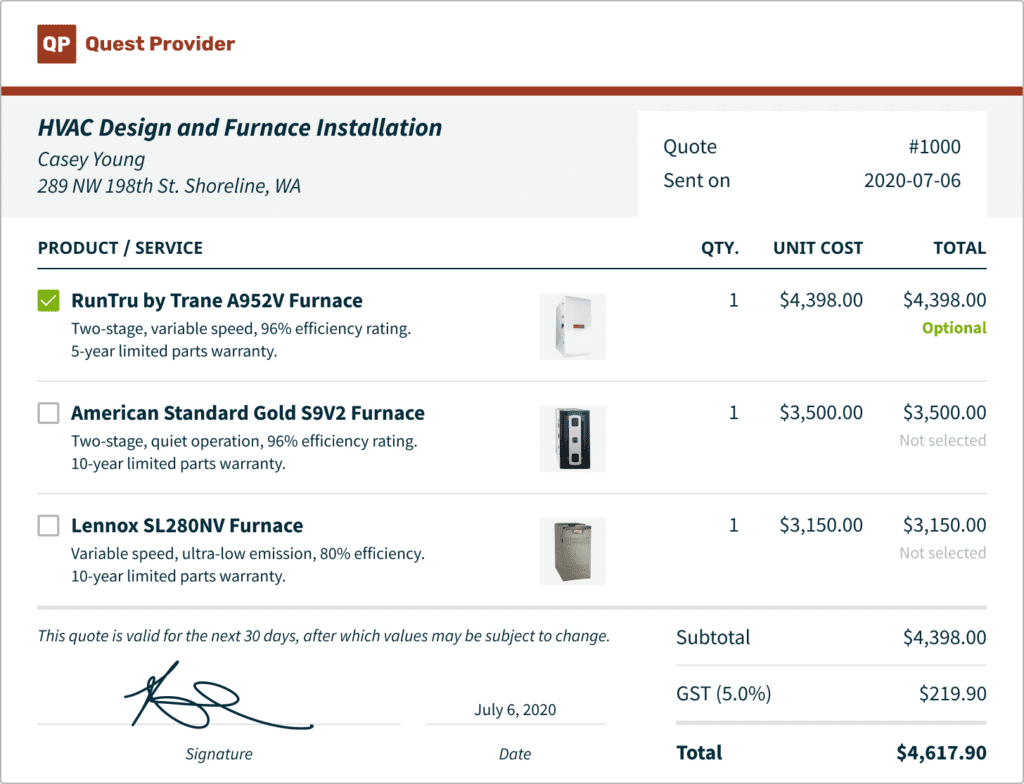
Or, create a good-better-best HVAC proposal that lets customers upgrade their system and maintenance agreement with. Once the estimate is approved, you can seamlessly convert quotes into jobs, either dispatching them right away or scheduling them for a future date.
I 100% recommend you try Jobber.
It’s so much easier, saves you time, saves your business money, and makes things all around easier. Your customers will enjoy it, and so will you.
7. Follow up after sending estimates
Following up is often where deals are won or lost. One of the simplest HVAC sales tips you can put into practice is to have a system for it.
Close the sale faster by setting up two or three standard quote follow-up emails that remind your client to approve the estimate. This keeps you top of mind before they get a competing bid or forget your name.
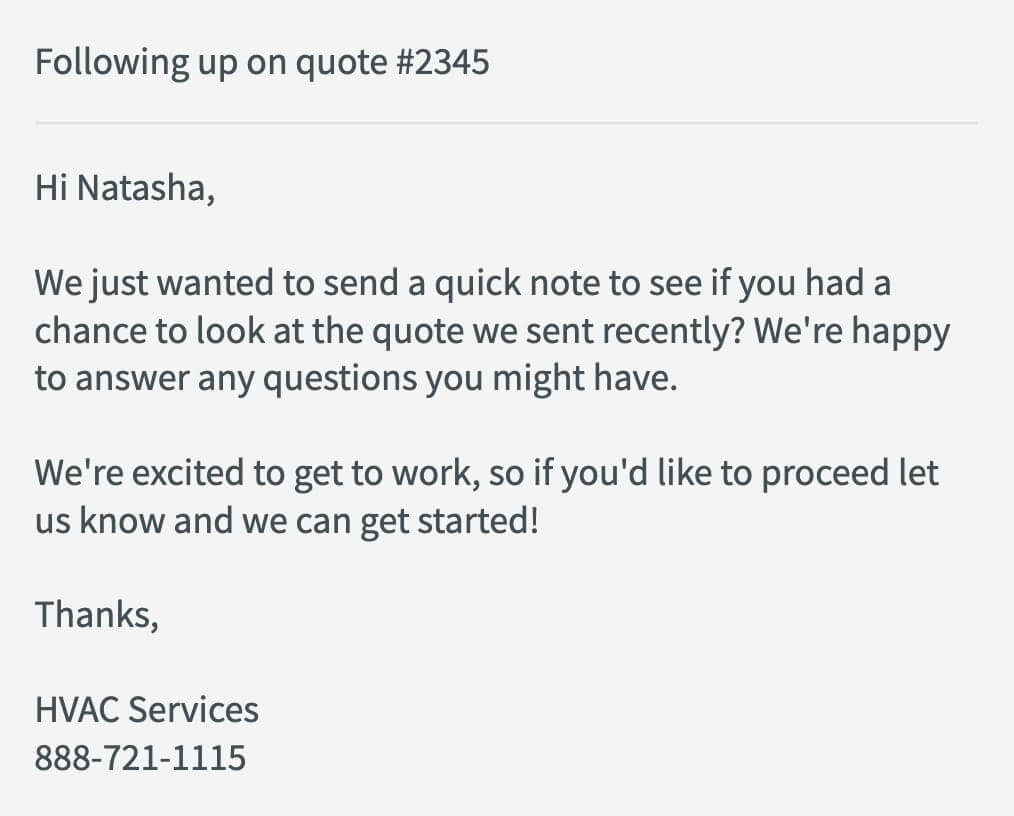
A quick note to see if they have any questions about the estimate is often all it takes to pick up the conversation again.
Jobber automatically sends follow-up texts and emails to customers you haven’t heard back from, so you can make sure you’re not leaving work on the table without lifting a finger.
8. Ask for referrals
Your current customers are the best spokespeople for your business. Creating a customer referral program that rewards customers for spreading the word is a great way to generate high-quality leads that turn into sales.
Follow these steps to ask for referrals:
- Create a standard follow-up email you can send to every HVAC customer asking if they’re happy with your work.
- At the end of the email, write one or two quick sentences explaining how the customer can send a referral and what reward they can get.
- Offer your customer a reward for booking your services, like a service discount or a gift card.
HVAC sales scripts for every phone call
Phone scripts can be a great guide for technicians and installers to improve their customer service—which helps you and your comfort advisors sell more HVAC work.
Creating HVAC sales scripts for your field techs’ calls with customers helps them use the most effective language to:
- Gather key information
- Earn a customer’s trust
- Offer additional services
Before using our phone call scripts, note that these are not for cold calls. The most effective way to sell is by having helpful customer service conversations with existing customers and HVAC leads who have contacted you.
The most important customer phone calls will happen:
- After you receive a work request
- Before a scheduled HVAC repair call
- After you complete a visit
After you receive a work request
Follow up with a customer immediately after they request information or an estimate through your online request form.
Use this sample phone call script to collect information about the customer’s system, book a site visit, and establish that your team is trustworthy.
Sample phone call script
You: Hi there, this is Bob. Is this Joanna Johnson?
(Customer answers “yes”)
You: Great. I’m with Open Air Heating and Cooling, and I’m calling because you requested information and pricing. I want to make sure we have the information you need. Do you mind if I ask you a few background questions?
(Customer agrees)
Recommended questions:
- What type of HVAC system do you have now?
- What’s the problem you’re having with your system?
- Do you know how old your system is? If not, what’s the age of your home?
- When’s the last time someone serviced your system?
(Customer answers questions)
You: Thanks for that info. Could we pop by and see your existing system so we can figure out exactly what it needs? After we take a look, we’ll get a better idea of whether we can do what you want. I can also show you all the different options you can have and how a new system would perform. Is that okay?
(Customer answers “yes”)
You: And if you’re interested, I can give you a sense of our pricing and show you our financing options. Does that sound helpful?
(Customer answers “yes”)
You: That’s great, Joanna. Just to recap, the goal of this visit will be to discuss all your options and answer all your questions. Is that alright?
(Customer answers “yes”)
You: Alright then. What’s the address of the property?
(Customer provides address)
You: Great. Let’s set aside about an hour, and we’ll use that time to get all your questions answered. What’s the best time to catch you at home? Mornings, afternoons, or evenings?
(Customer provides time)
You: Thank you. We’ll see you then!
Before a scheduled HVAC repair call
In a quick, two-minute phone call before an HVAC service call, your field techs can earn the customer’s trust by introducing themselves professionally even before they arrive.
This call is also an opportunity to collect information about the customer’s system and HVAC service history that can be used in sales conversations later on.
Sample phone call script
You: Hey there, this is Bob. Is this William Lee?
(Customer answers “yes”)
You: Hi, William. I’m with Open Air Heating and Cooling, and I’m on my way to your house to take care of your HVAC system problem. (Mention the problem if you know what it is).
Before I get there, I want to ask: how long has this been happening?
(Customer replies)
You: I see. Do you happen to know when you had your last AC maintenance?
(Customer replies)
You: Good to know. I should be there in about 15 minutes. Is there anywhere specific you want me to park? Any pets or anything else you need me to be aware of?
(Customer replies)
You: Thank you. I’ll see you there soon. Look forward to meeting you.
After you complete a visit
You or your field techs should call every customer the day after their service visit. This check-in phone call is more than just good customer service practice—it gives you the chance to fix any mistakes, collect feedback, and get new customer referrals.
Use this first script to check on a customer after you’ve completed a repair, install, or replacement:
Sample phone call script
You: Hi Mandy, it’s Bob from Open Air Heating and Cooling. How are you doing?
(Customer greets back and answers)
You: I don’t want to take too much of your time, but I wanted to check in with you and see how you found your service the other day?
(Listen carefully and note the customer’s feedback)
If the customer had a positive experience, continue the phone call with this script to ask for a referral:
You: That’s great to hear. We always love to hear feedback like that, and we want to continue to provide this level of service to our customers. So I really appreciate you sharing your thoughts on your experience with us.
(Positive response)
You: Because you had such a positive experience and you’ve been a customer for a while, I was wondering if you knew anyone else who would be interested in booking AC maintenance with us? We have a special referral offer I can tell you about.
(If positive, continue)
You: It’s pretty straightforward. If someone you refer completes a service with us, you’ll get 50% off your next appointment. All they have to do is mention your name at the time of booking and we’ll be sure to apply the discount the next time you book. This would apply every time a new customer is referred by you.
(Positive response)
You: It adds up quickly! We would really appreciate your continued support.
(Positive chatter)
You: Thanks again for your time and your business. As always, give us a call if there’s anything else we can do for you. We’re always around. Have a great day!
Selling your services effectively comes down to thoughtful planning, hiring, and training. Use the tips from this article to develop an effective HVAC sales process and guide each sale.
Don’t forget to document what’s working in your sales process. Keep track of all your activities, and you’ll have an easier time getting new sales team up to speed.