Car Detailing Prices 2026: How Much to Charge for Detailing Services

Key takeaways:
Setting the right prices for car detailing is crucial for profitability and long-term business success.
- Average pricing varies by service and vehicle size. Full detailing services typically range from $150 to $500+, with factors like vehicle size, condition, and location affecting costs. Hourly rates generally fall between $50 and $100/hour.
- Build your prices for profit. Use a formula that adds labor, materials, overhead, and a markup to ensure every job is profitable. Choose to charge per hour, by service, or by vehicle size.
- Cover all costs, including materials and overhead. Accurately calculate your expenses—from cleaning products to rent, insurance, and travel (if mobile)—so your pricing covers the real cost of doing business.
- Offer bundled and tiered packages. Price bundling and tiered (good, better, best) packages let customers choose services that fit their budget, while helping you increase upsells and job value.
- Adjust prices to reflect your market and expertise. Regularly review what competitors charge, consider your location’s cost of living, and raise rates as your skills and expenses increase. Always communicate changes transparently with your clients.
Stay up to date with service business pricing strategies and more—sign up for the Jobber Newsletter. Join here.
Setting the right prices for car detailing can be the difference between running a profitable business or struggling to make ends meet.
Pricing will vary based on factors like your location, the size and condition of the vehicle, and what competitors are charging. However, creating a price list alone isn’t enough if you’re unsure how to calculate prices based on profit.
In this guide, we’ll walk you through how to price auto detailing services and explore strategies to help you land bigger, more profitable detail jobs.
Learn how much to charge for detailing a car:
-
Average car detailing prices
-
How to price car detailing services
-
How much to charge for interior detailing
-
How much to charge for mobile detailing
-
Mobile car detailing prices list
-
Building a car detailing package
-
Car detail pricing best practices
-
Add-on services and upsell pricing
-
How to raise your prices
Average car detailing prices
If you’re wondering how much does it cost to detail a car, the answer depends on the type of service, vehicle size, and your local market.
Before you set your own rates, it helps to understand what customers typically pay. The benchmarks below are based on industry averages from sources like Angi and Mobile Tech RX.
Use them to position your car detailing pricing competitively. Then, adjust based on your costs, efficiency, and profit goals.
Average car detailing prices by service type
Interior detailing usually includes vacuuming, surface cleaning, and stain removal. Exterior services focus on washing, drying, and protecting the vehicle’s finish.
A full detail combines both and often includes premium add-ons like waxing or sealants.
| Service type | Average price range |
|---|---|
| Interior detailing | $100–$300 |
| Exterior detailing | $100–$250 |
| Full detail | $200–$300+ |
Car detailing prices by vehicle size
Larger vehicles take more time, labor, and product, which is why pricing increases with size. Heavily soiled vehicles or those with pet hair, stains, and odors may also fall on the higher end of these ranges.
| Vehicle type | Average price range (full detail) |
|---|---|
| Sedan | $150–$250 |
| SUV | $200–$350 |
| Truck | $200–$500 |
| Van | $250–$500+ |
Average hourly rates for car detailing
Some car detailing businesses charge by the hour instead of per vehicle, especially for deep cleaning or specialty services. On average, hourly rates typically fall between $50 and $100 per hour, depending on experience, service level, and local demand.
Understanding these average car detailing prices gives you a clear starting point. Your goal is not to match the market exactly. Instead, price your services in a way that reflects your value, covers your costs, and supports long-term growth.
There are three criteria of pricing: the size of the vehicle, the condition of the vehicle, and what the customer wants.
You don’t necessarily just charge more because it’s a nicer vehicle.

How to price your car detailing services
Before you set your price lists, you need to know how to calculate profitability. Here’s the formula you’ll use to calculate your service prices:
(Labor hours x Hourly labor rate) + Material costs + Overhead costs + Markup
Let’s imagine an easy scenario—a full interior car detail job that you’re doing yourself.
- Three hours of work at $25 per hour equals $75.
- Add $15 for materials and $10 for overhead, bringing the subtotal to $100.
- Finally, apply a 20% markup, which is $20, for a total price of $120.
In this example, you’d need to charge your customer $120 for a profitable full interior detail.
To break it down even further, follow these steps:
1. Choose how to price your services
There are three different ways you can charge customers for your auto detailing services: per hour, per car size, and per detailing service.
- Per hour: Charge your customers an hourly rate based on the number of hours you expect it will take to complete the service.
- Per car size: The bigger the car, the more time and materials it will take to detail it. Set prices based on whether you’ll be working on a small car (coupes or sedans), medium-sized car (crossovers or station wagons), or large vehicle (SUVs, trucks, or minivans).
- Per detailing service: Charge customers based on the types of services they want, like interior or engine detailing, and the time or skill it will take to complete that service. This is based on a “flat rate” fee per service.
2. Determine your labor costs
If you’re planning to outsource any car detailing work, remember to factor in labor. Your labor costs include the amount you’ll pay your employees (or yourself) to complete the job.
To calculate labor costs, know your hourly rate and the approximate number of hours each service will take.
Use this formula to determine your labor costs for a job:
Hourly rate x # of hours
If you plan on having more than one detailer working on the job, try this formula instead:
Hourly rate x # of workers x # of hours
Pro Tip: The average hourly rate for an auto detailer in the U.S. is $21–$32. (This does not include any tips or gratuity a worker might earn for a job well done.)
3. Add your material costs
Material costs include any supplies you’ll need to complete the job, like all-purpose cleaner, leather conditioner, and waxes or sealants.
To make sure the materials you use aren’t cutting into the job’s profitability, factor in the exact cost for each item (including taxes) to your car detailing prices.
If you use ¼ of an $80 bottle of cleaner on a job, divide the price of the cleaner by 4 to get your material cost. In this example, you’d factor in $20 of cleaner for one completed job. Then, add your total material costs to your labor costs and continue to the next step.
4. Calculate your overhead rate
Your overhead refers to any indirect costs that are needed to run your business—like car detailing marketing costs, insurance payments, utilities, or property rent and taxes.
To calculate your overhead rate, add up your monthly overhead amount and divide it by your monthly sales. Then multiply it by 100 to get a percentage.
Here’s what that formula looks like:
(Total monthly overhead costs ÷ total monthly sales) x 100
Once you know your overhead rate, you can use it to set more accurate pricing or identify service areas to cut costs and improve profitability.
For example, if your overhead rate is 30%, you’ll know that 30 cents of every dollar you earn goes toward covering indirect costs. This helps you decide if your pricing leaves enough room for profit.
Types of overhead costs
When adding up your overhead, there are two different types of overhead costs you’ll want to consider:
- Fixed overhead includes any costs that aren’t expected to change from one month to another, like insurance payments or rent.
- Variable overhead includes any costs that change month-to-month based on your business activity, like marketing expenses.
5. Apply your markup for a healthy profit margin
Markup is the additional amount you add to the cost of the job to ensure you’re making a profit on your services. Think about it like a “buffer” that protects you if a job takes longer than expected, or you use more materials than you bargained for.
Your profit margin is the percentage of revenue that you take home after applying your markup. Auto detailing has an average profit margin of 15–35%. If your ideal profit margin is 30%, the cost of your job should make up 70% of the total price.
Here’s the formula you would use to calculate your markup:
Total price = cost ÷ (1 – profit margin)
For example, say your overhead, labor, and material costs add up to $175. To get a profit margin of 30%, you’ll use the following formula:
Total price = $175 ÷ 0.70 = $250
Examples of auto detailing prices
- Beyond Limits Detailing of Palm Beach is a mobile auto detailer. They charge around $150 for a premium hand wash based on the type of vehicle (e.g., car, SUV, truck). The cost for a full detail (4 hours of work) is $350.
- ReVibe Auto in the San Francisco Bay Area charges between $255 to $325 for a Superior Full detail, which includes both interior and exterior services. A basic wash (exterior only) starts at $85 for small sedans, and goes up to $125.
Once you’ve set your pricing, you need an easy way to turn it into clear, professional quotes. Jobber’s quoting software lets you create preset detailing packages, send quotes in minutes, and track which ones convert.
Jobber also makes it easy to:
- Create preset detailing packages for services like interior only, exterior only, or full detail.
- Select a package, add optional markups, and send the details to clients in a few clicks.
- Keep all your quotes organized so you can see what has been sent, viewed, and approved.
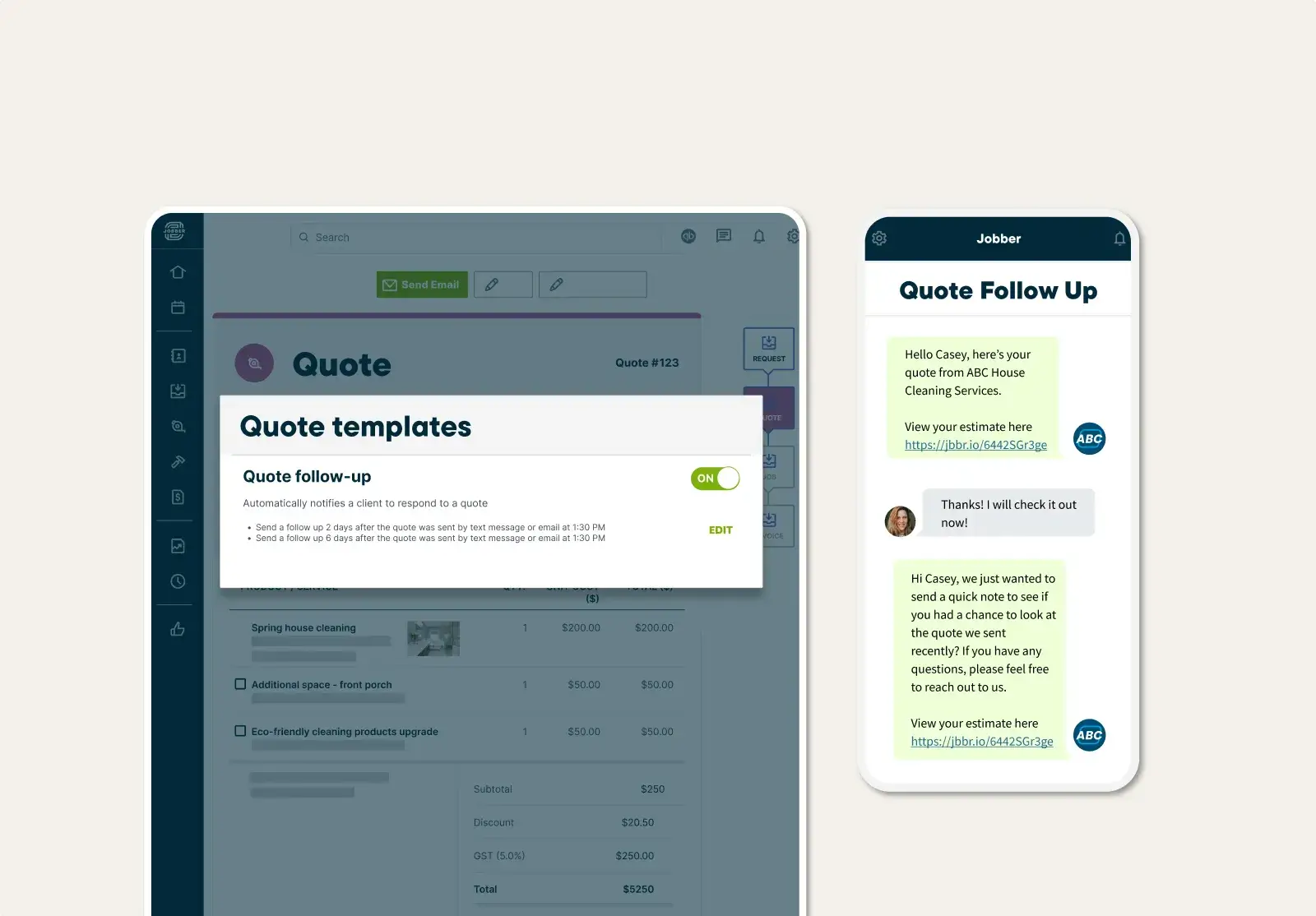
You can also set up automatic quote follow-ups to remind customers to review and accept. This helps you stay top of mind and win more jobs without needing to chase every lead manually.
How much to charge for interior detailing
Interior detailing focuses on cleaning and restoring the inside of the vehicle. Most businesses charge $100 to $350+, depending on the vehicle’s size and condition.
Here’s what’s included with interior detailing:
- Vacuuming carpets, seats, and floor mats
- Wiping and conditioning leather, vinyl, and plastic surfaces
- Interior glass cleaning
- Detail work on vents, door panels, and hard-to-reach areas
- Optional add-ons like shampooing or steam cleaning
These factors should affect your interior detailing prices:
- Pet hair, stains, and spills (adds time and labor)
- Strong odors or mold
- Material type (leather vs. fabric)
- Overall vehicle condition
- Estimated time required to clean
Most interior detailing jobs take 1.5 to 4+ hours, with larger or heavily soiled vehicles on the higher end. For accurate pricing, assess the interior upfront and adjust based on the level of cleaning required.
How much to charge for mobile detailing
Mobile detailing means traveling to your customers—at their homes, workplaces, or other locations—rather than offering in-shop detailing.
Because of that, pricing for mobile detailing typically includes additional operating costs compared to standard auto detailing.
Along with the fixed and variable overhead costs mentioned above, for mobile auto detailing you’ll have to consider:
- Cost of fuel for travel
- Routine maintenance on your work vehicle
- Commercial auto insurance
You can use the same formula as above to calculate your mobile auto detailing prices. The only difference is that you need to factor in these additional costs.
Mobile car detailing prices list
Here’s a quick glance at typical price points for different car or mobile detailing services. Keep in mind that these change based on your service region and even the type of car you’re cleaning.
| Service | What’s included | Price range |
|---|---|---|
| Basic exterior wash | Wash, dry, and tire shine | $25–$80 |
| Interior vacuum and wipe-down | Vacuum, dust, and wipe down interior surfaces | $50–$70 |
| Full exterior detail | Wash, clay bar, polish, wax, and wheel cleaning | $100–$150 |
| Full interior detail | Deep cleaning of carpets, seats, dashboard, etc. | $120–$180 |
| Full detail (interior and exterior) | Complete detail inside and out (package includes “the works”) | $180–$350 |
| Engine bay cleaning | Degrease and clean engine compartment | $50–$100 |
| Headlight restoration (add-on service) | Polish and restore cloudy or faded headlights | $40–$80 |
Once you have a good idea of your service list, you can move on to calculating how to charge for profitability.
Building a car detailing package
There are two types of car detailing packages that you can use for your auto detailing business—price bundling and tiered pricing.
What is price bundling?
Price or service bundling lets you combine multiple related services for one packaged price. You can use this pricing model to increase value for your customers and boost sales.
Here’s an example of three different price bundling packages you can use for auto detailing:
Exterior detailing package pricing
Exterior car detailing can cost anywhere from $175 to $250+. This car detailing service package typically includes:
- Exterior hand wash
- Wheel clean and tire shine
- Window cleaning and treating
- Waxing
- Contaminant and tar removal
Interior detailing package pricing
Interior car detailing prices range from $100 to $350. More comprehensive packages fall in the $175 to $250+ range. These service packages often include:
- Deep clean of carpet, floor mats and upholstery
- Steam cleaning headliner, leather, vinyl, and plastic surfaces
- Door jambs cleaning
- Interior and exterior glass cleaning
- Leather, vinyl, and plastic protectant
Full car detailing package pricing
A complete car detail typically costs between $150 and $500+, depending on the size, condition, and service level of the vehicle.
This premium package includes both interior and exterior detailing, combining deep cleaning, restoration, and protective treatments.
Pro Tip: Consider offering a small discount (10–15%) on your full car details. This might help persuade customers that a complete detail package is worth it.
What is tiered pricing?
Also known as “good, better, best pricing”, tiered pricing lets you offer clients three different service packages alongside each other. Each package is priced at a marginally higher price point and offers additional services or options for your customer.
Tiered pricing helps your auto detailing business better meet your customer’s needs and budgets, and win higher-priced jobs.
Here’s an example of how you can make tiered pricing work for your auto detailing company:
Bronze package
Interior auto detailing includes:
- Carpets, mats, and upholstery vacuumed
- Dash, console, and all vinyl cleaned
- Interior glass cleaned
Silver package
Interior auto detailing includes the bronze package plus:
- Carpet and upholstery stains are spot-treated
- Dash, console, and vinyl protected with a restoring UV protectant
- Leather is treated with special cleaner and conditioner
- Trunk is vacuumed
Gold package
Interior auto detailing includes the silver package plus:
- All carpets, mats, and cloth upholstery are scrubbed and steamed
- Leather is gently scrubbed, steamed, and conditioned
- Steering wheel, dash armrest, center console, and door handles are steam-cleaned and sanitized
With Jobber, you can create good, better, best quotes that present your detailing packages side by side.
Good, better, best quoting makes it easy for customers to choose what works best for their budget. They can also accept markups and add-ons that increase your earnings.
Car detail pricing best practices
Now that you know how to calculate pricing for auto detailing services, here are some tips to keep in mind along the way.
1. Don’t commit to pricing before seeing a car
Be prepared to increase your pricing based on the condition of the car. After all, a car with stains on the upholstery will be much harder and more time-consuming to detail than a car that’s been maintained well by the owner.
Here are a few other factors that may affect your pricing:
- Car size
- Vehicle condition
- Pet hair, mold growth, spills or stains
- Trim package of car
Whether you’re quoting a customer directly or posting prices on your website and social media pages, add “starting from” beside your prices.
This gives you the flexibility to adjust your pricing as necessary. Be honest, and inform your customer right away if you expect a job to take longer or require more work.
2. Know your competition
Research your competition to see what they’re charging for auto detailing services. Look for what services they offer, what their packages include, and how much their auto detailing services cost.
Once you know what your competitors are offering, you can fill in any service gaps and create a pricing strategy that aligns with the going market rate.
3. Consider your location
Each city or state will have differing auto detailing prices based on the cost of resources and labor—and what people are willing to pay for the service.
Auto detailing prices can vary widely by location. For example, in Florida, the average cost to detail a vehicle is around $150, which is lower than the national average.
In higher-cost markets like New York, average prices are closer to $300, depending on the service and vehicle condition.
4. Factor in your professional experience
The more experience you have as an auto detailer, the more value you’re bringing to your customer. Factor in the amount of experience you have working on luxury vehicles, detailing cars, and removing stains when pricing jobs.
Here’s the good news—as your company grows, your monthly revenue is likely to rise. Take it from three motivated entrepreneurs we spoke with. They started small but have grown their car detailing businesses to bring in over $18,000 per month.
Add-on services and upsell pricing
Add-on services are one of the easiest ways to increase your average ticket size without booking more jobs.
Instead of competing on base price alone, you can offer high-value upgrades that improve results for the customer while boosting your revenue per vehicle.
Below are some examples of popular car detailing add-ons with their average pricing:
| Add-on service | Average price range |
|---|---|
| Ceramic coating | $450–$2,000 |
| Paint correction | $200–$1,000 |
| Headlight restoration | $50–$150 |
| Clay bar treatment | $100–$350 |
| Ozone odor removal | $80–$150 |
| Engine bay cleaning | $175–$275 |
These services are typically offered on top of a standard or full detail and can significantly increase the total job value—especially for customers looking to restore or protect their vehicle long-term.
When to recommend add-on services
The best upsell opportunities come from what you see in front of you. If a vehicle has oxidized headlights, visible swirl marks, or strong odors, recommend the relevant service and explain the outcome clearly.
Customers are more likely to say yes when they understand the benefit, not just the feature.
By building add-ons into your pricing strategy, you create more flexibility in how you sell your services—and more opportunities to grow revenue without increasing your workload.
How to raise your car detailing prices
Raising your prices is a normal part of running a healthy detailing business. As your costs increase and your skills improve, your pricing should evolve with you. The key is knowing when to adjust your rates—and how to communicate those changes clearly.
When should you raise your detailing prices?
If you’re consistently booked out for weeks or months, turning away work, or struggling to maintain your profit margin, your pricing may be too low. Rising costs for supplies, fuel, or labor are also clear signals.
Many detailers also raise prices after gaining experience, adding new services, or upgrading auto detailing equipment to improve results.
How to communicate pricing changes
Be direct, professional, and transparent. Let customers know in advance, explain the reason for the increase, and reinforce the value they’re receiving. For example:
“Due to increased supply costs and continued improvements to our services, our pricing will be updated starting [date]. We’re committed to delivering the same high-quality results you expect.”
You can share updates via email, text, social media, or during booking confirmations to avoid surprises and maintain trust.
READ MORE: Price increase letter: tips and templates to use
Adjusting your car detailing prices over time helps you stay profitable, keep up with demand, and continue delivering high-quality service without undercharging.
If someone wants the most basic wash, they could go to a carwash down the street and pay $25.
But other customers want to make sure they’re getting a proper wash. That kind of customer is more than happy to pay double.
If you’re just starting an auto detailing business, knowing how to price your services will help you estimate jobs faster, win more work, and grow.
Use the advice in this article to create a profitable auto detail price list, then try Jobber’s free car detailing quote template to send professional quotes in just a few clicks and win more work.
Originally published in October 2023. Last updated on April 16, 2026.
Frequently Asked Questions
-
To calculate car detailing prices, start by adding up your labor, supplies, and overhead costs. Then, decide on your desired profit margin.
Factor in how long each job takes, your hourly rate, and the cost of products you use. You can also adjust pricing based on vehicle size and condition, charging more for larger or heavily soiled vehicles. -
Car detailing prices depend on several variables, including the size and type of vehicle, its condition, and the level of service provided.
Add-ons like paint correction, detailed waxing or ceramic coating will increase the price. Your local market, cost of living, and availability of mobile detailing services can also influence how much you charge. -
Most car detailing businesses charge between $150 and $500 or more for a full detail (including exterior and interior), depending on the size and condition of the vehicle. Smaller cars with light cleaning needs fall on the lower end. Larger vehicles or heavily soiled interiors cost more.
-
A good profit margin for auto detailing is typically 15–35%. This allows you to cover your costs while still generating enough profit to grow your business. If your margins are lower, it may be worth adjusting your pricing or improving efficiency.
-
Car detailing packages should be structured in tiers to make it easy for customers to choose the services that work for their needs and budget.
• A basic package might include an exterior wash and interior vacuum, while mid-tier options add surface cleaning and windows.
• Full detail packages typically include deep interior cleaning, waxing or sealing, and more intensive treatments.
• You can offer optional add-ons like engine cleaning or ceramic coating to increase revenue per job.